Saturday, July 3, 2010

Baby Pictures

This post was originally featured at seetrail under the title Camp Eagle. It has been slightly edited for relevance. -h

Swapping e-mails with a supportive and enthusiastic researcher certainly does seem reminiscent of swapping family photos - except our exchange started with blurry through-binoculars pictures. Funny, I'd hope that most family photos are a bit more direct than a stealthy drive-by 10x zoom plus 8x42 bins... it's more like espionage than a Christmas card photo.

Still, in a way it's like having an old friend and comparing baby pictures:


A photo of Anakin enjoying a ride in the jeep. Awww.

And here's Brian's little one:


Here's a pic from the day she was fitted with an transmitter. The falconry hood assists in keeping the eaglet calm during the fitting process.

Since this project is ultimately not hands-on except for the fitting, it's neat to see that others contribute photos as well:


Photographed in South Miami-Dade county. [...] The eaglet sighting and photograph was taken by Katy Raits in November 2007.

...it's exciting to hear back about the bird you've spotted, but it's remarkably awesome to know that the life history of the critter is not only being documented, but shared with innocent bystanders who take the time and effort to look into the sightings. I guess that makes us part of the "Camp Eagle" fan club - and by extension, our readers get to be subjected to our enthusiastic whims :)

Perhaps other couples experience this kind of nostalgia, when they open an e-mail from a researcher whose bird they saw... two weeks ago. Hey, you've gotta start somewhere!

When looking at a Bald Eagle with a fully white head and tail, you know the bird is at least 4 years old; young ones have varying degrees of light patches but are predominantly dark.

Friday, June 18, 2010

Curlews on the move

Recently there has been some curlew migration discussion on the Texbirds mailing list. Never one to let something cool slip by me, I e-mailed Joel about the project.

Nebraska Long-billed Curlew Tracking Project is following two female Long-Billed Curlews (Numenius americanus) - the site is amazing. One has not been heard from since December, but the other has made an early fall migration; she left the wintering grounds in April, and is almost back on them already and it's only mid June!

"Feel free to blog about the project and the website. It is a fun part of the curlew project and I think people find it interesting."

...Joel's suggestion that this study is interesting is an understatement. Take a look at Long-billed Curlew life history. First of all, it's a sandy colored bird about the size of a football. On stilts. With a long neck. And a beak that is longer than its legs. The curlew tracking project takes this fantastically proportioned bird and then adds a telemetry pack. The fine print also lists their life expectancy of 8-10 years.

Joel also offered some reassurance to my question of whether or not the transmitter interfered with mating: "I do not believe the satellite transmitter interfere with mating, other than the small battery, the rest of the transmitter is flexible."

And now for a paragraph of sage advice, and part of the wisdom behind all bird tracking (emphasis mine):
Why Track Long-billed Curlews?

Long-billed Curlew are migratory shorebirds that spend only a quarter or a third of their annual cycle on their Nebraska breeding grounds. While understanding Long-billed Curlew reproductive ecology in Nebraska is important and is part of the broader project, knowing where Nebraska curlews spend the rest of the year is equally important. For instance, the species' habitat and food resources may be secure in Nebraska, but curlews may face threats on their wintering grounds in Texas, California, or Mexico (we don't know for sure where Nebraska curlews go?). Linking birds breeding grounds with their wintering areas and migrations routes is key to conserving the species.


And so we end on a note of conservation: as guests on this planet, we need to make sure that what we do is not at the expense of others. Birds know no borders.

Thursday, June 3, 2010

behind the Black-whiskered Vireo

In the summer of 2009, my spouse and I witnessed a very active Black-whiskered Vireo rummaging around the treetops of Dagny Johnson Key Largo Hammock Botanical State Park. Whew. What a name! Anyway, the bird and its unbanded companion were the highlight of our time on Key Largo - so naturally we reported the banded bird and waited. And waited. And finally this spring we were prompted by the Bananaquit bander (see previous post) to re-send the information.

Hi Ms. Trudell,

Thanks for getting in touch with the Bird Banding Lab to report that you saw my bird! I've sent them a bit of information regarding when and where it was banded, so I think you should be getting a certificate of appreciation from them. I banded that guy (and yes, it is a male) on July 5th of last year, at Dagny Johnson. I'm happy that you saw him! Unless I'm mistaken, it was towards the end of last July that you spotted him?

As I said, you should be hearing from the Bird Banding Lab - but I'm more than happy to tell you a bit about my research and why I was banding Black-whiskered Vireos, if you'd like to know.

Thanks again for reporting your sighting!

Catherine Dale

***********************************************************
Catherine Dale
PhD Candidate
Department of Biology
Queen's University
Kingston, Ontario
***********************************************************

So when we saw the bird on July 29, he had only been wearing those bands for 24 days! Right leg color bands were green over pink, left leg was [some color we couldn't make out] over silver. Since the e-mail confirms that he was actually banded where we spotted him, it's neat to see that he hung around even after being accosted and color marked.

Sunday, May 23, 2010

Banded Bananaquits!

If you're still laughing about the title, check out the wiki page.

In my continuing effort to figure out which organization to contact for the West Indies (re: Black-whiskered Vireo that might not be through USGS), I found this: Bananaquit info by Chipper Woods Bird Observatory, hosted by Wild Birds Unlimited. It's not about banding per se, but the photos and discussion are pretty exciting.

Of note, under "Banding Recoveries" it mentions this:
Between 1955 and 2000, 12,074 Bananaquits were banded. A 2003 survey in the Caribbean (Jamaica, Mexico and Puerto Rico) to detect resident and migratory birds infected with West Nile Virus found that Bananaquits do harbor the West Nile Virus (Dupuis II et al. 2003).

If you should recover a banded Bananaquit, please report the band number to the Bird Banding Lab by calling 1-800-327-BAND.


...so not only did the Bananaquit banding in this case allow regular measurements and physiological data to be collected, it also added to the knowledge of West Nile Virus carriers. Pretty neat stuff.

Tuesday, May 11, 2010

Eagles and bands and collars, oh my!

Edit: this post is from SeeTrail, where it was originally posted as "eagles with accessories"

Here's a post for the technophiles among us:


"It's just a map," you say. Of course it's a map, that's how people learn things!


...and now you're accusing me of posting the blurry rump of a Bald Eagle (Haliaeetus leucocephalus). That accusation stands true as well. What doesn't show up in that photo is a little pack that is attached to the bird - and transmits information about the bird's geographic movement to a researcher named Brian.

Brian Mealey is the Executive Director, and thus primary researcher, when it comes to radio-collared Bald Eagles in the Everglades. There's even a page on the site that gives you a sample pair of eagle "tracks" from previous years.

We found Brian via the Tropical Audubon Society bird board, when I posted this query:
Ok, I know we bugged out of SE FL a while ago, but we were reviewing
pictures and one of the Bald Eagles in a fallow field along 997 (I
think that's the road north from Everglades NP to Hwy 41 and 75?) had
a transmitter on its back.

USGS doesn't have a category for reporting collared eagles, perhaps
y'all know of a local project?

In no time at all, "tricia" had responded to my post with:
It is probably one of Brian Mealey's birds.
follow this link and you can email him.
http://www.instwildlifesciences.org/eaglemain.html


So much for my own sleuthing! At least we had enough information from our sighting to e-mail Brian and sound more intelligent than "we saw an eagle and it had an antenna on it" - I'm sure researchers get that a lot.


Matt pointing to the Bald Eagle in a fallow field - there were also White Ibis, Black-necked Stilts, Laughing Gulls, American Crows, and Boat-tailed Grackles present. Then a tractor scared them. Sigh.

My e-mail to Brian:
My husband and I were on our way from Everglade NP back to hwy 41 and
maybe a mile south of the "Robert is here" fruit stand on 997, we
passed a fallow field with two eagles. One of them had a transmitter
backpack - since we didn't see bands or wing tags, I'm not sure that
the sighting is of any use to you, since the transmitter is probably
working... just wanted to say that it was quite a highlight on our
trip =) Exact date would be 7/28/09, I'd have to get back to you on
what time in the afternoon, though.


Brian's enthusiastic response:
Thank you Heidi!

Always useful and it great to know that folks are always on the look
out for wildlife!

I'm attaching a map of the most recent movement of Camp Eagle (56105)
includes your sighting.

Camp Eagle was banded as a nestling (about 50 days old) and fitted
with a transmitter back in March 2005! She's beating the odds of
survival!!!!! Yeah!


[truncated here -h]

If that first map wasn't nifty enough, here's the detailed map of SE FL activities during the time that Matt and I saw "Camp Eagle" (when was the last time you could put the name to a bird you were watching? ...on a project that's not yours??)


This map is infinitely cool, not just because it shows ample movement in the protected zone of Everglades National Park and tracks adventures east of Homestead, but because it even highlights the fruity awesomeness that is the "Robert is Here" fruit stand! And of course, we were just a bit south of "Robert is Here" when we saw "Camp Eagle," so our story has been validated with a bit of telemetry handiwork.

In the meantime, Brian reports that he is in the midst of analysis and manuscript work, so at some point in the near future, we'll get to find out what information "Camp Eagle" contributed by toting around the transmitter.
Monday, May 3, 2010

from "the Marvelous in nature" to you...

Seabrooke is a nature blogger like no other (and a bander as well!). One of her recent posts is an absolute must-read for anyone curious about banding. Why is it done? Who does it? What data is collected? While her post is geared towards her specific banding site (not all locations are seasonal), it also addresses a lot of the basics.

Without further ado, "On banding birds" from the Marvelous in nature."

An excerpt from the comments:

...a bird in its lifetime only ever gets the one silver, numbered band, unless that one is so old, and so worn, that the numbers are hard to read, in which case it’s removed and replaced. It only ever wears one at a time, though. Some projects will also put coloured plastic bands on them in addition to the silver ones, to make them easier to identify from a distance...


Colored leg bands (FL Scrub Jay) and wing tags (Am. White Pelican) are what this blog was started for - the ridiculously neat birds we've spotted in our adventures. Hopefully your path will cross with some of these critters, their stories are all unique and definitely worth the effort to look up!

Tuesday, March 30, 2010

Pending: Irish Robin

So the month of March doesn't echo like a hollow well, here's a taste of what will hopefully be the next post: Andrea's Robin, from her "Ireland, day 2" post

Andrea is a student from Florida who has been studying abroad; I'll let her provide any additional details. The thrill that I felt when I saw her post was twofold because not only did she get to see and photograph a very cooperative Robin (also European Robin, Erithacus rubecula), it's color banded in addition to the metal band! So even without getting a look at the metal band's numbers, there's a pretty decent chance of tracking this individual. (Kind of like the last full post with the Florida Scrub Jay!)

Hopefully I'll even get some links up for Euring (edit: voila, EURING is now in the sidebar!) so this blog can be less North-American-centric =)

Tuesday, March 9, 2010

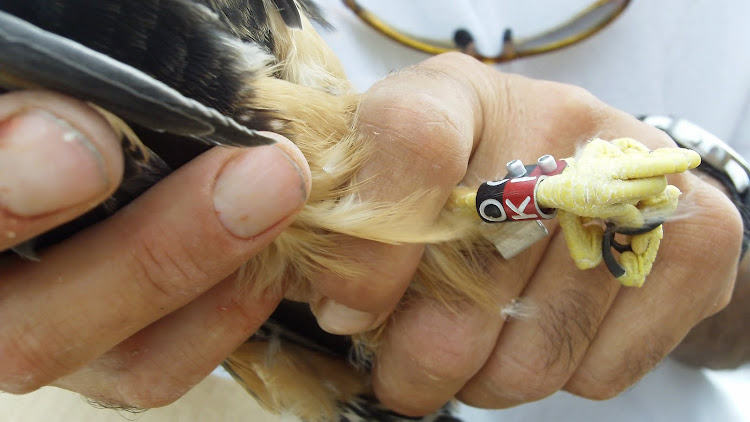
Travels of a Peregrine

Wildlife Rehabilitation and Education recently posted an entry: The Stories They Could Tell. It's a wonderfully informative blog, this post is of particular interest because it actually tracks a male Peregrine Falcon who had been banded as a wee fledgie in 2007 and ended up in Houston with my "old" rehabber.