This time from NPR: The Toughest Little Bird You've Never Heard Of
I'd lump it in with the previous few posts on Atlantic migrating Whimbrels, but these are the Pacific ones with a very different story than their Atlantic brethren. Basically instead of having a cushy (or deadly) stopover spot in the Bahamas, the west coast critters go straight from Alaska to New Zealand, though some go to Australia. NPR's page has a great tracking map, definitely worth a peek!
Showing posts with label alaska. Show all posts
Showing posts with label alaska. Show all posts
Monday, October 3, 2011


Wednesday, May 18, 2011
A Whimbrel named Hope
From: THE BIRDING COMMUNITY E-BULLETIN May 2011
WHIMBREL TRAVELS: “HOPE”
Also on the subject of shorebirds and their migrations, it may be particularly instructive to follow the travels of just a single Whimbrel, a bird nicknamed “Hope.”
Hope is a female Whimbrel that was captured in Virginia on the southern Delmarva Peninsula on 19 May 2009. There, she was banded and fitted with a satellite transmitter. Since then, Hope has logged more than 21,000 miles (33,000 kilometers), flying between a remote Canadian breeding territory on the MacKenzie River (an IBA site, by the way) near Alaska and a comfortable winter territory on St. Croix in the U.S. Virgin Islands!
Last month, on 8 April, Hope returned to Virginia following a 75-hour, 1,850-mile (2,900 kilometer) flight over the Atlantic Ocean. For more details and to see a fascinating route map showing Hope’s journeys, see here:
http:www.fws.gov/northeast/news/2011/041411.html
Sunday, April 10, 2011
Request for Godwit and Whimbrel reports
Just spreading the word!
***
Please Report Color-flagged Hudsonian Godwits and Whimbrels
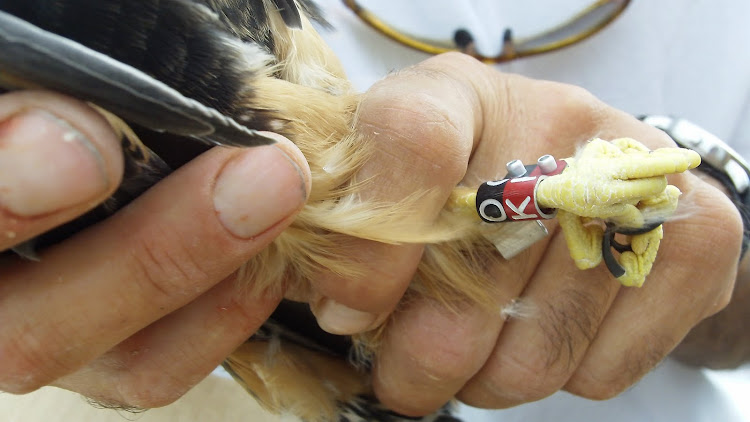
Since 2007, we have attached uniquely numbered/lettered, red color-flags to 790 Godwits and 355 Whimbrels on Chiloé Island, Chile. Godwits or Whimbrels have also been flagged in Alaska, Argentina, Chile, Colombia, Manitoba, and Virginia. If you see any of these flagged birds, please submit your observations to www.bandedbirds.org. On this site, there are instructions on how to read and report color-flagged birds, and you can click on “Report Resighting” to enter your observations. By using this site, to report one of our flagged godwits or whimbrels, you will immediately know where and when it was banded.
Banding projects to study migratory shorebirds that make epic hemispheric journeys have been underway since the mid 1990’s. In recent years, the birds have been tagged with engraved markers allowing identification of individuals with spotting scopes. The combination of banding and resighting data allows greater understanding of the habitat uses and needs by imperiled species. With this understanding comes the hope of achieving the protective actions required to halt, and even reverse, the population decline exhibited by many shorebird species.
For more information on the Hudsonian Godwit and Whimbrel project in Chile, contact Brad Andres (brad_andres@fws.gov; 303-275-2324) or Jim Johnson (jim_a_johnson@fws.gov; 907-786-3423).
Thanks in advance for the assistance.
Brent Ortego
Texas Parks and Wildlife Department
Victoria, TX
Saturday, March 5, 2011
one of the oldest Bald Eagles...
Band confirms dead eagle as 1 of Alaska's oldest
In captivity, Bald Eagles can live nearly as long as humans. In the wild, the average life span is less than half of what it is in captivity. So it's interesting to see that one of the oldest known wild Bald Eagles in North America would be electrocuted at the ripe age of 25.
From the article:
From Anchorage Daily News
In captivity, Bald Eagles can live nearly as long as humans. In the wild, the average life span is less than half of what it is in captivity. So it's interesting to see that one of the oldest known wild Bald Eagles in North America would be electrocuted at the ripe age of 25.
From the article:
"Once they reach that full adult stage - white head, brown body, white tail - you don't have any idea how old they are," said Steve Lewis, coordinator of raptor management for the Alaska region of the U.S. Fish and Wildlife Service.
The oldest eagle in the country was a 32-year-old bird from Maine. Alaska's oldest documented eagle was a 28-year-old from the Chilkat Valley outside Haines. Lewis suspects most eagles don't approach three decades but proving that with leg bands can be haphazard.
"Banding is one of these things, you put a lot of effort into it and you get little return, but the returns you get are really interesting," he said.
From Anchorage Daily News
Friday, November 5, 2010
RFI: Bristle-thighed Curlews
From the Ornithological Society of North America comes Neswsletter #198, which includes this request:
BRISTLE-THIGHED CURLEWS COLOR-MARKED IN ALASKA –
Thirty-two Bristle-thighed Curlews were uniquely marked with coded leg flags on the breeding grounds in western Alaska in the summer of 2010 as part of a three year mark-resight project. Additional curlews will be marked during the breeding season in 2011 and 2012. The ultimate goal of this project is to collect data that will be used to estimate the current size of the curlew population breeding in the southern Nulato Hills. Each curlew has a green flag on its upper right leg and a standard federal metal band on its upper left leg. The green flag has a unique code consisting of two white characters (either two numbers or two letters). Please report all sightings to KRISTINE SOWL, Yukon Delta National Wildlife Refuge, P.O. Box 346, Bethel, Alaska 99559, USA (EM: kristine_sowl@fws.gov). Please note the date, the leg flag code, location of the bird, and its behavior. Copies of photographs of the individual may provide information on sex. Thank you for your assistance.
Friday, July 23, 2010
4,000 miles by Rufous Hummingbird!
The July Gulf Coast Bird Observatory newsletter contained this gem:
This is backdated; I'd have posted it when I got it, but I've been monitoring (you guessed it!) banded birds in west Texas!
Another fantastic blog post about this record is at burdr.com - check it out!
Last January 13, Fred Dietrich, a hummingbird bander, put a numbered band on a Rufous Hummingbird that was coming to a feeder at a home in Tallahassee Florida. Fred determined that it was a second year female, meaning it had been hatched the previous summer. Fast forward to June 28. In Chenega Bay Alaska, Kate McLaughlin caught a Rufous Hummingbird with someone else's band on it. Yep, you guessed it - it was Fred's bird from Florida! This little hummingbird was nesting nearly 4,000 miles from where she spent the winter. Wow! Rufous Hummingbirds (along with several other species) commonly spend their winter in the southeastern U.S. including Texas. This recovery is significant as the longest distance between capture sites but also because it gives us information about migration routes of these birds. Without banding, we would never know these things. Leave your hummingbird feeder up this winter and see if you get a special winter visitor.
This is backdated; I'd have posted it when I got it, but I've been monitoring (you guessed it!) banded birds in west Texas!
Another fantastic blog post about this record is at burdr.com - check it out!
Subscribe to:
Posts (Atom)

