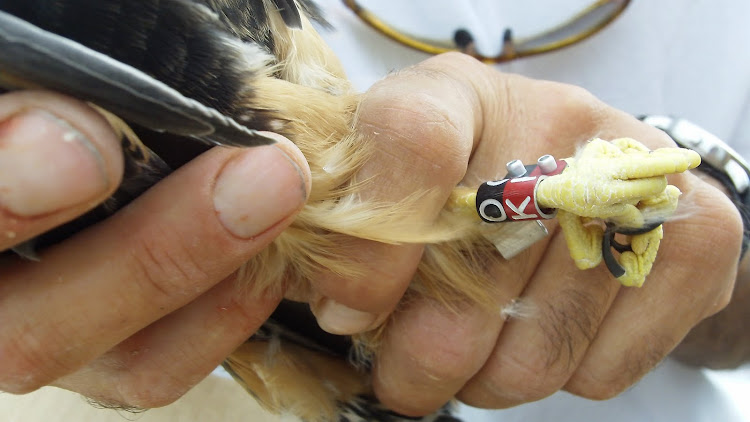
Thanks to eBird.org for this news of an 8 and a half year old Northern Shrike!
http://ebird.org/content/wi/news/the-oldest-northern-shrike-in-north-america
Showing posts with label leg band. Show all posts
Showing posts with label leg band. Show all posts
Wednesday, January 16, 2013


Sunday, August 26, 2012
American Oystercatcher adventures
What is black and white and red all over?
Ok, really it's black and brown and red and white with slightly pinkish/pale legs.
The American Oystercatcher - it is a bold, stocky shorebird with a red beak (or red bill, if you prefer), black head and neck, dark brown back and bright white belly. You are most likely to see them along a salty coastline or marsh and... yes, they will be eating bivalves.
Map via allaboutbirds.org

After a flurry of recent posts about shorebirds, I was contacted by one of the project database gurus with some additional information - hopefully this increased awareness and ease of reporting will get more reports rolling in! Without further delay....
***
I came across your blog while surfing, and I thought I'd write to let you know where people can submit color-banded American Oystercatcher sightings. You may already know, but there is a working group for the species which works to coordinate and facilitate rangewide research. One part of that research has been the color-banding of birds from almost all states in which they occur. Members of the public who sight a banded American Oystercatcher can report their bands at www.amoywg.org (under "Bands & Resighting -> "Report Form").
The reports will go into the working group's database of American Oystercatcher band records (captures and resightings). I curate band sightings submitted by the public, checking them for accuracy as much as possible before adding them to the working group's database, which
includes all band records from all states. If people include an email address, we write back to tell them where their bird was banded or sighted. It's easy to submit a band, and users can upload a picture as well. There will be some changes to the form, as the database is being finalized, but the website address will remain the same.
Thanks,
Lindsay
Ok, really it's black and brown and red and white with slightly pinkish/pale legs.
The American Oystercatcher - it is a bold, stocky shorebird with a red beak (or red bill, if you prefer), black head and neck, dark brown back and bright white belly. You are most likely to see them along a salty coastline or marsh and... yes, they will be eating bivalves.
Map via allaboutbirds.org
After a flurry of recent posts about shorebirds, I was contacted by one of the project database gurus with some additional information - hopefully this increased awareness and ease of reporting will get more reports rolling in! Without further delay....
***
 |
| American Oystercatcher photo courtesy of Lindsay Addison |
I came across your blog while surfing, and I thought I'd write to let you know where people can submit color-banded American Oystercatcher sightings. You may already know, but there is a working group for the species which works to coordinate and facilitate rangewide research. One part of that research has been the color-banding of birds from almost all states in which they occur. Members of the public who sight a banded American Oystercatcher can report their bands at www.amoywg.org (under "Bands & Resighting -> "Report Form").
The reports will go into the working group's database of American Oystercatcher band records (captures and resightings). I curate band sightings submitted by the public, checking them for accuracy as much as possible before adding them to the working group's database, which
includes all band records from all states. If people include an email address, we write back to tell them where their bird was banded or sighted. It's easy to submit a band, and users can upload a picture as well. There will be some changes to the form, as the database is being finalized, but the website address will remain the same.
Thanks,
Lindsay
Lindsay Addison
Coastal Biologist
Audubon North Carolina
7741 Market Street, Unit D
Wilmington, NC, 28411-9444
Tel: (910) 686-7527
Fax: (910) 686-7587
laddison at audubon dot org
Wednesday, August 15, 2012
Texas - oystercatcher update
It's no secret - I'm a HUGE fan of the Gulf Coast Bird Observatory - they have fantastic outreach programs to familiarize the public with research (not sure if the Xtreme Hummingbird Xtravaganza has been covered on this blog before, but it needs to happen!)
There's a great effort put forth by GCBO to track American Oystercatchers along the Upper and Central Texas coast, the e-mail below is from one of the staff biologists who has made the project very approachable by folks who see any of 'their' birds. It's so refreshing to not only have the transparency of "this project exists" but also "here's where to look up more information" - it's wonderful for the curious!
Without further delay...
***
13 August 2012
TexBirders,
As many of you know, GCBO has an ongoing project studying American Oystercatchers on the Upper and Central coasts. The breeding season is over for this species now and so they will begin to wander between now and December/January when they pair up and start defending their territories again. This year we had a Texas State student working on the upper coast and a Texas A&M student working on the central coast. All told we have now banded 125 adult and 58 chick oystercatchers. Chicks can be told from full adults by having black on their bills. Chicks from last year still have a small amount of black on their bill so if you look closely you should be able to tell them apart from full adults still. I would greatly appreciate everyone checking the legs of oystercatchers that they see for bands. They are banded on each leg above the ankle (what appears to be knee) with identical maroon color bands that have two codes on them. The codes are either two numbers, two letters, or a letter and a number combination. Again, the codes on each leg are identical. These bands can be hard to see unless you look closely. I'd appreciate any sightings of banded oystercatchers be sent to me. Photos are greatly appreciated. This helps is track movements of this species during the non-breeding season and also chick movements which are very important for conservation. You can see what the bands look like and read about this project on our website here:
http://www.gcbo.org/default.aspx/MenuItemID/246/MenuGroup/Home.htm
There is also a link to a spreadsheet which has information about where each bird was banded.
Thanks everyone.
Sue
Susan A. Heath, PhD
Gulf Coast Bird Observatory
103 Hwy 332 West
Lake Jackson, TX 77566
979-480-0999
www.gcbo.org
Monday, July 30, 2012
Banded Mourning Dove
Via Les Stewart on the Texbirds facebook group:
"Had this banded Mourning Dove show up in my yard in Nacogdoches twice this week (or it could be two different banded doves). Anyway just wondering who is tagging Mourning Doves and if I should report it anywhere. I assume that would be useless, unless I shoot it and get the tag number and I wasn't planning on that..."

"Had this banded Mourning Dove show up in my yard in Nacogdoches twice this week (or it could be two different banded doves). Anyway just wondering who is tagging Mourning Doves and if I should report it anywhere. I assume that would be useless, unless I shoot it and get the tag number and I wasn't planning on that..."

Wednesday, July 25, 2012
N 1 - Texas City Oystercatcher
The more we know... well, the more we know!
"American Oystercatcher 'N 1,' Haematopus palliatus, at the Texas City dike, 26 July 2012. This bird was tagged at the Nature Conservancy's Texas City Prairie Preserve, up the coast a bit. Its mate has a broken wing and is in rehab, so 'N 1' may have left to search for a new mate."
Click here for the photo.
Thursday, July 12, 2012
banded Prarie Warblers at Montague Sandplains IBA
Via Birding is Fun: banded Prairie Warblers at Montague Sandplains IBA.
No word on their background, or the project - but with multiple banded birds around, it's likely a target species for a study.
No word on their background, or the project - but with multiple banded birds around, it's likely a target species for a study.
Tuesday, July 10, 2012
Banded White-winged Dove in TX
White-winged Dove in a residential area in Victoria, TX (kind of the central coast - ish), likely part of a population study; via Texas Nature Notes!
Wednesday, June 27, 2012
Texas Black-necked Stilts
Anahuac NWR, on the Upper Texas Coast, is my old stomping ground... and now there are almost 200 banded Black-necked Stilts roaming around! Wish I were down there.
****
Texbirders,
Anahuac has been slow but steady through June. Shorebirds have returned, with up to 17 species seen (18 Jun).
Highlights include:
bronzed cowbird (male) continues by entrance
tropical kingbird, 20 June
red knot on Alice, Jackson, White (closed unit west of Shoveler
Pond), 23 June, undergoing extreme wing molt, will post photo to TOS
list when have access to my computer.
wood storks (up to 350 on Alice, Jackson, White), viewable at a distance from west side of Shoveler Pond
American avocets (up to 500)
stilt sandpiper, 20 June (early or late?)
In addition, ~175 black-necked stilts have been color-banded on Anahuac over the last two years, and capture efforts continue,
250-300 will have been banded by the end of July, please check stilt
legs for bands as we have experienced minimal resightings (Thanks Joe
Kennedy!). Much of this is due to a large stilt population
(>25,000) along the upper coast and inaccessible habitat, but I feel
that some of this is just due to people being unaware of our banding
operation, please tell others! Many of our radio-marked birds have
disappeared to parts unknown/off-refuge. Would greatly appreciate
assistance relocating these individuals.
Thanks,
Thomas Riecke
Chambers County, Texas
Thursday, June 14, 2012
13 year old Piping Plover
Via Vince Cavalieri, one of the brains behind this project!
The Great Lakes piping plover population has its own survivor story like B95 (aka moonbird) the red knot.

This is YOGs, currently our oldest known Great Lakes piping plover. In her 13 years, YOGs has flown something like 39,000 miles in migrations, well more than enough to fly completely around the world! Amongst countless predators, storms, human disturbance and many other hazards, this piping plover has survived and been a big part of the the increase in Great Lakes piping plover numbers.
B95 - Red Knot that keeps going
'Moonbird' is a Red Knot that has gotten some great coverage lately, not to mention a whole book!
Latest news is here: B95, the great survivor
Knots face some pretty amazing travel challenges as well as food shortages due to overharvesting of horseshoe crabs - the article above really does a nice job of covering some of those obstacles and outlining why the name 'moonbird' is appropriate. Namely, the distance this bird has traveled between Delaware and Argentina since being banded (as an adult!) in 1995 ...is astronomical.
Monday, May 14, 2012
Sometimes they get away...
Over the weekend, a banded Western Scrub Jay was seen - without camera or binoculars - with a silver leg band (observer does not recall which leg) at the L.E. Woods picnic area in the Davis Mts. Sightings like this are a bit frustrating because it takes a lot of asking - and asking who to ask - to find out about the bird. And you'll never know the individual's story, beyond a banding. So, to keep asking...
Curious!
Curious!
Tuesday, April 3, 2012
Scissor-tailed Flycatchers around Oklahoma
For folks who are wondering about where young Scissor-tailed Flycatchers go, here's a study trying to determine just that! So keep an eye out for banded STFL!
***
From: dvl04 AT hotmail.com
Sent: Saturday, March 31, 2012 10:42 PM
To: OKBIRDS AT LISTS.OU.EDU
Subject: [OKBIRDS] Scissor-tailed Flycatchers to watch for
Hi, OKbirders!
My name is Diane Landoll and I am a PhD student at the University of Oklahoma. I have been studying Scissor-tailed Flycatchers for four years now, and this has included banding birds with aluminum USGS bands. Many birds were also banded with a combination of three other colored bands, one on the leg with the aluminum band and two on the other leg. I would like to ask for everyone's help in trying to freight these birds. I am hoping to see where young birds are going because they do not return to the area of their birth. I am also trying to figure out a rough idea of when they arrive back in the area and the route they take to get there. Since there have already been a few sightings (I saw two beautiful male today on Lawton!), now is the time to see if any banded birds from previous years are making it back to us!
What I am asking is that if you see any Scissor-tailed Flycatchers and are interested in figuring out if they are banded, try to get a look at their legs to see if they have an aluminum band only or an aluminum band and color bands. The colors can be difficult to make out sometimes, specially since the birds tend to sit on their legs a bit, so it might be a fun challenge. It always is for me, but that is really part of what makes it so fun. If you do see any banded birds, please let me know as soon as possible. If you can figure out what the color combination is, that would be amazing, but simply knowing where our banded birds are is a great help. If you do try to figure out color combinations, knowing the position of each color and which leg they are on is very important in figuring out exactly which bird it is. For example, a bird might have an aluminum band on top of a red band (so that the red band is the one nearer the foot) on its right leg and a purple band over a blue band on its left leg. If you are able to get a picture of the birds and its bands, that is even better.
Of you do see any banded birds, please let me know at this email address (dvl04 AT hotmail.com). Thank you all in advance for any help. Any sightings are very valuable and will help us get a better understanding of our magnificent state bird.
Thanks again, and good birding!
Diane Landoll
PhD Student
University of Oklahoma
Tuesday, March 13, 2012
Look for banded Golden-cheeked Warblers!
From a Texbirds post, re: a banded Golden-cheeked Warbler photographed by Sean Paul Kelly (click here for the photos) "This bird is part of the Balcones Canyonlands Preserve Golden-cheeked Warbler study that is now going on. This bird was banded last year on April 20th at Emma Long Park."
Subject: banded Golden-cheeked Warblers
From: Bill Reiner (spizella/AT/SBCGLOBAL/./NET)
Date: Mon, 12 Mar 2012 20:45:18 -0700
TexBirders,
I had a feeling I needed to send out this message pronto, and it seems I am one day late. But thanks to Mr. Kelley, for asking the question, and for posting those photos of the banded Golden-cheeked Warbler in Emma Long Park this morning! (And also thanks to the quick-responding TexBirders who alerted me to his post.)
The bird Mr. Kelley photographed is one of more than 350 Golden-cheeked Warblers that have been banded by biologists on study plots scattered across the Balcones Canyonlands Preserve, on the west side of Austin, over the past three years. The vast majority of the banded birds have been males, but a few females have also been banded. Biologists at Fort Hood have banded even more individuals of this species, over an even longer time. The goals of the studies in these two locations have included learning more about the survival rates, age ratios, and dispersal of these endangered birds.
Some of the plots where Golden-cheeks have been banded around Austin are in areas open to the public, such as Emma Long Park (Turkey Creek Trail), Barton Creek Greenbelt (Sculpture Falls area), Saint Edwards Park, and, for the first time last year, Wild Basin. However, the birds returning from their winter ranges could turn up anywhere (even South Padre Island!), so please look closely at the legs of any Golden-cheeked Warbler you spot. A banded warbler will have one numbered aluminum band (don’t even try to read it with binoculars) and two or three colored resin or plastic bands to allow for recognition of individuals in the field. If you do see a banded Golden-cheeked Warbler, I will be very happy to hear about it, and can direct the information to the biologists -- either at Fort Hood or here in Austin -- who banded it. The best place to contact me is: william.reiner AT austintexas.gov
Information to provide:
1) What color bands in what order. Banders read bands as: upper left leg/lower left leg : upper right leg/lower right leg. So, for example, Mr. Kelley's bird is red/orange : white/silver. Colors are not always what they appear at first glance, so a photograph is always welcome, if it's possible. Colors can often be misread. Legs can be mixed up -- it's the bird's left and right legs, not which is right or left as you are looking at it. Even upper and lower can be confused depending upon your vantage point. Because of the potential for confusion, it is also very important to give us...
2) The location of the bird. A GPS position would be very helpful to pinpoint its location, but if this is not possible, landmarks along a trail or road or other feature can greatly help us to relocate the individual and verify its identity.
If you want to help even more with this project, please come volunteer with us!
The BCP biologists cannot possibly watch all the suitable habitat on the Preserve, so we are seeking experienced birders willing to devote at least 3 field days this spring to searching for banded warblers. Volunteers will have the opportunity to explore a part of the Balcones Canyonlands Preserve that is not normally open to the public. Several birders are already trained and ready to go this spring, but, because we banded birds on new plots last year, we still need people to look for returning birds on the outskirts of those plots. If you have the time and the interest, please contact me at the e-mail address above.
Thank you,
Bill Reiner, field biologist
Balcones Canyonlands Preserve
City of Austin
(512) 972-1676
Saturday, June 25, 2011
Black-necked Stilts at Anahuac NWR
This was a post on the Texbirds listserv recently; a spot close to my heart and a species that makes black & white look exotic!
***
Subject: Color-banded black-necked stilts and noteworthy sightings at Anahuac
From: Thomas Riecke (riecket13/Y)
Date: Fri, 24 Jun 2011 15:49:00
Dear Texbirders,
We have started color-banding black-necked stilts on the refuge. Band combos will be orange over aluminum over blue/red/or green (male/female/hatch year)on the right leg, and a unique combination of three color-bands on the left leg. We expect to band several hundred birds this summer and early fall. I would greatly appreciate any observers who resight marked individuals to report them by phone AT (214) 384-8085 or by email at riecket AT titan.sfasu.edu. Phone is preferred as internet access is spotty in the field. GPS coordinates would be amazing, but even a general description of the location will be more than acceptable.
In other news, Kelli Haskett and I had black rail along Frozen Point Rd. (at
the 90 degree left hand before the long straightaway that leads to the kayak
launch on the bay) while conducting frog surveys early Thursday morning, and
Steve McDowell and I had a pair of least grebes are nest-building on one of the
moist soil units on the East Unit (closed to the public).
Thomas
Monday, May 30, 2011
Piping Plovers!
This quick exchange was sent to me (by request); I've shuffled the order so it's in chronological order and a bit easier to read. What a fast response, even if official location is still pending!
> Sent: Tuesday, April 26, 2011 8:15 PM
> Subject: Banded Piping Plovers
>
> http://www.pbase.com/lgprice/texas_central_coast
>
> I observed several Piping Plovers today on Mustang Island, TX, USA just south of Mustang Island State Park at Corpus Christi Pass.
>
> There were at least two banded Piping Plovers.
>
> I put photos of the birds in the above album. There are several photos of each bird.
>
> They were foraging on the wet sand spits.
>
> Linda Gail Price
> Longview, Texas
> Pineywoods
> Date: April 26, 2011 10:40:01 PM CDT
> Subject: RE: Banded Piping Plovers
>
> Linda- Much appreciated!
>
> It looks as if they have dark green flags (colour bands that stick out for the leg) as well as normal colour bands, so they will have been banded by Virginia Tech in Texas or along the Missouri River, SD. I've forwarded your message to them - they should be able to get back to you with more information about the birds.
>
> Thanks for sending them in!
>
> Cheri
>
> Dr. C. L. Gratto-Trevor
> Research Scientist Shorebirds
> Prairie and Northern Wildlife Research Centre
> Wildlife and Landscape Science Directorate
> Science and Technology Branch
> Environment Canada
> 115 Perimeter Road
> Saskatoon, SK S7N 0X4 Canada
> cheri.gratto-trevor@ec.gc.ca
> Telephone 306-975-6128
> Facsimile 306-975-4089
> Government of Canada
Sunday, March 20, 2011
Piping Plovers return to Canda
Beach Birds - from On Nature magazine
The Piping Plover is small, specialized and finally returning to its former Canadian range with much help from Michigan efforts... but unless wintering grounds see a decline in similar pressures, the population is still facing precarious challenges.
Oh, yes, and color bands, leg bands and good interviews with biologists are included!
Tuesday, March 15, 2011
60 years old and raising young
This is another fantastic example of how we know some of what we know: America's oldest wild bird is a new mom
Laysan Albatrosses are fantastic examples of fragility, of all things - since they have such a low reproductive rate, they're quite susceptible to environmental interference (plastic, long-line fishing, etc).
***
And this, from a wildlife rehab list, source uncited:
MIDWAY ATOLL — The oldest known U.S. wild bird – a coyly conservative 60 -- is a new mother.
The bird, a Laysan albatross named Wisdom, was spotted a few weeks ago with a chick by John Klavitter, a U.S. Fish and Wildlife Service biologist and the deputy manager of the Midway Atoll National Wildlife Refuge.
The bird has sported and worn out 5 bird bands since she was first banded by U.S. Geological Survey scientist Chandler Robbins in 1956 as she incubated an egg. Chandler rediscovered Wisdom in 2001. In 1956, he estimated Wisdom to be at least 5 years old then since this is the earliest age at which these birds breed, though they more typically breed at 8 or 9 after an involved courtship lasting several years. This means, of course, that Wisdom is likely to be in her early sixties.
There must be something to all that fish oil she consumes because Wisdom does not look her age (see photo below).
“She looks great,” said Bruce Peterjohn, the chief of the North American Bird Banding Program at the USGS Patuxent Wildlife Research Center in Laurel, Md. “And she is now the oldest wild bird documented in the 90-year history of our USGS-FWS and Canadian bird banding program,” he added. “To know that she can still successfully raise young at age 60-plus, that is beyond words. While the process of banding a bird has not changed greatly during the past century, the information provided by birds marked with a simple numbered metal band has transformed our knowledge of birds.”
Wisdom, Peterjohn said, has likely raised at least 30 to 35 chicks during her breeding life, though the number may well be higher because experienced parents tend to be better parents than younger breeders. Albatross lay only one egg a year, but it takes much of a year to incubate and raise the chick. After years in which they have successfully raised and fledged a chick – which on Midway is about two-thirds of the time – the parents may take the occasional next year off from parenting. Klavitter said that Wisdom also nested in 2006, 2008, 2009 and 2010.
And since adult albatross mate for life, with both parents raising the young, it makes one wonder if Wisdom has had the same partner all these years or not.
Almost as amazing as being a parent at 60 is the number of miles this bird has likely logged – about 50,000 miles a year as an adult – which means that Wisdom has flown at least 2 to 3 million miles since she was first banded. Or, to put it another way, that’s 4 to 6 trips from the Earth to the Moon and back again with plenty of miles to spare.
One reason for all these miles is that Laysan albatross spend the first 3 to 5 years after fledging at sea, never touching land. Then they return to breed in the northwestern Hawaiian Island chain but some of their feeding grounds are actually off the coast of western North America, including the Gulf of Alaska. The parents tend to feed closer to the islands where their nests are when the chicks are very young, but they regularly commute to the northern Pacific Ocean and even the Gulf of Alaska when the chicks are older or when the adults are incubating. They convert the fish eggs and squid oil they eat into a rich, oily liquid, which they regurgitate and feed to their chick.
In the non-breeding part of the year, albatross do not touch land -- the birds, scientists believe, often even sleep while flying over the ocean.
Peterjohn noted that Wisdom’s remarkable record is just one example of the valuable data provided by bird banding. In addition to establishing longevity records for birds, banding data from the North American Bird Banding Program documents migratory patterns, provides critical harvest and survival information used to manage populations of migratory game birds, and supports research activities on many issues from toxicology to disease transmission and behavior. Since 1920, approximately 64.5 million birds have been banded by this Interior Department-Canadian Wildlife Service program, and of those, nearly 4.5 million bands have been recovered.
About albatross
Albatross are legendary birds for many reasons – in Samuel Coleridge’s poem, “The Rime of the Ancient Mariner,” a sailor has to wear an albatross around his neck as punishment for killing the bird. According to seafaring legends, albatross are the souls of lost sailors and should not be killed. However, as reported by James Cook, sailors regularly killed and ate albatross.
Albatross are remarkable fliers who travel thousands of miles on wind currents without ever flapping their wings. They do this by angling their 6-foot wings to adjust for wind currents and varying air speeds above the water.
Nineteen of 21 species of albatross are threatened with extinction, according to the International Union for the Conservation of Nature. Present threats to the birds include lead poisoning of chicks on Midway from lead paint used in previous decades; longline fishing, where the birds are inadvertently hooked and drowned, though conservation groups have banded with fishermen and dramatically lowered the number of deaths from this cause; and pollution, especially from garbage floating on the ocean.
The birds ingest large amounts of marine debris – by some estimates 5 tons of plastic are unknowingly fed to albatross chicks each year by their parents. Although the plastic may not kill the chicks directly, it reduces their food intake, which leads to dehydration and most likely lessens their chance of survival. In addition, albatross are threatened by invasive species such as rats and wild cats, which prey on chicks, nesting adults and eggs. Albatross evolved on islands where land mammals were absent, so have no defenses against them.
Photos for this release:
Visit: http://gallery.usgs.gov/tags/NR2011_03_08 for all available photos.
Laysan Albatrosses are fantastic examples of fragility, of all things - since they have such a low reproductive rate, they're quite susceptible to environmental interference (plastic, long-line fishing, etc).
The bird was first identified and banded by a USGS researcher in 1956 when she was incubating an egg, according to the USGS. As the Laysan albatross can't breed before age 5 – and spends much of its life before that at sea – scientists estimate Wisdom is at least 60 years old. She may be even older, though, as most Laysan albatrosses don't breed until age 8 or 9 after an extended courtship, according to the USGS.
***
And this, from a wildlife rehab list, source uncited:
MIDWAY ATOLL — The oldest known U.S. wild bird – a coyly conservative 60 -- is a new mother.
The bird, a Laysan albatross named Wisdom, was spotted a few weeks ago with a chick by John Klavitter, a U.S. Fish and Wildlife Service biologist and the deputy manager of the Midway Atoll National Wildlife Refuge.
The bird has sported and worn out 5 bird bands since she was first banded by U.S. Geological Survey scientist Chandler Robbins in 1956 as she incubated an egg. Chandler rediscovered Wisdom in 2001. In 1956, he estimated Wisdom to be at least 5 years old then since this is the earliest age at which these birds breed, though they more typically breed at 8 or 9 after an involved courtship lasting several years. This means, of course, that Wisdom is likely to be in her early sixties.
There must be something to all that fish oil she consumes because Wisdom does not look her age (see photo below).
“She looks great,” said Bruce Peterjohn, the chief of the North American Bird Banding Program at the USGS Patuxent Wildlife Research Center in Laurel, Md. “And she is now the oldest wild bird documented in the 90-year history of our USGS-FWS and Canadian bird banding program,” he added. “To know that she can still successfully raise young at age 60-plus, that is beyond words. While the process of banding a bird has not changed greatly during the past century, the information provided by birds marked with a simple numbered metal band has transformed our knowledge of birds.”
Wisdom, Peterjohn said, has likely raised at least 30 to 35 chicks during her breeding life, though the number may well be higher because experienced parents tend to be better parents than younger breeders. Albatross lay only one egg a year, but it takes much of a year to incubate and raise the chick. After years in which they have successfully raised and fledged a chick – which on Midway is about two-thirds of the time – the parents may take the occasional next year off from parenting. Klavitter said that Wisdom also nested in 2006, 2008, 2009 and 2010.
And since adult albatross mate for life, with both parents raising the young, it makes one wonder if Wisdom has had the same partner all these years or not.
Almost as amazing as being a parent at 60 is the number of miles this bird has likely logged – about 50,000 miles a year as an adult – which means that Wisdom has flown at least 2 to 3 million miles since she was first banded. Or, to put it another way, that’s 4 to 6 trips from the Earth to the Moon and back again with plenty of miles to spare.
One reason for all these miles is that Laysan albatross spend the first 3 to 5 years after fledging at sea, never touching land. Then they return to breed in the northwestern Hawaiian Island chain but some of their feeding grounds are actually off the coast of western North America, including the Gulf of Alaska. The parents tend to feed closer to the islands where their nests are when the chicks are very young, but they regularly commute to the northern Pacific Ocean and even the Gulf of Alaska when the chicks are older or when the adults are incubating. They convert the fish eggs and squid oil they eat into a rich, oily liquid, which they regurgitate and feed to their chick.
In the non-breeding part of the year, albatross do not touch land -- the birds, scientists believe, often even sleep while flying over the ocean.
Peterjohn noted that Wisdom’s remarkable record is just one example of the valuable data provided by bird banding. In addition to establishing longevity records for birds, banding data from the North American Bird Banding Program documents migratory patterns, provides critical harvest and survival information used to manage populations of migratory game birds, and supports research activities on many issues from toxicology to disease transmission and behavior. Since 1920, approximately 64.5 million birds have been banded by this Interior Department-Canadian Wildlife Service program, and of those, nearly 4.5 million bands have been recovered.
About albatross
Albatross are legendary birds for many reasons – in Samuel Coleridge’s poem, “The Rime of the Ancient Mariner,” a sailor has to wear an albatross around his neck as punishment for killing the bird. According to seafaring legends, albatross are the souls of lost sailors and should not be killed. However, as reported by James Cook, sailors regularly killed and ate albatross.
Albatross are remarkable fliers who travel thousands of miles on wind currents without ever flapping their wings. They do this by angling their 6-foot wings to adjust for wind currents and varying air speeds above the water.
Nineteen of 21 species of albatross are threatened with extinction, according to the International Union for the Conservation of Nature. Present threats to the birds include lead poisoning of chicks on Midway from lead paint used in previous decades; longline fishing, where the birds are inadvertently hooked and drowned, though conservation groups have banded with fishermen and dramatically lowered the number of deaths from this cause; and pollution, especially from garbage floating on the ocean.
The birds ingest large amounts of marine debris – by some estimates 5 tons of plastic are unknowingly fed to albatross chicks each year by their parents. Although the plastic may not kill the chicks directly, it reduces their food intake, which leads to dehydration and most likely lessens their chance of survival. In addition, albatross are threatened by invasive species such as rats and wild cats, which prey on chicks, nesting adults and eggs. Albatross evolved on islands where land mammals were absent, so have no defenses against them.
Photos for this release:
Visit: http://gallery.usgs.gov/tags/NR2011_03_08 for all available photos.
Saturday, March 5, 2011
one of the oldest Bald Eagles...
Band confirms dead eagle as 1 of Alaska's oldest
In captivity, Bald Eagles can live nearly as long as humans. In the wild, the average life span is less than half of what it is in captivity. So it's interesting to see that one of the oldest known wild Bald Eagles in North America would be electrocuted at the ripe age of 25.
From the article:
From Anchorage Daily News
In captivity, Bald Eagles can live nearly as long as humans. In the wild, the average life span is less than half of what it is in captivity. So it's interesting to see that one of the oldest known wild Bald Eagles in North America would be electrocuted at the ripe age of 25.
From the article:
"Once they reach that full adult stage - white head, brown body, white tail - you don't have any idea how old they are," said Steve Lewis, coordinator of raptor management for the Alaska region of the U.S. Fish and Wildlife Service.
The oldest eagle in the country was a 32-year-old bird from Maine. Alaska's oldest documented eagle was a 28-year-old from the Chilkat Valley outside Haines. Lewis suspects most eagles don't approach three decades but proving that with leg bands can be haphazard.
"Banding is one of these things, you put a lot of effort into it and you get little return, but the returns you get are really interesting," he said.
From Anchorage Daily News
Monday, February 14, 2011
Valentine's Cranes
On a somewhat romantic note, this from Sacramento:
Sandhill Cranes are in it for the long haul
A banded pair of Sandhill Cranes has been tracked since the late 1980s, from rearing offspring to migrating and courting; and not too anthropomorphic, all things considered! Except for the first few lines, anyway. From the article:
I certainly mean no offense to those who named the birds, but my hamsters in 4th grade had similar names!
Sandhill Cranes are in it for the long haul
A banded pair of Sandhill Cranes has been tracked since the late 1980s, from rearing offspring to migrating and courting; and not too anthropomorphic, all things considered! Except for the first few lines, anyway. From the article:
Wing to wing, Softie and Sweetie have seen it all, from those exhausting 600-mile flights to Oregon in spring to those chilly nights near Sacramento standing in water 4 inches deep to avoid being gobbled up by coyotes or roughed up by raccoons.
Whatever the bond and no matter the explanation, these two sandhill cranes – majestic and wise and possessing an uncanny number of human traits – have been flying, feeding, parenting and chortling when need be since at least 1987, when a federal researcher trapped them and attached ID bands to their legs.
I certainly mean no offense to those who named the birds, but my hamsters in 4th grade had similar names!
Saturday, January 15, 2011
Colbert Nation meets banded vulture
I try to keep this blog at least mostly scientific... but for the love of witty sarcasm, I present to you:Israeli Vulture Spy
Authorities in Saudi Arabia conclude that a vulture wearing a GPS tag from the Tel Aviv University is an Israeli spy. (02:34)
See also: Israeli Vulture Spy Declared Innocent By Saudi Arabia
...the world never ceases to amaze me!
Authorities in Saudi Arabia conclude that a vulture wearing a GPS tag from the Tel Aviv University is an Israeli spy. (02:34)
| The Colbert Report | Mon - Thurs 11:30pm / 10:30c | |||
| Israeli Vulture Spy | ||||
| ||||
See also: Israeli Vulture Spy Declared Innocent By Saudi Arabia
...the world never ceases to amaze me!
Subscribe to:
Posts (Atom)

