Showing posts with label telemetry. Show all posts

Wednesday, September 5, 2012

Snagged straight off of facebook, for obvious reasons:

The Center for Conservation Biology

CCB has tracked 3 whimbrels off the east coast of Canada to the northern shore of South America via a previously unknown migration pathway over the open Atlantic Ocean. The route passed through the center of the vast Atlantic at one point passing 1,000 miles closer to Africa than to North America and within 700 miles of the Cape Verde Islands. The bird with the longest flight flew nonstop for 145 hours (6 days) covering a distance of 7,000 kilometers (4,355 miles).

The three birds named Mackenzie, Taglu, and Akpik were originally marked by CCB and Canadian Wildlife Service staff on the breeding grounds along the Mackenzie River Delta in far western Canada (Mackenzie was fitted with a transmitter recovered from Machi, a bird that was shot on Guadeloupe in September of 2011). In mid-July the birds flew across the continent to the east coast of Canada and staged for approximately 2 weeks in the James Bay and the Gulf of St. Lawrence to build fat reserves. The birds then flew southeast, reaching the center of the Atlantic Ocean before turning south and making landfall in South America between Guyana and Brazil. Although this portion of the Atlantic is used by true seabirds that roost on the water, it is so isolated from shore that species such as whimbrel that cannot land on water were not believed to reach it. The birds may receive some benefit from venturing this far out to sea in the form of favorable tailwinds. Mackenzie averaged just under 30 miles per hour (48 kilometers per hour) for the 6-day flight.

The three birds are part of a larger project that has included 20 additional birds that have been tracked to better understand migratory pathways and locations that are critical for this declining species. The study has tracked whimbrels for more than 185,000 miles (300,000 kilometers) since 2008. The broader tracking project is a collaborative effort between The Center for Conservation Biology, The Canadian Wildlife Service, The Nature Conservancy, The U.S. Fish and Wildlife Service, Georgia Department of Natural Resources, the Virginia Coastal Zone Management Program, and Manomet Center for Conservation Sciences.

http://ccb-wm.org/news/pressreleases_pdfs/20120814_whimbrel.pdf


Thursday, October 20, 2011

Whimbrels in the news

From:
THE BIRDING COMMUNITY E-BULLETIN October 2011

WHIMBREL LOSS RAISES ISSUES ACROSS THE CARIBBEAN

As part of an international effort to map shorebird migration, Whimbrels on the Eastern Shore in Virginia have recently been fitted with satellite tracking devices. Some of these birds have been tracked for years. This is a project previously brought to the attention of E-bulletin readers, most recently in July when we described the remarkable international journey of one of these birds, a Whimbrel named “Hope”:
www.refugenet.org/birding/julsbc11.html#TOC05

Two other Whimbrels, a female named “Machi” and a male named “Goshen,” have also been tracked for several years. Last month, both Machi and Goshen landed on the Caribbean island of Guadeloupe, after first having successfully navigated their way through or around Tropical Storm Maria and Hurricane Irene, respectively. Although they were not migrating together, both stopped at Guadeloupe after encountering the two different storm systems. Then, on the morning of 12 September, both satellite-tracked birds were shot by hunters at two different wetlands in Guadeloupe. Not surprisingly, the loss of these two individuals on the same day and on the same island quickly raised international concerns from birders and conservationists over the vulnerability of migratory shorebirds throughout the Caribbean and the need for increased protection.

According to the United States Shorebird Conservation Plan, 28 of North America’s 57 shorebird species are now considered highly imperiled or of high conservation concern in the U.S. Among these species, population information suggests that Whimbrels may have declined by as much as 50 percent over the last several decades. Hunting and habitat loss are among the leading causes for this decline. These factors are exacerbated during migration following severe storms, when large numbers of shorebirds are sometimes forced to land at often restricted Caribbean stopover sites. Guadeloupe, Martinique, and Barbados are specifically islands where limited natural or artificial wetlands (created to attract migrant shorebirds for sport shooting) during fall migration account for tens of thousands of shorebirds getting shot annually.

Fortunately, there has been some recent progress to change this activity on Barbados, a story the E-bulletin highlighted in July 2009
www.refugenet.org/birding/julSBC09.html#TOC05

While hunters and bird conservationists on many of the islands from the Bahamas to Barbados have formed partnerships to support wiser use of hunted species and their habitats, adequate conservation regulations still seem to be lacking.

Over many decades, the International Migratory Bird Treaty (IMBT) has protected many bird species that migrate across international borders. Unfortunately neither Guadeloupe nor Martinique which are operated as French overseas departments is party to this Treaty. More importantly, birds which are protected in the French overseas departments do not benefit from the same level of protection that exists in metropolitan France. The European Directives of Birds and Habitats, pillars of conservation of nature in Europe, do not apply to these territories. Barbados, once a British colony and now an independent state, is also not party to the IMBT.

These factors complicate matters considerably.

While birds are falling between the cracks of regulation and enforcement, bird-conservation organizations across the Americas, including the Society for the Conservation and Study of Caribbean Birds (SCSCB), are calling for action to increase shorebird protection in the French West Indies. NGOs in France, Guadeloupe, French Guiana, and Martinique have called for examining a number of options, including the need for the following:
– updating the standing of hunted species, notably shorebirds, according to their population status;
– adapting the hunting season to forbid hunting during periods of reproduction, dependence, and prenuptial migration;
– limiting the number of days of hunting and bag limits;
– limiting the use of lead in wetland zones.

Lisa Sorenson, President of SCSCB commented, “This event has quickly raised awareness of the issue of shorebird hunting and the need for updated hunting regulations in the French West Indies in a way that was not possible previously. We are optimistic that better hunting laws and other shorebird conservation measures will come out of this experience.” (Those interested in writing to decision-makers in the Caribbean, with an emphasis on the French West Indies, can contact Lisa Sorenson for some guidance at: lsoren@bu.edu )

To obtain further information, visit:

http://ccb-wm.org/news/pressreleases_pdfs/20110912_Machi.pdf

and
www.birds.cornell.edu/roundrobin/2011/09/13/whimbrel-survives-tropical-storm-shot-in-caribbean/
Wednesday, September 14, 2011

Whimbrel down

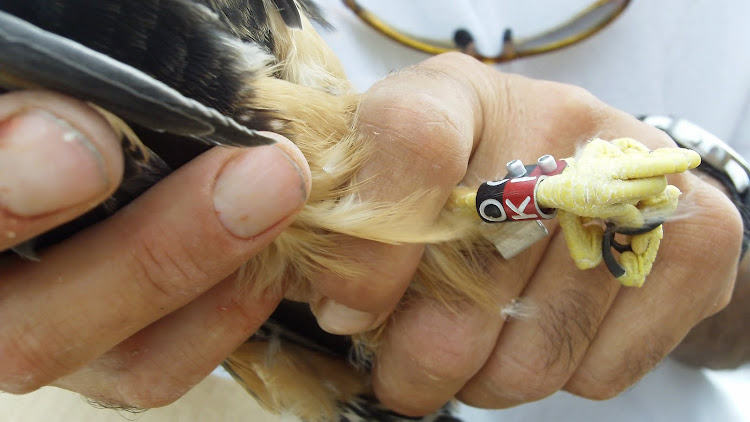
Goshen, a shorebird tracked by scientists, becomes second study bird to be lost on Guadeloupe

Unfortunately, large birds are often hunted outside of the US; tracking birds tells us not only about migration routes but also the unfortunate pressures they face. Goshen was a Whimbrel, but even American White Pelicans become food. (Follow-up to American White Pelican post is here)

Friday, August 26, 2011

Whimbrel vs. Hurricane Irene

Here's a great 3 page pdf on a Whimbrel (named Chinquapin) that has skirted Hurricane Irene on a four-day non-stop flight:
click for the pdf

Update: now there's a non-pdf link!

Friday, February 25, 2011

Golden Eagles and wind farms

I had these links in a draft tucked away sometime in December; apologies for the delay! It's incredibly important to have bird patterns monitored in cases like this, where wind farm development can be modified and bird patterns.

Tracking Golden Eagles via satellite - Eat More Cookies

Tracking Golden Eagles by Satellite; Impact of Large-Scale Wind Farms Studied - Science Daily

Friday, December 3, 2010

Osprey by satellite

Recently there's been press about Osprey migration; Backpacking Ospreys was a feature over at Cornell's Lab of Ornithology.

Their great article and map highlight the work of Dr. Bierregaard, Osprey researcher extraordinaire.
...a three-month-old female Osprey named Penelope pushed off from Martha’s Vineyard, Massachusetts, and flew, alone, 2,700 miles to French Guiana in 13 days.

That, my friends, is why Cornell's article, Backpacking Ospreys, needs to be read. And then Dr. Bierregaard's page needs to be perused. Pure, delicious, researchy goodness.

Wednesday, November 3, 2010

Egrets among us

Occasionally there will be a post on Texbirds (the Texas bird sighting list) about a bird with a band or tag or dye. Recently the bird in question was a white morph of the Reddish Egret.

The fellow in charge of the project, Clay Green, was fairly quickly found and kindly gave permission to post about his project here. To visit his site, click here - waterbird colony research awaits!

Because the bird is so young, there's not much data on it:
I dont know much more about the bird but it has been foraging along Texas coast since it fledged the nest in July. We have been tracking it regularly, we get latitude-longtidue fixes every 48 hours... Attached is a jpeg map of the bird's movement, we just banded it in June so it hasn't moved that much, but you can see at least where it has been going...

So this young one hatched in June of 2010, was banded in July, and this map shows through the middle of September:


With those dots representing 48 hr intervals, the huge gaps are distances covered in only two days. Dot clusters then show places that the bird loitered for extended amounts of time. I wonder if it will return to the rookery where it hatched to breed?

Saturday, July 3, 2010

Baby Pictures

This post was originally featured at seetrail under the title Camp Eagle. It has been slightly edited for relevance. -h

Swapping e-mails with a supportive and enthusiastic researcher certainly does seem reminiscent of swapping family photos - except our exchange started with blurry through-binoculars pictures. Funny, I'd hope that most family photos are a bit more direct than a stealthy drive-by 10x zoom plus 8x42 bins... it's more like espionage than a Christmas card photo.

Still, in a way it's like having an old friend and comparing baby pictures:


A photo of Anakin enjoying a ride in the jeep. Awww.

And here's Brian's little one:


Here's a pic from the day she was fitted with an transmitter. The falconry hood assists in keeping the eaglet calm during the fitting process.

Since this project is ultimately not hands-on except for the fitting, it's neat to see that others contribute photos as well:


Photographed in South Miami-Dade county. [...] The eaglet sighting and photograph was taken by Katy Raits in November 2007.

...it's exciting to hear back about the bird you've spotted, but it's remarkably awesome to know that the life history of the critter is not only being documented, but shared with innocent bystanders who take the time and effort to look into the sightings. I guess that makes us part of the "Camp Eagle" fan club - and by extension, our readers get to be subjected to our enthusiastic whims :)

Perhaps other couples experience this kind of nostalgia, when they open an e-mail from a researcher whose bird they saw... two weeks ago. Hey, you've gotta start somewhere!

When looking at a Bald Eagle with a fully white head and tail, you know the bird is at least 4 years old; young ones have varying degrees of light patches but are predominantly dark.

Friday, June 18, 2010

Curlews on the move

Recently there has been some curlew migration discussion on the Texbirds mailing list. Never one to let something cool slip by me, I e-mailed Joel about the project.

Nebraska Long-billed Curlew Tracking Project is following two female Long-Billed Curlews (Numenius americanus) - the site is amazing. One has not been heard from since December, but the other has made an early fall migration; she left the wintering grounds in April, and is almost back on them already and it's only mid June!

"Feel free to blog about the project and the website. It is a fun part of the curlew project and I think people find it interesting."

...Joel's suggestion that this study is interesting is an understatement. Take a look at Long-billed Curlew life history. First of all, it's a sandy colored bird about the size of a football. On stilts. With a long neck. And a beak that is longer than its legs. The curlew tracking project takes this fantastically proportioned bird and then adds a telemetry pack. The fine print also lists their life expectancy of 8-10 years.

Joel also offered some reassurance to my question of whether or not the transmitter interfered with mating: "I do not believe the satellite transmitter interfere with mating, other than the small battery, the rest of the transmitter is flexible."

And now for a paragraph of sage advice, and part of the wisdom behind all bird tracking (emphasis mine):
Why Track Long-billed Curlews?

Long-billed Curlew are migratory shorebirds that spend only a quarter or a third of their annual cycle on their Nebraska breeding grounds. While understanding Long-billed Curlew reproductive ecology in Nebraska is important and is part of the broader project, knowing where Nebraska curlews spend the rest of the year is equally important. For instance, the species' habitat and food resources may be secure in Nebraska, but curlews may face threats on their wintering grounds in Texas, California, or Mexico (we don't know for sure where Nebraska curlews go?). Linking birds breeding grounds with their wintering areas and migrations routes is key to conserving the species.


And so we end on a note of conservation: as guests on this planet, we need to make sure that what we do is not at the expense of others. Birds know no borders.

Tuesday, May 11, 2010

Eagles and bands and collars, oh my!

Edit: this post is from SeeTrail, where it was originally posted as "eagles with accessories"

Here's a post for the technophiles among us:


"It's just a map," you say. Of course it's a map, that's how people learn things!


...and now you're accusing me of posting the blurry rump of a Bald Eagle (Haliaeetus leucocephalus). That accusation stands true as well. What doesn't show up in that photo is a little pack that is attached to the bird - and transmits information about the bird's geographic movement to a researcher named Brian.

Brian Mealey is the Executive Director, and thus primary researcher, when it comes to radio-collared Bald Eagles in the Everglades. There's even a page on the site that gives you a sample pair of eagle "tracks" from previous years.

We found Brian via the Tropical Audubon Society bird board, when I posted this query:
Ok, I know we bugged out of SE FL a while ago, but we were reviewing
pictures and one of the Bald Eagles in a fallow field along 997 (I
think that's the road north from Everglades NP to Hwy 41 and 75?) had
a transmitter on its back.

USGS doesn't have a category for reporting collared eagles, perhaps
y'all know of a local project?

In no time at all, "tricia" had responded to my post with:
It is probably one of Brian Mealey's birds.
follow this link and you can email him.
http://www.instwildlifesciences.org/eaglemain.html


So much for my own sleuthing! At least we had enough information from our sighting to e-mail Brian and sound more intelligent than "we saw an eagle and it had an antenna on it" - I'm sure researchers get that a lot.


Matt pointing to the Bald Eagle in a fallow field - there were also White Ibis, Black-necked Stilts, Laughing Gulls, American Crows, and Boat-tailed Grackles present. Then a tractor scared them. Sigh.

My e-mail to Brian:
My husband and I were on our way from Everglade NP back to hwy 41 and
maybe a mile south of the "Robert is here" fruit stand on 997, we
passed a fallow field with two eagles. One of them had a transmitter
backpack - since we didn't see bands or wing tags, I'm not sure that
the sighting is of any use to you, since the transmitter is probably
working... just wanted to say that it was quite a highlight on our
trip =) Exact date would be 7/28/09, I'd have to get back to you on
what time in the afternoon, though.


Brian's enthusiastic response:
Thank you Heidi!

Always useful and it great to know that folks are always on the look
out for wildlife!

I'm attaching a map of the most recent movement of Camp Eagle (56105)
includes your sighting.

Camp Eagle was banded as a nestling (about 50 days old) and fitted
with a transmitter back in March 2005! She's beating the odds of
survival!!!!! Yeah!


[truncated here -h]

If that first map wasn't nifty enough, here's the detailed map of SE FL activities during the time that Matt and I saw "Camp Eagle" (when was the last time you could put the name to a bird you were watching? ...on a project that's not yours??)


This map is infinitely cool, not just because it shows ample movement in the protected zone of Everglades National Park and tracks adventures east of Homestead, but because it even highlights the fruity awesomeness that is the "Robert is Here" fruit stand! And of course, we were just a bit south of "Robert is Here" when we saw "Camp Eagle," so our story has been validated with a bit of telemetry handiwork.

In the meantime, Brian reports that he is in the midst of analysis and manuscript work, so at some point in the near future, we'll get to find out what information "Camp Eagle" contributed by toting around the transmitter.

Saturday, February 27, 2010

the inspiration

Be sure to check out the "Welcome" page - it has information on how to report banded and tagged birds! Otherwise, discussion and history is fair game.


Here are a few stories of reports past, ones that inspired us to collect information and share with other curious minds:

A Dove and a Pelican from Big Country Audubon (TX)

eagles with accessories and Camp Eagle from Seetrail (FL)

Edit: "eagles with accessories" has been reposted in this blog as "Eagles and bands and collars, oh my!"

Appleton to Alamo; 1,482 miles by pelican & Jeff and pelicans from Seetrail (TX)