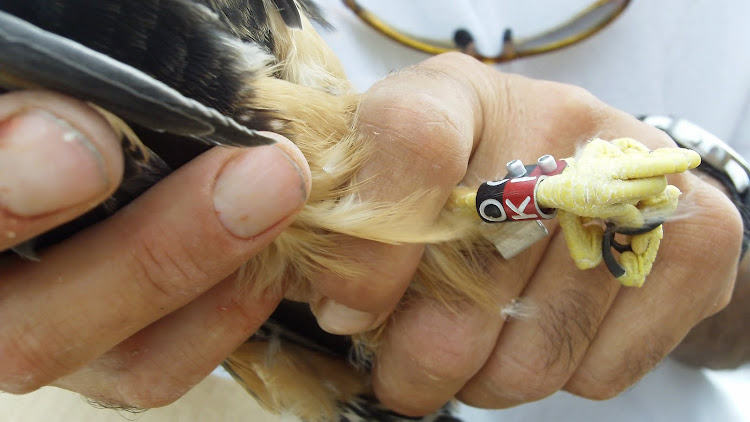
'Moonbird' is a Red Knot that has gotten some great coverage lately, not to mention a whole book!
Latest news is here: B95, the great survivor
Knots face some pretty amazing travel challenges as well as food shortages due to overharvesting of horseshoe crabs - the article above really does a nice job of covering some of those obstacles and outlining why the name 'moonbird' is appropriate. Namely, the distance this bird has traveled between Delaware and Argentina since being banded (as an adult!) in 1995 ...is astronomical.
Showing posts with label leg flag. Show all posts
Showing posts with label leg flag. Show all posts
Thursday, June 14, 2012


Monday, May 30, 2011
Piping Plovers!
This quick exchange was sent to me (by request); I've shuffled the order so it's in chronological order and a bit easier to read. What a fast response, even if official location is still pending!
> Sent: Tuesday, April 26, 2011 8:15 PM
> Subject: Banded Piping Plovers
>
> http://www.pbase.com/lgprice/texas_central_coast
>
> I observed several Piping Plovers today on Mustang Island, TX, USA just south of Mustang Island State Park at Corpus Christi Pass.
>
> There were at least two banded Piping Plovers.
>
> I put photos of the birds in the above album. There are several photos of each bird.
>
> They were foraging on the wet sand spits.
>
> Linda Gail Price
> Longview, Texas
> Pineywoods
> Date: April 26, 2011 10:40:01 PM CDT
> Subject: RE: Banded Piping Plovers
>
> Linda- Much appreciated!
>
> It looks as if they have dark green flags (colour bands that stick out for the leg) as well as normal colour bands, so they will have been banded by Virginia Tech in Texas or along the Missouri River, SD. I've forwarded your message to them - they should be able to get back to you with more information about the birds.
>
> Thanks for sending them in!
>
> Cheri
>
> Dr. C. L. Gratto-Trevor
> Research Scientist Shorebirds
> Prairie and Northern Wildlife Research Centre
> Wildlife and Landscape Science Directorate
> Science and Technology Branch
> Environment Canada
> 115 Perimeter Road
> Saskatoon, SK S7N 0X4 Canada
> cheri.gratto-trevor@ec.gc.ca
> Telephone 306-975-6128
> Facsimile 306-975-4089
> Government of Canada
> Sent: Tuesday, April 26, 2011 8:15 PM
> Subject: Banded Piping Plovers
>
> http://www.pbase.com/lgprice/texas_central_coast
>
> I observed several Piping Plovers today on Mustang Island, TX, USA just south of Mustang Island State Park at Corpus Christi Pass.
>
> There were at least two banded Piping Plovers.
>
> I put photos of the birds in the above album. There are several photos of each bird.
>
> They were foraging on the wet sand spits.
>
> Linda Gail Price
> Longview, Texas
> Pineywoods
> Date: April 26, 2011 10:40:01 PM CDT
> Subject: RE: Banded Piping Plovers
>
> Linda- Much appreciated!
>
> It looks as if they have dark green flags (colour bands that stick out for the leg) as well as normal colour bands, so they will have been banded by Virginia Tech in Texas or along the Missouri River, SD. I've forwarded your message to them - they should be able to get back to you with more information about the birds.
>
> Thanks for sending them in!
>
> Cheri
>
> Dr. C. L. Gratto-Trevor
> Research Scientist Shorebirds
> Prairie and Northern Wildlife Research Centre
> Wildlife and Landscape Science Directorate
> Science and Technology Branch
> Environment Canada
> 115 Perimeter Road
> Saskatoon, SK S7N 0X4 Canada
> cheri.gratto-trevor@ec.gc.ca
> Telephone 306-975-6128
> Facsimile 306-975-4089
> Government of Canada
Sunday, April 10, 2011
Request for Godwit and Whimbrel reports
Just spreading the word!
***
Please Report Color-flagged Hudsonian Godwits and Whimbrels
Since 2007, we have attached uniquely numbered/lettered, red color-flags to 790 Godwits and 355 Whimbrels on Chiloé Island, Chile. Godwits or Whimbrels have also been flagged in Alaska, Argentina, Chile, Colombia, Manitoba, and Virginia. If you see any of these flagged birds, please submit your observations to www.bandedbirds.org. On this site, there are instructions on how to read and report color-flagged birds, and you can click on “Report Resighting” to enter your observations. By using this site, to report one of our flagged godwits or whimbrels, you will immediately know where and when it was banded.
Banding projects to study migratory shorebirds that make epic hemispheric journeys have been underway since the mid 1990’s. In recent years, the birds have been tagged with engraved markers allowing identification of individuals with spotting scopes. The combination of banding and resighting data allows greater understanding of the habitat uses and needs by imperiled species. With this understanding comes the hope of achieving the protective actions required to halt, and even reverse, the population decline exhibited by many shorebird species.
For more information on the Hudsonian Godwit and Whimbrel project in Chile, contact Brad Andres (brad_andres@fws.gov; 303-275-2324) or Jim Johnson (jim_a_johnson@fws.gov; 907-786-3423).
Thanks in advance for the assistance.
Brent Ortego
Texas Parks and Wildlife Department
Victoria, TX
***
Please Report Color-flagged Hudsonian Godwits and Whimbrels
Since 2007, we have attached uniquely numbered/lettered, red color-flags to 790 Godwits and 355 Whimbrels on Chiloé Island, Chile. Godwits or Whimbrels have also been flagged in Alaska, Argentina, Chile, Colombia, Manitoba, and Virginia. If you see any of these flagged birds, please submit your observations to www.bandedbirds.org. On this site, there are instructions on how to read and report color-flagged birds, and you can click on “Report Resighting” to enter your observations. By using this site, to report one of our flagged godwits or whimbrels, you will immediately know where and when it was banded.
Banding projects to study migratory shorebirds that make epic hemispheric journeys have been underway since the mid 1990’s. In recent years, the birds have been tagged with engraved markers allowing identification of individuals with spotting scopes. The combination of banding and resighting data allows greater understanding of the habitat uses and needs by imperiled species. With this understanding comes the hope of achieving the protective actions required to halt, and even reverse, the population decline exhibited by many shorebird species.
For more information on the Hudsonian Godwit and Whimbrel project in Chile, contact Brad Andres (brad_andres@fws.gov; 303-275-2324) or Jim Johnson (jim_a_johnson@fws.gov; 907-786-3423).
Thanks in advance for the assistance.
Brent Ortego
Texas Parks and Wildlife Department
Victoria, TX
Friday, November 5, 2010
RFI: Bristle-thighed Curlews
From the Ornithological Society of North America comes Neswsletter #198, which includes this request:
BRISTLE-THIGHED CURLEWS COLOR-MARKED IN ALASKA –
Thirty-two Bristle-thighed Curlews were uniquely marked with coded leg flags on the breeding grounds in western Alaska in the summer of 2010 as part of a three year mark-resight project. Additional curlews will be marked during the breeding season in 2011 and 2012. The ultimate goal of this project is to collect data that will be used to estimate the current size of the curlew population breeding in the southern Nulato Hills. Each curlew has a green flag on its upper right leg and a standard federal metal band on its upper left leg. The green flag has a unique code consisting of two white characters (either two numbers or two letters). Please report all sightings to KRISTINE SOWL, Yukon Delta National Wildlife Refuge, P.O. Box 346, Bethel, Alaska 99559, USA (EM: kristine_sowl@fws.gov). Please note the date, the leg flag code, location of the bird, and its behavior. Copies of photographs of the individual may provide information on sex. Thank you for your assistance.
BRISTLE-THIGHED CURLEWS COLOR-MARKED IN ALASKA –
Thirty-two Bristle-thighed Curlews were uniquely marked with coded leg flags on the breeding grounds in western Alaska in the summer of 2010 as part of a three year mark-resight project. Additional curlews will be marked during the breeding season in 2011 and 2012. The ultimate goal of this project is to collect data that will be used to estimate the current size of the curlew population breeding in the southern Nulato Hills. Each curlew has a green flag on its upper right leg and a standard federal metal band on its upper left leg. The green flag has a unique code consisting of two white characters (either two numbers or two letters). Please report all sightings to KRISTINE SOWL, Yukon Delta National Wildlife Refuge, P.O. Box 346, Bethel, Alaska 99559, USA (EM: kristine_sowl@fws.gov). Please note the date, the leg flag code, location of the bird, and its behavior. Copies of photographs of the individual may provide information on sex. Thank you for your assistance.
Friday, October 15, 2010
Knots in the news
The Western Hemisphere Shorebird Reserve Network has a fantastic reference page, mentioned in the previous post, Birding for Banded Shorebirds - it's worth printing out and keeping a copy on hand if you bird coastal areas much.
So when I came across another note on banded shorebirds, I had to share that link again before adding an article about Red Knots (Calidris canutus) from the Corpus Christi area.
Bag 'em, flag 'em and tag 'em
Coastal Bend bird biologist tracking red knots
Keep your eyes open! Red Knots are seriously declining and research like this is helping track the populations as they migrate globally.
So when I came across another note on banded shorebirds, I had to share that link again before adding an article about Red Knots (Calidris canutus) from the Corpus Christi area.
Bag 'em, flag 'em and tag 'em
Coastal Bend bird biologist tracking red knots
Keep your eyes open! Red Knots are seriously declining and research like this is helping track the populations as they migrate globally.
Sunday, October 10, 2010
Birding for Banded Birds
This post was an e-mail to Texbirds in mid September, it is posted here with permission from Brent - enjoy!
****
Birding for Banded Birds
Sat Sep 11 12:46:36 2010
Birding for Banded Shorebirds
Several times per year people ask how to report banded birds. Many of the banded birds that have color markers are shorebirds. It is not difficult to locate a color marked bird and the information is very useful to the researchers and can be quite interesting to the reporter.
A recent report from the Western Hemisphere Shorebird Reserve Network is pasted above for your use.
A number of color marking programs in which I am familiar are for Piping Plover, Snowy Plover, Red Knot, Long-billed Curlew, Reddish Egret, Black Skimmer, Purple Martin, hummingbirds, Turkey Vulture, Black-capped Vireo.
Brent Ortego
Victoria, TX
****
Birding for Banded Birds
Sat Sep 11 12:46:36 2010
Birding for Banded Shorebirds
Several times per year people ask how to report banded birds. Many of the banded birds that have color markers are shorebirds. It is not difficult to locate a color marked bird and the information is very useful to the researchers and can be quite interesting to the reporter.
A recent report from the Western Hemisphere Shorebird Reserve Network is pasted above for your use.
A number of color marking programs in which I am familiar are for Piping Plover, Snowy Plover, Red Knot, Long-billed Curlew, Reddish Egret, Black Skimmer, Purple Martin, hummingbirds, Turkey Vulture, Black-capped Vireo.
Brent Ortego
Victoria, TX
Subscribe to:
Posts (Atom)

