Become an Osprey Watcher: Connect with a global community of observers
The Center for Conservation Biology has launched Osprey-Watch, a project created to engage a global community to collect data on breeding osprey. Linked by an interest in osprey and a concern for the health of the aquatic environments on which they rely, this community will for the first time provide a global perspective on this charismatic species. The mission of Osprey-Watch is to bring citizen scientists together in order to collect information on a large enough spatial scale to be useful in addressing three of the most pressing issues facing aquatic ecosystems including global climate change, depletion of fish stocks, and environmental contaminants.
Osprey are one of very few truly global sentinels for aquatic health. They feed almost exclusively on live fish throughout their entire life cycle. They are a top consumer within aquatic ecosystems and are very sensitive to both overfishing and environmental contaminants. Nearly all populations breed in the northern latitudes and winter in the southern latitudes, effectively linking the aquatic health of the hemispheres. Their breeding season in the north is highly seasonal making them an effective barometer of climate change.
Osprey-Watch is a user-friendly, internet platform that allows observers across the globe to map their nests, log observations, upload photos, and interact within an observer forum. Information entered into the platform will be immediately accessible to users and will be summarized following the breeding season.
To join a growing community of global citizens, please visit http://www.osprey-watch.org and become an Osprey-Watcher.
Michael Wilson
Center for Conservation Biology
College of William and Mary & Virginia Commonwealth University
P.O. Box 8795
Williamsburg, VA 23187-8795
phone: 757-221-1649
fax: 757-221-1650
email: mdwils AT wm.edu
http://www.osprey-watch.org
Showing posts with label osprey. Show all posts
Showing posts with label osprey. Show all posts
Sunday, April 15, 2012


Friday, August 5, 2011
Banded Osprey sightings
From the Texas wildlife rehab list:
Banded Osprey sightings
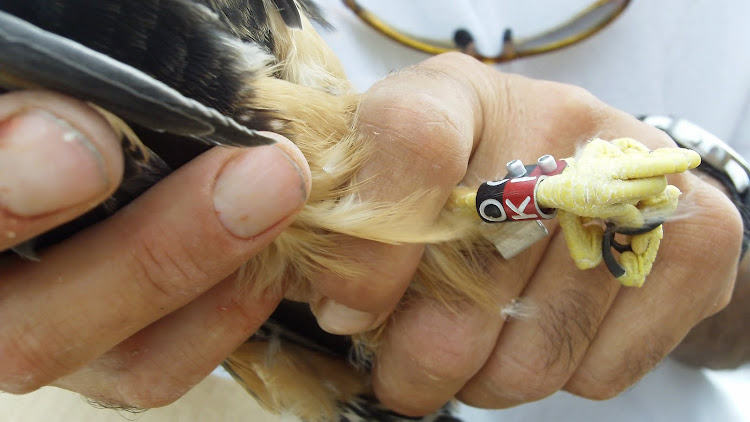
PLEASE REPORT SIGHTINGS - We banded reintroduced ospreys with blue, green and orange color bands with alpha-numeric codes during a project in southeastern South Dakota from 2004-2010. Please report sightings of birds with these color bands and codes, if possible, to EILEEN DOWD STUKEL, SD Game, Fish and Parks (EM:eileen.dowdstukel/at/state.sd. us; PH 605-773-4229) .
Banded Osprey sightings
PLEASE REPORT SIGHTINGS - We banded reintroduced ospreys with blue, green and orange color bands with alpha-numeric codes during a project in southeastern South Dakota from 2004-2010. Please report sightings of birds with these color bands and codes, if possible, to EILEEN DOWD STUKEL, SD Game, Fish and Parks (EM:eileen.dowdstukel/at/state.sd. us; PH 605-773-4229) .
Friday, December 3, 2010
Osprey by satellite
Recently there's been press about Osprey migration; Backpacking Ospreys was a feature over at Cornell's Lab of Ornithology.
Their great article and map highlight the work of Dr. Bierregaard, Osprey researcher extraordinaire.
That, my friends, is why Cornell's article, Backpacking Ospreys, needs to be read. And then Dr. Bierregaard's page needs to be perused. Pure, delicious, researchy goodness.
Their great article and map highlight the work of Dr. Bierregaard, Osprey researcher extraordinaire.
...a three-month-old female Osprey named Penelope pushed off from Martha’s Vineyard, Massachusetts, and flew, alone, 2,700 miles to French Guiana in 13 days.
That, my friends, is why Cornell's article, Backpacking Ospreys, needs to be read. And then Dr. Bierregaard's page needs to be perused. Pure, delicious, researchy goodness.
Subscribe to:
Posts (Atom)

