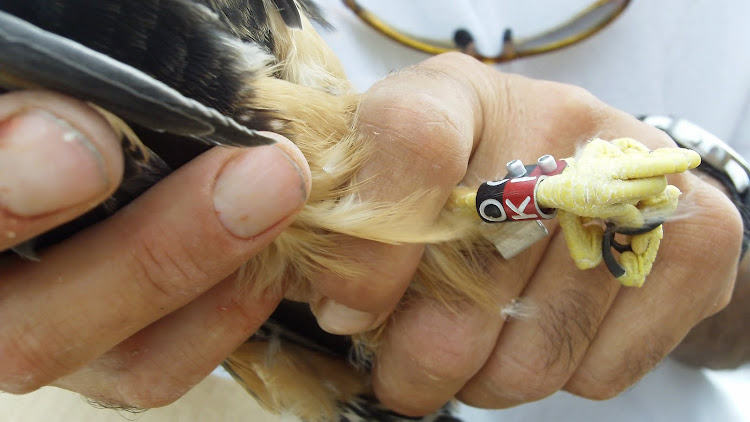
Snagged straight off of facebook, for obvious reasons:
The Center for Conservation Biology
CCB has tracked 3 whimbrels off the east coast of Canada to the northern shore of South America via a previously unknown migration pathway over the open Atlantic Ocean. The route passed through the center of the vast Atlantic at one point passing 1,000 miles closer to Africa than to North America and within 700 miles of the Cape Verde Islands. The bird with the longest flight flew nonstop for 145 hours (6 days) covering a distance of 7,000 kilometers (4,355 miles).
The three birds named Mackenzie, Taglu, and Akpik were originally marked by CCB and Canadian Wildlife Service staff on the breeding grounds along the Mackenzie River Delta in far western Canada (Mackenzie was fitted with a transmitter recovered from Machi, a bird that was shot on Guadeloupe in September of 2011). In mid-July the birds flew across the continent to the east coast of Canada and staged for approximately 2 weeks in the James Bay and the Gulf of St. Lawrence to build fat reserves. The birds then flew southeast, reaching the center of the Atlantic Ocean before turning south and making landfall in South America between Guyana and Brazil. Although this portion of the Atlantic is used by true seabirds that roost on the water, it is so isolated from shore that species such as whimbrel that cannot land on water were not believed to reach it. The birds may receive some benefit from venturing this far out to sea in the form of favorable tailwinds. Mackenzie averaged just under 30 miles per hour (48 kilometers per hour) for the 6-day flight.
The three birds are part of a larger project that has included 20 additional birds that have been tracked to better understand migratory pathways and locations that are critical for this declining species. The study has tracked whimbrels for more than 185,000 miles (300,000 kilometers) since 2008. The broader tracking project is a collaborative effort between The Center for Conservation Biology, The Canadian Wildlife Service, The Nature Conservancy, The U.S. Fish and Wildlife Service, Georgia Department of Natural Resources, the Virginia Coastal Zone Management Program, and Manomet Center for Conservation Sciences.
http://ccb-wm.org/news/pressreleases_pdfs/20120814_whimbrel.pdf
Showing posts with label canada. Show all posts
Wednesday, September 5, 2012
Sunday, January 15, 2012
If you see a banded Piping Plover...
Via Texbirds, pre-dated and modified for format and lack of photos:
Here is a repost from last year, if you see Piping Plovers with colored bands:
Here is some info on what to do if you see a banded or unbanded Piping Plover. It was sent to me in 2008 from Cheri Gratto-Trevor, a Canadian researcher. Research and researchers come and go, so I'm not sure if all of the info is still current, but it's worth trying an email or 2:
"If you see a marked Piping Plover, please write down the location, date, behaviour of bird (foraging; with mate or nest), a detailed description of the bands (see below).
* To describe a band combination: describe each band:
* Type: metal, colour band, flag (band with a tab sticking out from the leg
* Colours: as exact as possible - common colours are red, yellow, orange, light blue (very pale), dark blue, white, light green (very pale), dark green, black, grey. Some are bi-coloured (2 colours on one band). Sometimes two bands of the same colour are placed over each other on a leg (may look like a very tall band). Common flag colours are black, white, dark green, yellow, orange and light blue.
* Location on bird's leg:
bird's upper left (above the "knee"), lower left (below the "knee"), upper right, lower right; above or below other bands on the same part of the leg.
* * * Note if you are unsure of any of the bands or if you did not see all parts of the leg clearly.
* * * Example:
"Black flag upper left, dark blue band lower left, metal upper right, light green over dark blue band lower right."
* Plovers banded as adults in Saskatchewan have 5 bands: a white flag upper right OR black flag upper left or right; metal upper on opposite leg to flag (rarely on lower leg with colour bands), 2 colour bands on 1 lower leg, and one plain colour on the other lower leg. Colours used were red, orange, yellow, light green, dark green, grey, black, dark blue; there may be two of the same colour on the same part of the leg).
Plovers banded as chicks are variable - some are similar to the adult schemes noted above, while others just have either a white or black flag upper and metal upper, no other colour bands. In other projects; some chicks (Lake Diefenbaker, SK) have a white band upper left (not a flag), metal on a lower leg, and 1-3 other bands; some (Chaplin Lake, SK) have a light green/dark green bi-coloured band on one leg, metal other upper leg, and 1-2 bands on the lower legs; some (Alberta) have a bicoloured black and white band, metal and 1-2 colour bands. Some plovers from the U.S. Great Lakes have been banded with an orange flag on an upper leg (metal other upper, 2 colour bands on one lower leg and one on the other), and in the Missouri River, USA with a dark green flag upper (2 colour bands on each lower leg, no metal; or just the flag and 2 colour bands in total), or yellow flag on an upper leg (metal other upper, 2 colour bands on one lower leg and one on the other) . And of course, bands can discolour, or occasionally, fall off.
However this information can provide very useful data on Piping Plover movements and survival, so please look for marked birds and send in your sightings!
Band sightings can be sent to Greg Pavelka (Gregory.A.Pavelka AT usace.army.mil), especially if no flag or a light blue flag is seen; or directly to the bander if a flag is observed:
white or black flag: Cheri Gratto-Trevor (cheri.gratto-trevor AT ec.gc.ca)
dark green flag: Dan Catlin (dcatlin AT vt.edu)
yellow or red flag: Jennifer Stucker (jstucker AT usgs.gov)
orange flag: Great Lakes (plover AT umn.edu)
Thanks for looking for our birds!
Here is a repost from last year, if you see Piping Plovers with colored bands:
Here is some info on what to do if you see a banded or unbanded Piping Plover. It was sent to me in 2008 from Cheri Gratto-Trevor, a Canadian researcher. Research and researchers come and go, so I'm not sure if all of the info is still current, but it's worth trying an email or 2:
"If you see a marked Piping Plover, please write down the location, date, behaviour of bird (foraging; with mate or nest), a detailed description of the bands (see below).
* To describe a band combination: describe each band:
* Type: metal, colour band, flag (band with a tab sticking out from the leg
* Colours: as exact as possible - common colours are red, yellow, orange, light blue (very pale), dark blue, white, light green (very pale), dark green, black, grey. Some are bi-coloured (2 colours on one band). Sometimes two bands of the same colour are placed over each other on a leg (may look like a very tall band). Common flag colours are black, white, dark green, yellow, orange and light blue.
* Location on bird's leg:
bird's upper left (above the "knee"), lower left (below the "knee"), upper right, lower right; above or below other bands on the same part of the leg.
* * * Note if you are unsure of any of the bands or if you did not see all parts of the leg clearly.
* * * Example:
"Black flag upper left, dark blue band lower left, metal upper right, light green over dark blue band lower right."
* Plovers banded as adults in Saskatchewan have 5 bands: a white flag upper right OR black flag upper left or right; metal upper on opposite leg to flag (rarely on lower leg with colour bands), 2 colour bands on 1 lower leg, and one plain colour on the other lower leg. Colours used were red, orange, yellow, light green, dark green, grey, black, dark blue; there may be two of the same colour on the same part of the leg).
Plovers banded as chicks are variable - some are similar to the adult schemes noted above, while others just have either a white or black flag upper and metal upper, no other colour bands. In other projects; some chicks (Lake Diefenbaker, SK) have a white band upper left (not a flag), metal on a lower leg, and 1-3 other bands; some (Chaplin Lake, SK) have a light green/dark green bi-coloured band on one leg, metal other upper leg, and 1-2 bands on the lower legs; some (Alberta) have a bicoloured black and white band, metal and 1-2 colour bands. Some plovers from the U.S. Great Lakes have been banded with an orange flag on an upper leg (metal other upper, 2 colour bands on one lower leg and one on the other), and in the Missouri River, USA with a dark green flag upper (2 colour bands on each lower leg, no metal; or just the flag and 2 colour bands in total), or yellow flag on an upper leg (metal other upper, 2 colour bands on one lower leg and one on the other) . And of course, bands can discolour, or occasionally, fall off.
However this information can provide very useful data on Piping Plover movements and survival, so please look for marked birds and send in your sightings!
Band sightings can be sent to Greg Pavelka (Gregory.A.Pavelka AT usace.army.mil), especially if no flag or a light blue flag is seen; or directly to the bander if a flag is observed:
white or black flag: Cheri Gratto-Trevor (cheri.gratto-trevor AT ec.gc.ca)
dark green flag: Dan Catlin (dcatlin AT vt.edu)
yellow or red flag: Jennifer Stucker (jstucker AT usgs.gov)
orange flag: Great Lakes (plover AT umn.edu)
Thanks for looking for our birds!
Labels:
alberta,
canada,
great lakes,
piping plover,
saskatchewan
Friday, August 26, 2011
Whimbrel vs. Hurricane Irene
Here's a great 3 page pdf on a Whimbrel (named Chinquapin) that has skirted Hurricane Irene on a four-day non-stop flight:
click for the pdf
Update: now there's a non-pdf link!
click for the pdf
Update: now there's a non-pdf link!
Wednesday, May 18, 2011
A Whimbrel named Hope
From: THE BIRDING COMMUNITY E-BULLETIN May 2011
WHIMBREL TRAVELS: “HOPE”
Also on the subject of shorebirds and their migrations, it may be particularly instructive to follow the travels of just a single Whimbrel, a bird nicknamed “Hope.”
Hope is a female Whimbrel that was captured in Virginia on the southern Delmarva Peninsula on 19 May 2009. There, she was banded and fitted with a satellite transmitter. Since then, Hope has logged more than 21,000 miles (33,000 kilometers), flying between a remote Canadian breeding territory on the MacKenzie River (an IBA site, by the way) near Alaska and a comfortable winter territory on St. Croix in the U.S. Virgin Islands!
Last month, on 8 April, Hope returned to Virginia following a 75-hour, 1,850-mile (2,900 kilometer) flight over the Atlantic Ocean. For more details and to see a fascinating route map showing Hope’s journeys, see here:
http:www.fws.gov/northeast/news/2011/041411.html
WHIMBREL TRAVELS: “HOPE”
Also on the subject of shorebirds and their migrations, it may be particularly instructive to follow the travels of just a single Whimbrel, a bird nicknamed “Hope.”
Hope is a female Whimbrel that was captured in Virginia on the southern Delmarva Peninsula on 19 May 2009. There, she was banded and fitted with a satellite transmitter. Since then, Hope has logged more than 21,000 miles (33,000 kilometers), flying between a remote Canadian breeding territory on the MacKenzie River (an IBA site, by the way) near Alaska and a comfortable winter territory on St. Croix in the U.S. Virgin Islands!
Last month, on 8 April, Hope returned to Virginia following a 75-hour, 1,850-mile (2,900 kilometer) flight over the Atlantic Ocean. For more details and to see a fascinating route map showing Hope’s journeys, see here:
http:www.fws.gov/northeast/news/2011/041411.html
Friday, April 15, 2011
Ross's Goose seen in OH then MI
From Julie A. Craves of the Rouge River Bird Observatory - a Ross's Goose in Michigan that was also seen in Ohio!
The two links: first with general ID and photos, second with map
New for Dearborn: Ross's Goose
Update on Ross's Goose
This is a fantastic combination of sightings on one bird, kudos to Joe Hildreth for making the connection re: bands!
According to the posts, the bird was banded as a wee nestling in 2006 in Canada, seen in Ohio this March, and made the Michigan appearance in April... not a bad record of a bird on the move!
The two links: first with general ID and photos, second with map
New for Dearborn: Ross's Goose
Update on Ross's Goose
This is a fantastic combination of sightings on one bird, kudos to Joe Hildreth for making the connection re: bands!
According to the posts, the bird was banded as a wee nestling in 2006 in Canada, seen in Ohio this March, and made the Michigan appearance in April... not a bad record of a bird on the move!
Sunday, April 10, 2011
Request for Godwit and Whimbrel reports
Just spreading the word!
***
Please Report Color-flagged Hudsonian Godwits and Whimbrels
Since 2007, we have attached uniquely numbered/lettered, red color-flags to 790 Godwits and 355 Whimbrels on ChiloĆ© Island, Chile. Godwits or Whimbrels have also been flagged in Alaska, Argentina, Chile, Colombia, Manitoba, and Virginia. If you see any of these flagged birds, please submit your observations to www.bandedbirds.org. On this site, there are instructions on how to read and report color-flagged birds, and you can click on “Report Resighting” to enter your observations. By using this site, to report one of our flagged godwits or whimbrels, you will immediately know where and when it was banded.
Banding projects to study migratory shorebirds that make epic hemispheric journeys have been underway since the mid 1990’s. In recent years, the birds have been tagged with engraved markers allowing identification of individuals with spotting scopes. The combination of banding and resighting data allows greater understanding of the habitat uses and needs by imperiled species. With this understanding comes the hope of achieving the protective actions required to halt, and even reverse, the population decline exhibited by many shorebird species.
For more information on the Hudsonian Godwit and Whimbrel project in Chile, contact Brad Andres (brad_andres@fws.gov; 303-275-2324) or Jim Johnson (jim_a_johnson@fws.gov; 907-786-3423).
Thanks in advance for the assistance.
Brent Ortego
Texas Parks and Wildlife Department
Victoria, TX
***
Please Report Color-flagged Hudsonian Godwits and Whimbrels
Since 2007, we have attached uniquely numbered/lettered, red color-flags to 790 Godwits and 355 Whimbrels on ChiloĆ© Island, Chile. Godwits or Whimbrels have also been flagged in Alaska, Argentina, Chile, Colombia, Manitoba, and Virginia. If you see any of these flagged birds, please submit your observations to www.bandedbirds.org. On this site, there are instructions on how to read and report color-flagged birds, and you can click on “Report Resighting” to enter your observations. By using this site, to report one of our flagged godwits or whimbrels, you will immediately know where and when it was banded.
Banding projects to study migratory shorebirds that make epic hemispheric journeys have been underway since the mid 1990’s. In recent years, the birds have been tagged with engraved markers allowing identification of individuals with spotting scopes. The combination of banding and resighting data allows greater understanding of the habitat uses and needs by imperiled species. With this understanding comes the hope of achieving the protective actions required to halt, and even reverse, the population decline exhibited by many shorebird species.
For more information on the Hudsonian Godwit and Whimbrel project in Chile, contact Brad Andres (brad_andres@fws.gov; 303-275-2324) or Jim Johnson (jim_a_johnson@fws.gov; 907-786-3423).
Thanks in advance for the assistance.
Brent Ortego
Texas Parks and Wildlife Department
Victoria, TX
Friday, March 25, 2011
Canadian plover conundrum
A friend of mine, a Michigan plover biologist, posted a rather interesting saga of a one-legged plover: click here to go to The Birding Life blog.
It is an interesting issue - a plover that hasn't migrated in spite of the lateness of season, an endangered bird that would not survive if left alone, but one that would not be releasable by the time warmer weather rolled around. Thankfully at least it's not unheard of to keep plovers alive in captivity...
Sunday, March 20, 2011
Piping Plovers return to Canda
Beach Birds - from On Nature magazine
The Piping Plover is small, specialized and finally returning to its former Canadian range with much help from Michigan efforts... but unless wintering grounds see a decline in similar pressures, the population is still facing precarious challenges.
Oh, yes, and color bands, leg bands and good interviews with biologists are included!
The Piping Plover is small, specialized and finally returning to its former Canadian range with much help from Michigan efforts... but unless wintering grounds see a decline in similar pressures, the population is still facing precarious challenges.
Oh, yes, and color bands, leg bands and good interviews with biologists are included!
Labels:
canada,
color bands,
leg band,
michigan,
piping plover
Monday, November 15, 2010
Birding Community E-Bulletin highlights
From the Birding Community E-Bulletin - Nov. 2010
LOOK FOR EGRETS WITH MARKINGS
Also in Canada, this time in southern Ontario, we have news about Great Egrets.
In the past decade, over 1,200 young Great Egrets have been banded with readable red leg-bands marked with white alpha numerics (number-number-letter) in the Great Lakes region and southward. This year, over 100 egrets were marked with very obvious orange wing-tags with similar alpha-numerics. If you see any marked egrets bearing red leg-bands or with bright orange wing-tags, please try to accurately read the number-letter combinations and report the details (where and when observed and by whom). Send any observations to: chip.weseloh@ec.gc.ca
***
BIRD HAZARD SURVEY
Researchers at Muhlenberg College in Allentown, Pennsylvania, are studying the risks and benefits to birds caused by human behavior and technology (e.g., alternative energy efforts, cats, windows, and communications) as they are perceived by Americans with varying interests in birds. The researchers do not expect those responding to the survey to know the degree of risk associated with each of these behaviors or technologies. Indeed, some consequences remain unknown. The responses on these perceived risks will help more fully understand public opinions and behavior. The responses are expected to provide tools to raise bird conservation awareness.
The anonymous online survey (which takes about 25 minutes to complete) can be found here: ( http://www.zoomerang.com/Survey/WEB22BDFEUJWXT )
LOOK FOR EGRETS WITH MARKINGS
Also in Canada, this time in southern Ontario, we have news about Great Egrets.
In the past decade, over 1,200 young Great Egrets have been banded with readable red leg-bands marked with white alpha numerics (number-number-letter) in the Great Lakes region and southward. This year, over 100 egrets were marked with very obvious orange wing-tags with similar alpha-numerics. If you see any marked egrets bearing red leg-bands or with bright orange wing-tags, please try to accurately read the number-letter combinations and report the details (where and when observed and by whom). Send any observations to: chip.weseloh@ec.gc.ca
***
BIRD HAZARD SURVEY
Researchers at Muhlenberg College in Allentown, Pennsylvania, are studying the risks and benefits to birds caused by human behavior and technology (e.g., alternative energy efforts, cats, windows, and communications) as they are perceived by Americans with varying interests in birds. The researchers do not expect those responding to the survey to know the degree of risk associated with each of these behaviors or technologies. Indeed, some consequences remain unknown. The responses on these perceived risks will help more fully understand public opinions and behavior. The responses are expected to provide tools to raise bird conservation awareness.
The anonymous online survey (which takes about 25 minutes to complete) can be found here: ( http://www.zoomerang.com/Survey/WEB22BDFEUJWXT )
Sunday, September 5, 2010
correspondence - MI birds
Greetings.
I have been meaning to pass along our page of recoveries of banded birds from the Rouge River Bird Observatory outside Detroit, MI. This page has a map of recoveries outside of Michigan, and there are a couple links on the sidebar of stories about one of our waterthrushes being recovered, and our recovery of a kinglet from Toronto that your readers might find interesting:
Rouge River Bird Observatory band resightings
Thanks for promoting the reporting of bands!
--
Julie A. Craves
Rouge River Bird Observatory
University of Michigan-Dearborn
http://www.rrbo.org
http://net-results.blogspot.com
http://twitter.com/RRBO
I have been meaning to pass along our page of recoveries of banded birds from the Rouge River Bird Observatory outside Detroit, MI. This page has a map of recoveries outside of Michigan, and there are a couple links on the sidebar of stories about one of our waterthrushes being recovered, and our recovery of a kinglet from Toronto that your readers might find interesting:
Rouge River Bird Observatory band resightings
Thanks for promoting the reporting of bands!
--
Julie A. Craves
Rouge River Bird Observatory
University of Michigan-Dearborn
http://www.rrbo.org
http://net-results.blogspot.com
http://twitter.com/RRBO
Friday, August 6, 2010
Loggerhead Shrike
REQUEST FOR ASSISTANCE
LOGGERHEAD SHRIKE SIGHTINGS – Loggerhead shrikes are declining across much of their range. In Canada, the Eastern subspecies is considered critically endangered, with less than 35 pairs found in 2009. The vast majority of pairs now breed in Ontario. An extremely active and multi-faceted recovery program is underway for this species in Ontario, including a captive breeding and release program. This program has been releasing approximately 100 juvenile shrikes annually since 2006. While much is known and has been learned about this species, a critical piece of the puzzle is still missing: where exactly do these birds spend the winter? To maximize our chances of locating wintering areas and better define migration routes we will be coloring the breast of released young produced from the captive breeding program, to make them more detectable by birders. Birds will be released over July and August. Birds will have an extensive area of their breast colored in green, blue or purple. All released birds, and a large proportion of the wild population, are also color banded. If you see a shrike with a colored breast and/or wearing bands, please report it to Wildlife Preservation Canada at (EM: jessica@wildlifepreservation.ca, PH: 519-836-9314, FX: 519-836-8840). We will need details about specific location (GPS coordinates are ideal, but not essential) and color(s) (breast and/or bands) seen.
(from OSNA http://www.osnabirds.org/on/197.htm )
LOGGERHEAD SHRIKE SIGHTINGS – Loggerhead shrikes are declining across much of their range. In Canada, the Eastern subspecies is considered critically endangered, with less than 35 pairs found in 2009. The vast majority of pairs now breed in Ontario. An extremely active and multi-faceted recovery program is underway for this species in Ontario, including a captive breeding and release program. This program has been releasing approximately 100 juvenile shrikes annually since 2006. While much is known and has been learned about this species, a critical piece of the puzzle is still missing: where exactly do these birds spend the winter? To maximize our chances of locating wintering areas and better define migration routes we will be coloring the breast of released young produced from the captive breeding program, to make them more detectable by birders. Birds will be released over July and August. Birds will have an extensive area of their breast colored in green, blue or purple. All released birds, and a large proportion of the wild population, are also color banded. If you see a shrike with a colored breast and/or wearing bands, please report it to Wildlife Preservation Canada at (EM: jessica@wildlifepreservation.ca, PH: 519-836-9314, FX: 519-836-8840). We will need details about specific location (GPS coordinates are ideal, but not essential) and color(s) (breast and/or bands) seen.
(from OSNA http://www.osnabirds.org/on/197.htm )
Thursday, June 3, 2010
behind the Black-whiskered Vireo
In the summer of 2009, my spouse and I witnessed a very active Black-whiskered Vireo rummaging around the treetops of Dagny Johnson Key Largo Hammock Botanical State Park. Whew. What a name! Anyway, the bird and its unbanded companion were the highlight of our time on Key Largo - so naturally we reported the banded bird and waited. And waited. And finally this spring we were prompted by the Bananaquit bander (see previous post) to re-send the information.
So when we saw the bird on July 29, he had only been wearing those bands for 24 days! Right leg color bands were green over pink, left leg was [some color we couldn't make out] over silver. Since the e-mail confirms that he was actually banded where we spotted him, it's neat to see that he hung around even after being accosted and color marked.
Hi Ms. Trudell,
Thanks for getting in touch with the Bird Banding Lab to report that you saw my bird! I've sent them a bit of information regarding when and where it was banded, so I think you should be getting a certificate of appreciation from them. I banded that guy (and yes, it is a male) on July 5th of last year, at Dagny Johnson. I'm happy that you saw him! Unless I'm mistaken, it was towards the end of last July that you spotted him?
As I said, you should be hearing from the Bird Banding Lab - but I'm more than happy to tell you a bit about my research and why I was banding Black-whiskered Vireos, if you'd like to know.
Thanks again for reporting your sighting!
Catherine Dale
***********************************************************
Catherine Dale
PhD Candidate
Department of Biology
Queen's University
Kingston, Ontario
***********************************************************
So when we saw the bird on July 29, he had only been wearing those bands for 24 days! Right leg color bands were green over pink, left leg was [some color we couldn't make out] over silver. Since the e-mail confirms that he was actually banded where we spotted him, it's neat to see that he hung around even after being accosted and color marked.
Labels:
black-whiskered vireo,
canada,
color bands,
florida,
leg band
Monday, May 3, 2010
from "the Marvelous in nature" to you...
Seabrooke is a nature blogger like no other (and a bander as well!). One of her recent posts is an absolute must-read for anyone curious about banding. Why is it done? Who does it? What data is collected? While her post is geared towards her specific banding site (not all locations are seasonal), it also addresses a lot of the basics.
Without further ado, "On banding birds" from the Marvelous in nature."
An excerpt from the comments:
Colored leg bands (FL Scrub Jay) and wing tags (Am. White Pelican) are what this blog was started for - the ridiculously neat birds we've spotted in our adventures. Hopefully your path will cross with some of these critters, their stories are all unique and definitely worth the effort to look up!
Without further ado, "On banding birds" from the Marvelous in nature."
An excerpt from the comments:
...a bird in its lifetime only ever gets the one silver, numbered band, unless that one is so old, and so worn, that the numbers are hard to read, in which case it’s removed and replaced. It only ever wears one at a time, though. Some projects will also put coloured plastic bands on them in addition to the silver ones, to make them easier to identify from a distance...
Colored leg bands (FL Scrub Jay) and wing tags (Am. White Pelican) are what this blog was started for - the ridiculously neat birds we've spotted in our adventures. Hopefully your path will cross with some of these critters, their stories are all unique and definitely worth the effort to look up!
Subscribe to:
Posts (Atom)
