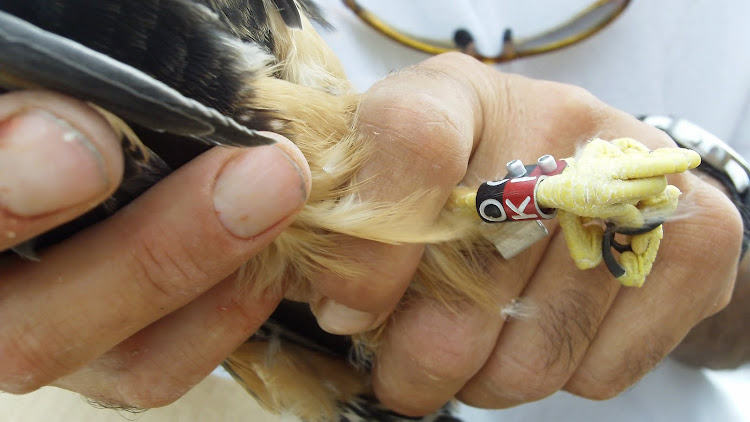
From the AOL Birding Community newsletter:
Bands attached to penguins’ flippers have helped scientists track their movement and migration for 50 years. Now, a new study reports that the seemingly innocuous bands have a significant effect on penguin mortality. Over a decade, flipper-banded penguins produced 39 percent fewer chicks and had a 44 percent lower survival rate, compared with penguins that did not have bands but had microchips inserted under the skin, according to the study, which appears in the journal Nature. That’s because the bands cause drag as penguins swim, and they are unable to gather food as efficiently for themselves or their chicks, said Claire Saraux, the study’s lead author and a biologist at the French National Center for Scientific Research and the University of Strasbourg.
New York Times
A NPR radio show on the subject of bands harming penguins can be heard at:
NPR.org
Showing posts with label penguin. Show all posts
Showing posts with label penguin. Show all posts
Wednesday, February 2, 2011


Thursday, January 20, 2011
When bands are bad...
Penguins tagged by scientists with metal bands 'die more quickly and have fewer chicks'
...what a headline! It seems there's a bit of controversy over band types (for example, single flipper band vs. double flipper band) and whether or not different band materials impact other species in detrimental ways.
There's definitely an ethical challenge here - and it's not really in the comments, since most folks aren't familiar with the intimate details of banding - but it remains to be seen whether or not there will be any significant changes in the way King Penguins are studied. Implants may be the most ethical method for now; but it's also important to gather and compare this sort of data so we CAN know what impact banding is having on its subjects.
...what a headline! It seems there's a bit of controversy over band types (for example, single flipper band vs. double flipper band) and whether or not different band materials impact other species in detrimental ways.
The researchers followed 50 banded adult penguins and 50 unbanded birds for 10 years, tracking them with under-the-skin transponders.
Thirty six per cent of the non-banded survived for 10 years, compared to only 20 per cent of the band-wearing birds.
Penguins generally live for around 20 years although King penguins - among the largest penguins at 3ft tall - can live even longer.
The non-banded penguins had 80 chicks, while the banded seabirds produced 47 chicks, a 41 per cent drop.
There's definitely an ethical challenge here - and it's not really in the comments, since most folks aren't familiar with the intimate details of banding - but it remains to be seen whether or not there will be any significant changes in the way King Penguins are studied. Implants may be the most ethical method for now; but it's also important to gather and compare this sort of data so we CAN know what impact banding is having on its subjects.
Subscribe to:
Posts (Atom)

