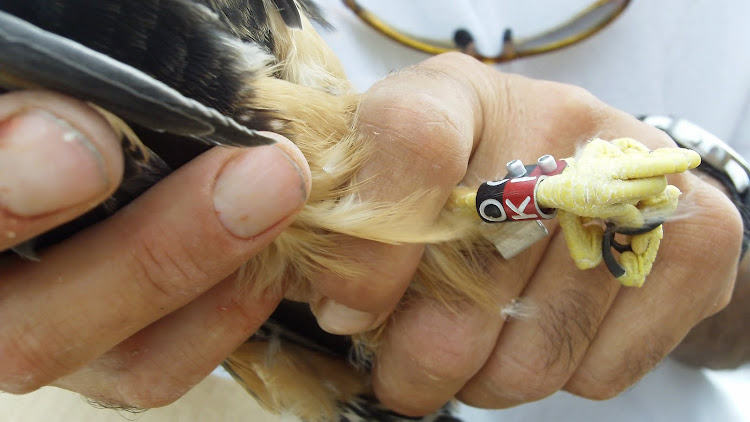
Thanks to eBird.org for this news of an 8 and a half year old Northern Shrike!
http://ebird.org/content/wi/news/the-oldest-northern-shrike-in-north-america
Showing posts with label color bands. Show all posts
Showing posts with label color bands. Show all posts
Wednesday, January 16, 2013


Sunday, August 26, 2012
American Oystercatcher adventures
What is black and white and red all over?
Ok, really it's black and brown and red and white with slightly pinkish/pale legs.
The American Oystercatcher - it is a bold, stocky shorebird with a red beak (or red bill, if you prefer), black head and neck, dark brown back and bright white belly. You are most likely to see them along a salty coastline or marsh and... yes, they will be eating bivalves.
Map via allaboutbirds.org

After a flurry of recent posts about shorebirds, I was contacted by one of the project database gurus with some additional information - hopefully this increased awareness and ease of reporting will get more reports rolling in! Without further delay....
***
I came across your blog while surfing, and I thought I'd write to let you know where people can submit color-banded American Oystercatcher sightings. You may already know, but there is a working group for the species which works to coordinate and facilitate rangewide research. One part of that research has been the color-banding of birds from almost all states in which they occur. Members of the public who sight a banded American Oystercatcher can report their bands at www.amoywg.org (under "Bands & Resighting -> "Report Form").
The reports will go into the working group's database of American Oystercatcher band records (captures and resightings). I curate band sightings submitted by the public, checking them for accuracy as much as possible before adding them to the working group's database, which
includes all band records from all states. If people include an email address, we write back to tell them where their bird was banded or sighted. It's easy to submit a band, and users can upload a picture as well. There will be some changes to the form, as the database is being finalized, but the website address will remain the same.
Thanks,
Lindsay
Ok, really it's black and brown and red and white with slightly pinkish/pale legs.
The American Oystercatcher - it is a bold, stocky shorebird with a red beak (or red bill, if you prefer), black head and neck, dark brown back and bright white belly. You are most likely to see them along a salty coastline or marsh and... yes, they will be eating bivalves.
Map via allaboutbirds.org
After a flurry of recent posts about shorebirds, I was contacted by one of the project database gurus with some additional information - hopefully this increased awareness and ease of reporting will get more reports rolling in! Without further delay....
***
 |
| American Oystercatcher photo courtesy of Lindsay Addison |
I came across your blog while surfing, and I thought I'd write to let you know where people can submit color-banded American Oystercatcher sightings. You may already know, but there is a working group for the species which works to coordinate and facilitate rangewide research. One part of that research has been the color-banding of birds from almost all states in which they occur. Members of the public who sight a banded American Oystercatcher can report their bands at www.amoywg.org (under "Bands & Resighting -> "Report Form").
The reports will go into the working group's database of American Oystercatcher band records (captures and resightings). I curate band sightings submitted by the public, checking them for accuracy as much as possible before adding them to the working group's database, which
includes all band records from all states. If people include an email address, we write back to tell them where their bird was banded or sighted. It's easy to submit a band, and users can upload a picture as well. There will be some changes to the form, as the database is being finalized, but the website address will remain the same.
Thanks,
Lindsay
Lindsay Addison
Coastal Biologist
Audubon North Carolina
7741 Market Street, Unit D
Wilmington, NC, 28411-9444
Tel: (910) 686-7527
Fax: (910) 686-7587
laddison at audubon dot org
Wednesday, August 15, 2012
Texas - oystercatcher update
It's no secret - I'm a HUGE fan of the Gulf Coast Bird Observatory - they have fantastic outreach programs to familiarize the public with research (not sure if the Xtreme Hummingbird Xtravaganza has been covered on this blog before, but it needs to happen!)
There's a great effort put forth by GCBO to track American Oystercatchers along the Upper and Central Texas coast, the e-mail below is from one of the staff biologists who has made the project very approachable by folks who see any of 'their' birds. It's so refreshing to not only have the transparency of "this project exists" but also "here's where to look up more information" - it's wonderful for the curious!
Without further delay...
***
13 August 2012
TexBirders,
As many of you know, GCBO has an ongoing project studying American Oystercatchers on the Upper and Central coasts. The breeding season is over for this species now and so they will begin to wander between now and December/January when they pair up and start defending their territories again. This year we had a Texas State student working on the upper coast and a Texas A&M student working on the central coast. All told we have now banded 125 adult and 58 chick oystercatchers. Chicks can be told from full adults by having black on their bills. Chicks from last year still have a small amount of black on their bill so if you look closely you should be able to tell them apart from full adults still. I would greatly appreciate everyone checking the legs of oystercatchers that they see for bands. They are banded on each leg above the ankle (what appears to be knee) with identical maroon color bands that have two codes on them. The codes are either two numbers, two letters, or a letter and a number combination. Again, the codes on each leg are identical. These bands can be hard to see unless you look closely. I'd appreciate any sightings of banded oystercatchers be sent to me. Photos are greatly appreciated. This helps is track movements of this species during the non-breeding season and also chick movements which are very important for conservation. You can see what the bands look like and read about this project on our website here:
http://www.gcbo.org/default.aspx/MenuItemID/246/MenuGroup/Home.htm
There is also a link to a spreadsheet which has information about where each bird was banded.
Thanks everyone.
Sue
Susan A. Heath, PhD
Gulf Coast Bird Observatory
103 Hwy 332 West
Lake Jackson, TX 77566
979-480-0999
www.gcbo.org
There's a great effort put forth by GCBO to track American Oystercatchers along the Upper and Central Texas coast, the e-mail below is from one of the staff biologists who has made the project very approachable by folks who see any of 'their' birds. It's so refreshing to not only have the transparency of "this project exists" but also "here's where to look up more information" - it's wonderful for the curious!
Without further delay...
***
13 August 2012
TexBirders,
As many of you know, GCBO has an ongoing project studying American Oystercatchers on the Upper and Central coasts. The breeding season is over for this species now and so they will begin to wander between now and December/January when they pair up and start defending their territories again. This year we had a Texas State student working on the upper coast and a Texas A&M student working on the central coast. All told we have now banded 125 adult and 58 chick oystercatchers. Chicks can be told from full adults by having black on their bills. Chicks from last year still have a small amount of black on their bill so if you look closely you should be able to tell them apart from full adults still. I would greatly appreciate everyone checking the legs of oystercatchers that they see for bands. They are banded on each leg above the ankle (what appears to be knee) with identical maroon color bands that have two codes on them. The codes are either two numbers, two letters, or a letter and a number combination. Again, the codes on each leg are identical. These bands can be hard to see unless you look closely. I'd appreciate any sightings of banded oystercatchers be sent to me. Photos are greatly appreciated. This helps is track movements of this species during the non-breeding season and also chick movements which are very important for conservation. You can see what the bands look like and read about this project on our website here:
http://www.gcbo.org/default.aspx/MenuItemID/246/MenuGroup/Home.htm
There is also a link to a spreadsheet which has information about where each bird was banded.
Thanks everyone.
Sue
Susan A. Heath, PhD
Gulf Coast Bird Observatory
103 Hwy 332 West
Lake Jackson, TX 77566
979-480-0999
www.gcbo.org
Thursday, July 12, 2012
banded Prarie Warblers at Montague Sandplains IBA
Via Birding is Fun: banded Prairie Warblers at Montague Sandplains IBA.
No word on their background, or the project - but with multiple banded birds around, it's likely a target species for a study.
No word on their background, or the project - but with multiple banded birds around, it's likely a target species for a study.
Tuesday, April 3, 2012
Scissor-tailed Flycatchers around Oklahoma
For folks who are wondering about where young Scissor-tailed Flycatchers go, here's a study trying to determine just that! So keep an eye out for banded STFL!
***
From: dvl04 AT hotmail.com
Sent: Saturday, March 31, 2012 10:42 PM
To: OKBIRDS AT LISTS.OU.EDU
Subject: [OKBIRDS] Scissor-tailed Flycatchers to watch for
Hi, OKbirders!
My name is Diane Landoll and I am a PhD student at the University of Oklahoma. I have been studying Scissor-tailed Flycatchers for four years now, and this has included banding birds with aluminum USGS bands. Many birds were also banded with a combination of three other colored bands, one on the leg with the aluminum band and two on the other leg. I would like to ask for everyone's help in trying to freight these birds. I am hoping to see where young birds are going because they do not return to the area of their birth. I am also trying to figure out a rough idea of when they arrive back in the area and the route they take to get there. Since there have already been a few sightings (I saw two beautiful male today on Lawton!), now is the time to see if any banded birds from previous years are making it back to us!
What I am asking is that if you see any Scissor-tailed Flycatchers and are interested in figuring out if they are banded, try to get a look at their legs to see if they have an aluminum band only or an aluminum band and color bands. The colors can be difficult to make out sometimes, specially since the birds tend to sit on their legs a bit, so it might be a fun challenge. It always is for me, but that is really part of what makes it so fun. If you do see any banded birds, please let me know as soon as possible. If you can figure out what the color combination is, that would be amazing, but simply knowing where our banded birds are is a great help. If you do try to figure out color combinations, knowing the position of each color and which leg they are on is very important in figuring out exactly which bird it is. For example, a bird might have an aluminum band on top of a red band (so that the red band is the one nearer the foot) on its right leg and a purple band over a blue band on its left leg. If you are able to get a picture of the birds and its bands, that is even better.
Of you do see any banded birds, please let me know at this email address (dvl04 AT hotmail.com). Thank you all in advance for any help. Any sightings are very valuable and will help us get a better understanding of our magnificent state bird.
Thanks again, and good birding!
Diane Landoll
PhD Student
University of Oklahoma
***
From: dvl04 AT hotmail.com
Sent: Saturday, March 31, 2012 10:42 PM
To: OKBIRDS AT LISTS.OU.EDU
Subject: [OKBIRDS] Scissor-tailed Flycatchers to watch for
Hi, OKbirders!
My name is Diane Landoll and I am a PhD student at the University of Oklahoma. I have been studying Scissor-tailed Flycatchers for four years now, and this has included banding birds with aluminum USGS bands. Many birds were also banded with a combination of three other colored bands, one on the leg with the aluminum band and two on the other leg. I would like to ask for everyone's help in trying to freight these birds. I am hoping to see where young birds are going because they do not return to the area of their birth. I am also trying to figure out a rough idea of when they arrive back in the area and the route they take to get there. Since there have already been a few sightings (I saw two beautiful male today on Lawton!), now is the time to see if any banded birds from previous years are making it back to us!
What I am asking is that if you see any Scissor-tailed Flycatchers and are interested in figuring out if they are banded, try to get a look at their legs to see if they have an aluminum band only or an aluminum band and color bands. The colors can be difficult to make out sometimes, specially since the birds tend to sit on their legs a bit, so it might be a fun challenge. It always is for me, but that is really part of what makes it so fun. If you do see any banded birds, please let me know as soon as possible. If you can figure out what the color combination is, that would be amazing, but simply knowing where our banded birds are is a great help. If you do try to figure out color combinations, knowing the position of each color and which leg they are on is very important in figuring out exactly which bird it is. For example, a bird might have an aluminum band on top of a red band (so that the red band is the one nearer the foot) on its right leg and a purple band over a blue band on its left leg. If you are able to get a picture of the birds and its bands, that is even better.
Of you do see any banded birds, please let me know at this email address (dvl04 AT hotmail.com). Thank you all in advance for any help. Any sightings are very valuable and will help us get a better understanding of our magnificent state bird.
Thanks again, and good birding!
Diane Landoll
PhD Student
University of Oklahoma
Tuesday, March 13, 2012
Look for banded Golden-cheeked Warblers!
From a Texbirds post, re: a banded Golden-cheeked Warbler photographed by Sean Paul Kelly (click here for the photos) "This bird is part of the Balcones Canyonlands Preserve Golden-cheeked Warbler study that is now going on. This bird was banded last year on April 20th at Emma Long Park."
Subject: banded Golden-cheeked Warblers
From: Bill Reiner (spizella/AT/SBCGLOBAL/./NET)
Date: Mon, 12 Mar 2012 20:45:18 -0700
TexBirders,
I had a feeling I needed to send out this message pronto, and it seems I am one day late. But thanks to Mr. Kelley, for asking the question, and for posting those photos of the banded Golden-cheeked Warbler in Emma Long Park this morning! (And also thanks to the quick-responding TexBirders who alerted me to his post.)
The bird Mr. Kelley photographed is one of more than 350 Golden-cheeked Warblers that have been banded by biologists on study plots scattered across the Balcones Canyonlands Preserve, on the west side of Austin, over the past three years. The vast majority of the banded birds have been males, but a few females have also been banded. Biologists at Fort Hood have banded even more individuals of this species, over an even longer time. The goals of the studies in these two locations have included learning more about the survival rates, age ratios, and dispersal of these endangered birds.
Some of the plots where Golden-cheeks have been banded around Austin are in areas open to the public, such as Emma Long Park (Turkey Creek Trail), Barton Creek Greenbelt (Sculpture Falls area), Saint Edwards Park, and, for the first time last year, Wild Basin. However, the birds returning from their winter ranges could turn up anywhere (even South Padre Island!), so please look closely at the legs of any Golden-cheeked Warbler you spot. A banded warbler will have one numbered aluminum band (don’t even try to read it with binoculars) and two or three colored resin or plastic bands to allow for recognition of individuals in the field. If you do see a banded Golden-cheeked Warbler, I will be very happy to hear about it, and can direct the information to the biologists -- either at Fort Hood or here in Austin -- who banded it. The best place to contact me is: william.reiner AT austintexas.gov
Information to provide:
1) What color bands in what order. Banders read bands as: upper left leg/lower left leg : upper right leg/lower right leg. So, for example, Mr. Kelley's bird is red/orange : white/silver. Colors are not always what they appear at first glance, so a photograph is always welcome, if it's possible. Colors can often be misread. Legs can be mixed up -- it's the bird's left and right legs, not which is right or left as you are looking at it. Even upper and lower can be confused depending upon your vantage point. Because of the potential for confusion, it is also very important to give us...
2) The location of the bird. A GPS position would be very helpful to pinpoint its location, but if this is not possible, landmarks along a trail or road or other feature can greatly help us to relocate the individual and verify its identity.
If you want to help even more with this project, please come volunteer with us!
The BCP biologists cannot possibly watch all the suitable habitat on the Preserve, so we are seeking experienced birders willing to devote at least 3 field days this spring to searching for banded warblers. Volunteers will have the opportunity to explore a part of the Balcones Canyonlands Preserve that is not normally open to the public. Several birders are already trained and ready to go this spring, but, because we banded birds on new plots last year, we still need people to look for returning birds on the outskirts of those plots. If you have the time and the interest, please contact me at the e-mail address above.
Thank you,
Bill Reiner, field biologist
Balcones Canyonlands Preserve
City of Austin
(512) 972-1676
Subject: banded Golden-cheeked Warblers
From: Bill Reiner (spizella/AT/SBCGLOBAL/./NET)
Date: Mon, 12 Mar 2012 20:45:18 -0700
TexBirders,
I had a feeling I needed to send out this message pronto, and it seems I am one day late. But thanks to Mr. Kelley, for asking the question, and for posting those photos of the banded Golden-cheeked Warbler in Emma Long Park this morning! (And also thanks to the quick-responding TexBirders who alerted me to his post.)
The bird Mr. Kelley photographed is one of more than 350 Golden-cheeked Warblers that have been banded by biologists on study plots scattered across the Balcones Canyonlands Preserve, on the west side of Austin, over the past three years. The vast majority of the banded birds have been males, but a few females have also been banded. Biologists at Fort Hood have banded even more individuals of this species, over an even longer time. The goals of the studies in these two locations have included learning more about the survival rates, age ratios, and dispersal of these endangered birds.
Some of the plots where Golden-cheeks have been banded around Austin are in areas open to the public, such as Emma Long Park (Turkey Creek Trail), Barton Creek Greenbelt (Sculpture Falls area), Saint Edwards Park, and, for the first time last year, Wild Basin. However, the birds returning from their winter ranges could turn up anywhere (even South Padre Island!), so please look closely at the legs of any Golden-cheeked Warbler you spot. A banded warbler will have one numbered aluminum band (don’t even try to read it with binoculars) and two or three colored resin or plastic bands to allow for recognition of individuals in the field. If you do see a banded Golden-cheeked Warbler, I will be very happy to hear about it, and can direct the information to the biologists -- either at Fort Hood or here in Austin -- who banded it. The best place to contact me is: william.reiner AT austintexas.gov
Information to provide:
1) What color bands in what order. Banders read bands as: upper left leg/lower left leg : upper right leg/lower right leg. So, for example, Mr. Kelley's bird is red/orange : white/silver. Colors are not always what they appear at first glance, so a photograph is always welcome, if it's possible. Colors can often be misread. Legs can be mixed up -- it's the bird's left and right legs, not which is right or left as you are looking at it. Even upper and lower can be confused depending upon your vantage point. Because of the potential for confusion, it is also very important to give us...
2) The location of the bird. A GPS position would be very helpful to pinpoint its location, but if this is not possible, landmarks along a trail or road or other feature can greatly help us to relocate the individual and verify its identity.
If you want to help even more with this project, please come volunteer with us!
The BCP biologists cannot possibly watch all the suitable habitat on the Preserve, so we are seeking experienced birders willing to devote at least 3 field days this spring to searching for banded warblers. Volunteers will have the opportunity to explore a part of the Balcones Canyonlands Preserve that is not normally open to the public. Several birders are already trained and ready to go this spring, but, because we banded birds on new plots last year, we still need people to look for returning birds on the outskirts of those plots. If you have the time and the interest, please contact me at the e-mail address above.
Thank you,
Bill Reiner, field biologist
Balcones Canyonlands Preserve
City of Austin
(512) 972-1676
Friday, August 5, 2011
Banded Osprey sightings
From the Texas wildlife rehab list:
Banded Osprey sightings
PLEASE REPORT SIGHTINGS - We banded reintroduced ospreys with blue, green and orange color bands with alpha-numeric codes during a project in southeastern South Dakota from 2004-2010. Please report sightings of birds with these color bands and codes, if possible, to EILEEN DOWD STUKEL, SD Game, Fish and Parks (EM:eileen.dowdstukel/at/state.sd. us; PH 605-773-4229) .
Banded Osprey sightings
PLEASE REPORT SIGHTINGS - We banded reintroduced ospreys with blue, green and orange color bands with alpha-numeric codes during a project in southeastern South Dakota from 2004-2010. Please report sightings of birds with these color bands and codes, if possible, to EILEEN DOWD STUKEL, SD Game, Fish and Parks (EM:eileen.dowdstukel/at/state.sd. us; PH 605-773-4229) .
Saturday, June 25, 2011
Black-necked Stilts at Anahuac NWR
This was a post on the Texbirds listserv recently; a spot close to my heart and a species that makes black & white look exotic!
***
Subject: Color-banded black-necked stilts and noteworthy sightings at Anahuac
From: Thomas Riecke (riecket13/Y)
Date: Fri, 24 Jun 2011 15:49:00
Dear Texbirders,
We have started color-banding black-necked stilts on the refuge. Band combos will be orange over aluminum over blue/red/or green (male/female/hatch year)on the right leg, and a unique combination of three color-bands on the left leg. We expect to band several hundred birds this summer and early fall. I would greatly appreciate any observers who resight marked individuals to report them by phone AT (214) 384-8085 or by email at riecket AT titan.sfasu.edu. Phone is preferred as internet access is spotty in the field. GPS coordinates would be amazing, but even a general description of the location will be more than acceptable.
In other news, Kelli Haskett and I had black rail along Frozen Point Rd. (at
the 90 degree left hand before the long straightaway that leads to the kayak
launch on the bay) while conducting frog surveys early Thursday morning, and
Steve McDowell and I had a pair of least grebes are nest-building on one of the
moist soil units on the East Unit (closed to the public).
Thomas
***
Subject: Color-banded black-necked stilts and noteworthy sightings at Anahuac
From: Thomas Riecke (riecket13/Y)
Date: Fri, 24 Jun 2011 15:49:00
Dear Texbirders,
We have started color-banding black-necked stilts on the refuge. Band combos will be orange over aluminum over blue/red/or green (male/female/hatch year)on the right leg, and a unique combination of three color-bands on the left leg. We expect to band several hundred birds this summer and early fall. I would greatly appreciate any observers who resight marked individuals to report them by phone AT (214) 384-8085 or by email at riecket AT titan.sfasu.edu. Phone is preferred as internet access is spotty in the field. GPS coordinates would be amazing, but even a general description of the location will be more than acceptable.
In other news, Kelli Haskett and I had black rail along Frozen Point Rd. (at
the 90 degree left hand before the long straightaway that leads to the kayak
launch on the bay) while conducting frog surveys early Thursday morning, and
Steve McDowell and I had a pair of least grebes are nest-building on one of the
moist soil units on the East Unit (closed to the public).
Thomas
Sunday, March 20, 2011
Piping Plovers return to Canda
Beach Birds - from On Nature magazine
The Piping Plover is small, specialized and finally returning to its former Canadian range with much help from Michigan efforts... but unless wintering grounds see a decline in similar pressures, the population is still facing precarious challenges.
Oh, yes, and color bands, leg bands and good interviews with biologists are included!
The Piping Plover is small, specialized and finally returning to its former Canadian range with much help from Michigan efforts... but unless wintering grounds see a decline in similar pressures, the population is still facing precarious challenges.
Oh, yes, and color bands, leg bands and good interviews with biologists are included!
Saturday, January 15, 2011
Colbert Nation meets banded vulture
I try to keep this blog at least mostly scientific... but for the love of witty sarcasm, I present to you:Israeli Vulture Spy
Authorities in Saudi Arabia conclude that a vulture wearing a GPS tag from the Tel Aviv University is an Israeli spy. (02:34)
See also: Israeli Vulture Spy Declared Innocent By Saudi Arabia
...the world never ceases to amaze me!
Authorities in Saudi Arabia conclude that a vulture wearing a GPS tag from the Tel Aviv University is an Israeli spy. (02:34)
| The Colbert Report | Mon - Thurs 11:30pm / 10:30c | |||
| Israeli Vulture Spy | ||||
| ||||
See also: Israeli Vulture Spy Declared Innocent By Saudi Arabia
...the world never ceases to amaze me!
Thursday, June 3, 2010
behind the Black-whiskered Vireo
In the summer of 2009, my spouse and I witnessed a very active Black-whiskered Vireo rummaging around the treetops of Dagny Johnson Key Largo Hammock Botanical State Park. Whew. What a name! Anyway, the bird and its unbanded companion were the highlight of our time on Key Largo - so naturally we reported the banded bird and waited. And waited. And finally this spring we were prompted by the Bananaquit bander (see previous post) to re-send the information.
So when we saw the bird on July 29, he had only been wearing those bands for 24 days! Right leg color bands were green over pink, left leg was [some color we couldn't make out] over silver. Since the e-mail confirms that he was actually banded where we spotted him, it's neat to see that he hung around even after being accosted and color marked.
Hi Ms. Trudell,
Thanks for getting in touch with the Bird Banding Lab to report that you saw my bird! I've sent them a bit of information regarding when and where it was banded, so I think you should be getting a certificate of appreciation from them. I banded that guy (and yes, it is a male) on July 5th of last year, at Dagny Johnson. I'm happy that you saw him! Unless I'm mistaken, it was towards the end of last July that you spotted him?
As I said, you should be hearing from the Bird Banding Lab - but I'm more than happy to tell you a bit about my research and why I was banding Black-whiskered Vireos, if you'd like to know.
Thanks again for reporting your sighting!
Catherine Dale
***********************************************************
Catherine Dale
PhD Candidate
Department of Biology
Queen's University
Kingston, Ontario
***********************************************************
So when we saw the bird on July 29, he had only been wearing those bands for 24 days! Right leg color bands were green over pink, left leg was [some color we couldn't make out] over silver. Since the e-mail confirms that he was actually banded where we spotted him, it's neat to see that he hung around even after being accosted and color marked.
Monday, May 3, 2010
from "the Marvelous in nature" to you...
Seabrooke is a nature blogger like no other (and a bander as well!). One of her recent posts is an absolute must-read for anyone curious about banding. Why is it done? Who does it? What data is collected? While her post is geared towards her specific banding site (not all locations are seasonal), it also addresses a lot of the basics.
Without further ado, "On banding birds" from the Marvelous in nature."
An excerpt from the comments:
Colored leg bands (FL Scrub Jay) and wing tags (Am. White Pelican) are what this blog was started for - the ridiculously neat birds we've spotted in our adventures. Hopefully your path will cross with some of these critters, their stories are all unique and definitely worth the effort to look up!
Without further ado, "On banding birds" from the Marvelous in nature."
An excerpt from the comments:
...a bird in its lifetime only ever gets the one silver, numbered band, unless that one is so old, and so worn, that the numbers are hard to read, in which case it’s removed and replaced. It only ever wears one at a time, though. Some projects will also put coloured plastic bands on them in addition to the silver ones, to make them easier to identify from a distance...
Colored leg bands (FL Scrub Jay) and wing tags (Am. White Pelican) are what this blog was started for - the ridiculously neat birds we've spotted in our adventures. Hopefully your path will cross with some of these critters, their stories are all unique and definitely worth the effort to look up!
Tuesday, March 30, 2010
Pending: Irish Robin
So the month of March doesn't echo like a hollow well, here's a taste of what will hopefully be the next post: Andrea's Robin, from her "Ireland, day 2" post
Andrea is a student from Florida who has been studying abroad; I'll let her provide any additional details. The thrill that I felt when I saw her post was twofold because not only did she get to see and photograph a very cooperative Robin (also European Robin, Erithacus rubecula), it's color banded in addition to the metal band! So even without getting a look at the metal band's numbers, there's a pretty decent chance of tracking this individual. (Kind of like the last full post with the Florida Scrub Jay!)
Hopefully I'll even get some links up for Euring (edit: voila, EURING is now in the sidebar!) so this blog can be less North-American-centric =)
Andrea is a student from Florida who has been studying abroad; I'll let her provide any additional details. The thrill that I felt when I saw her post was twofold because not only did she get to see and photograph a very cooperative Robin (also European Robin, Erithacus rubecula), it's color banded in addition to the metal band! So even without getting a look at the metal band's numbers, there's a pretty decent chance of tracking this individual. (Kind of like the last full post with the Florida Scrub Jay!)
Hopefully I'll even get some links up for Euring (edit: voila, EURING is now in the sidebar!) so this blog can be less North-American-centric =)
Saturday, February 27, 2010
FL Scrub Jay paper trail
(originally posted at Seetrail) I can't believe I didn't post this when the e-mail came in, but here's a look behind one Florida Scrub Jay (from Matt's Scrub-Jays, the Floridians post)
A few details are omitted for privacy, but this is a fascinating look at what goes on in the background! We knew the odds were good that this bird had a story - every jay at Oscar Scherer State Park is banded, but hey, why not look into it?
Here's the bird in question:

And here's the series of e-mails in chronological order:
USGS-PATUXENT WILDLIFE RESEARCH CENTER
12100 Beech Forest Road
Laurel, Maryland 20708-4037
FAX 301-497-5717
AUGUST 11, 2009
In Reply Refer To: BLL-19.2A
Dear Ms B,
The United States Geological Survey authorizes and coordinates the use of auxiliary-marking devices on all wild, migratory birds. Such devices allow researchers to identify individual or groups of birds from a distance, thus helping them in their studies of various aspects of avian biology.
Enclosed is copy of a letter reporting an auxiliary-marked bird. Our records indicate that you are using markers of this type. Because there is no way from this sighting to identify the individual bird to a specific band number, we will not be able to provide the observer with a certificate. If you believe this to be a bird you marked, it is imperative that you contact the observer with any information you have concerning your studies. If this marker is not yours, please accept our apologies and notify me. If you know of another researcher using similar markers, please indicate the name and/or permit number on the letter.
We have provided a copy of this letter to the observer, who will be anticipating your prompt response.
Sincerely,
D B, Biologist
Bird Banding Laboratory
See ORIGINAL REPORT below:
ORIGINAL REPORT
Email Address: h.trudell [at] gmail [dot] com
Type: color leg band w/o codes
Species: Florida Scrub Jay
Marker Color: white
Other Marker Color:
Code Color: white
Other Code Color:
Pattern of Codes: row
Row:
Top:
Bottom:
Upright:
Sideways:
Other:
Web:
Radio:
How Code: live bird how 29/pres cond 07
How Other:
Recovery Date Type: Exact
Exact Date: 26/07/09
Inexact Date of Recovery:
Recovery Location Descript: Oscar Scherer State Park, the "scrub jay" loop
Recovery Location: USA
Other Country:
State: Florida
County: Sarasota
Miles: 3
Direction: SE
Town: Osprey, FL
Name: H Trudell
Street 1: [street]
Street 2:
City: Waco
State: TX
Zip:
Country:
Phone Number:
Fax Number:
Comment: Right leg was white band over silver/service band, left leg had no bands.
***
From: B, J
Sent: Tuesday, August 11, 2009 12:44 PM
To: M, K
Subject: FW: BLL-192.A: STATE OF FLORIDA - NONGAME / MS B (21980)
These are fun…..do you know this bird?
***
From: M, K
Sent: Tuesday, August 11, 2009 12:46 PM
To: B, J
Subject: RE: BLL-192.A: STATE OF FLORIDA - NONGAME / MS J B (21980)
Probably banded at Oscar Scherer by T H.
-K
__________________
K M, Ph.D.
Upland Nongame Bird Lead
Wildlife Research Laboratory - FWRI
Florida Fish & Wildlife Conservation Commission
***
from H, T
to "H. Trudell"
cc KM, JB, RD
date Wed, Aug 12, 2009 at 11:43 AM
subject RE: Banded Florida scrub-jay
Hello,
We conduct a monthly census of Florida Scrub-jays at Oscar Scherer State Park.
We have not recently had a bird identified with a White over Silver/service, and no bands on the left leg.
However, we do have a bird identified with a Flesh over Silver/service on its right leg, and no bands on its left leg.
This bird was banded at Oscar Scherer State Park on March 24, 1999, and the flesh band has faded.
The bird is currently the male breeder in its territory in the vicinity of the campground.
T H
Environmental Specialist III
District 4, Florida Park Service
Department of Environmental Protection
***
So there you have it - an adult male bird who has been rockin' OSSP for over 10 years now! I'm glad I didn't just get a certificate, it's so much more fun to hear the details. It didn't take much sleuthing for the bander to let us know that the "flesh" band had faded to white, but that's the sort of thing that regular monitoring tells you. Not bad, for 10 years of sun bleaching in Florida.
What a handsome fellow.
A few details are omitted for privacy, but this is a fascinating look at what goes on in the background! We knew the odds were good that this bird had a story - every jay at Oscar Scherer State Park is banded, but hey, why not look into it?
Here's the bird in question:
And here's the series of e-mails in chronological order:
USGS-PATUXENT WILDLIFE RESEARCH CENTER
12100 Beech Forest Road
Laurel, Maryland 20708-4037
FAX 301-497-5717
AUGUST 11, 2009
In Reply Refer To: BLL-19.2A
Dear Ms B,
The United States Geological Survey authorizes and coordinates the use of auxiliary-marking devices on all wild, migratory birds. Such devices allow researchers to identify individual or groups of birds from a distance, thus helping them in their studies of various aspects of avian biology.
Enclosed is copy of a letter reporting an auxiliary-marked bird. Our records indicate that you are using markers of this type. Because there is no way from this sighting to identify the individual bird to a specific band number, we will not be able to provide the observer with a certificate. If you believe this to be a bird you marked, it is imperative that you contact the observer with any information you have concerning your studies. If this marker is not yours, please accept our apologies and notify me. If you know of another researcher using similar markers, please indicate the name and/or permit number on the letter.
We have provided a copy of this letter to the observer, who will be anticipating your prompt response.
Sincerely,
D B, Biologist
Bird Banding Laboratory
See ORIGINAL REPORT below:
ORIGINAL REPORT
Email Address: h.trudell [at] gmail [dot] com
Type: color leg band w/o codes
Species: Florida Scrub Jay
Marker Color: white
Other Marker Color:
Code Color: white
Other Code Color:
Pattern of Codes: row
Row:
Top:
Bottom:
Upright:
Sideways:
Other:
Web:
Radio:
How Code: live bird how 29/pres cond 07
How Other:
Recovery Date Type: Exact
Exact Date: 26/07/09
Inexact Date of Recovery:
Recovery Location Descript: Oscar Scherer State Park, the "scrub jay" loop
Recovery Location: USA
Other Country:
State: Florida
County: Sarasota
Miles: 3
Direction: SE
Town: Osprey, FL
Name: H Trudell
Street 1: [street]
Street 2:
City: Waco
State: TX
Zip:
Country:
Phone Number:
Fax Number:
Comment: Right leg was white band over silver/service band, left leg had no bands.
***
From: B, J
Sent: Tuesday, August 11, 2009 12:44 PM
To: M, K
Subject: FW: BLL-192.A: STATE OF FLORIDA - NONGAME / MS B (21980)
These are fun…..do you know this bird?
***
From: M, K
Sent: Tuesday, August 11, 2009 12:46 PM
To: B, J
Subject: RE: BLL-192.A: STATE OF FLORIDA - NONGAME / MS J B (21980)
Probably banded at Oscar Scherer by T H.
-K
__________________
K M, Ph.D.
Upland Nongame Bird Lead
Wildlife Research Laboratory - FWRI
Florida Fish & Wildlife Conservation Commission
***
from H, T
to "H. Trudell"
cc KM, JB, RD
date Wed, Aug 12, 2009 at 11:43 AM
subject RE: Banded Florida scrub-jay
Hello,
We conduct a monthly census of Florida Scrub-jays at Oscar Scherer State Park.
We have not recently had a bird identified with a White over Silver/service, and no bands on the left leg.
However, we do have a bird identified with a Flesh over Silver/service on its right leg, and no bands on its left leg.
This bird was banded at Oscar Scherer State Park on March 24, 1999, and the flesh band has faded.
The bird is currently the male breeder in its territory in the vicinity of the campground.
T H
Environmental Specialist III
District 4, Florida Park Service
Department of Environmental Protection
***
So there you have it - an adult male bird who has been rockin' OSSP for over 10 years now! I'm glad I didn't just get a certificate, it's so much more fun to hear the details. It didn't take much sleuthing for the bander to let us know that the "flesh" band had faded to white, but that's the sort of thing that regular monitoring tells you. Not bad, for 10 years of sun bleaching in Florida.
What a handsome fellow.
Subscribe to:
Posts (Atom)

