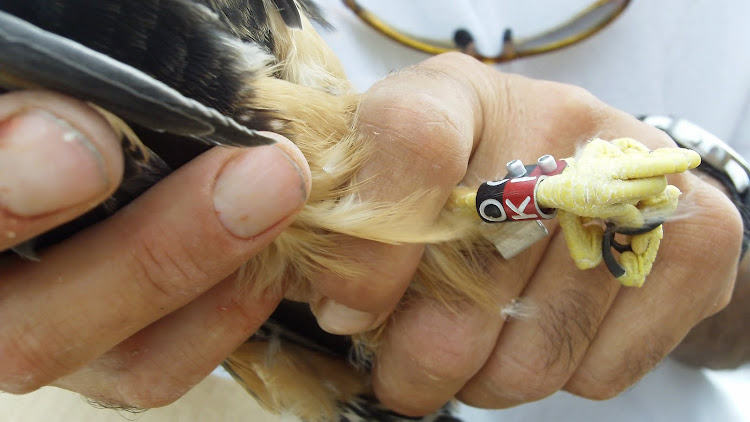
The Western Hemisphere Shorebird Reserve Network has a fantastic reference page, mentioned in the previous post, Birding for Banded Shorebirds - it's worth printing out and keeping a copy on hand if you bird coastal areas much.
So when I came across another note on banded shorebirds, I had to share that link again before adding an article about Red Knots (Calidris canutus) from the Corpus Christi area.
Bag 'em, flag 'em and tag 'em
Coastal Bend bird biologist tracking red knots
Keep your eyes open! Red Knots are seriously declining and research like this is helping track the populations as they migrate globally.
Friday, October 15, 2010


Sunday, October 10, 2010
Birding for Banded Birds
This post was an e-mail to Texbirds in mid September, it is posted here with permission from Brent - enjoy!
****
Birding for Banded Birds
Sat Sep 11 12:46:36 2010
Birding for Banded Shorebirds
Several times per year people ask how to report banded birds. Many of the banded birds that have color markers are shorebirds. It is not difficult to locate a color marked bird and the information is very useful to the researchers and can be quite interesting to the reporter.
A recent report from the Western Hemisphere Shorebird Reserve Network is pasted above for your use.
A number of color marking programs in which I am familiar are for Piping Plover, Snowy Plover, Red Knot, Long-billed Curlew, Reddish Egret, Black Skimmer, Purple Martin, hummingbirds, Turkey Vulture, Black-capped Vireo.
Brent Ortego
Victoria, TX
****
Birding for Banded Birds
Sat Sep 11 12:46:36 2010
Birding for Banded Shorebirds
Several times per year people ask how to report banded birds. Many of the banded birds that have color markers are shorebirds. It is not difficult to locate a color marked bird and the information is very useful to the researchers and can be quite interesting to the reporter.
A recent report from the Western Hemisphere Shorebird Reserve Network is pasted above for your use.
A number of color marking programs in which I am familiar are for Piping Plover, Snowy Plover, Red Knot, Long-billed Curlew, Reddish Egret, Black Skimmer, Purple Martin, hummingbirds, Turkey Vulture, Black-capped Vireo.
Brent Ortego
Victoria, TX
Thursday, September 30, 2010
Short-tailed Albatross as 'bycatch'
Here's a press release from the American Bird Conservancy:
Short-tailed Albatross Death on Longline Hook Underscores Need for Revamped Alaskan Fisheries Observer Program
The last two paragraphs from the post:
(emphasis mine)
Short-tailed Albatross Death on Longline Hook Underscores Need for Revamped Alaskan Fisheries Observer Program
The last two paragraphs from the post:
The albatross killed in the Bering Sea wore a metal leg band identifying it as a 7 ½ year old bird from Torishima Island in Japan, where the majority of Short-tailed Albatrosses breed.
The Short-tailed Albatross was once the most abundant of the North Pacific albatross species, numbering more than a million birds. It was decimated by feather hunting at the turn of the 20th Century, and by the late 1940s was thought to be extinct. In the early 1950s, ten pairs were discovered breeding on Torishima, and the population has now reached 3,000 individuals. For the last five years, the Short-tailed Albatross Recovery Team, an international group of collaborators, have been working on establishing a colony that is safe from volcanic activity and other problems.
(emphasis mine)
Saturday, September 18, 2010
Yellow-crowned Night Herons
I am absolutely enthralled with the idea of banding all rehab birds. It's not common by any means but a group in Houston, WR&E, participates when it comes to Yellow-crowned Night Herons. They're a fantastic species to observe hunting, and they often congregate in populated areas along the coast (many wading birds prefer undisturbed habitats) so they're ideal for a project like banding.
Without further delay: Ongoing Research from Wildlife Rehab & Education
Without further delay: Ongoing Research from Wildlife Rehab & Education
Sunday, September 5, 2010
correspondence - MI birds
Greetings.
I have been meaning to pass along our page of recoveries of banded birds from the Rouge River Bird Observatory outside Detroit, MI. This page has a map of recoveries outside of Michigan, and there are a couple links on the sidebar of stories about one of our waterthrushes being recovered, and our recovery of a kinglet from Toronto that your readers might find interesting:
Rouge River Bird Observatory band resightings
Thanks for promoting the reporting of bands!
--
Julie A. Craves
Rouge River Bird Observatory
University of Michigan-Dearborn
http://www.rrbo.org
http://net-results.blogspot.com
http://twitter.com/RRBO
I have been meaning to pass along our page of recoveries of banded birds from the Rouge River Bird Observatory outside Detroit, MI. This page has a map of recoveries outside of Michigan, and there are a couple links on the sidebar of stories about one of our waterthrushes being recovered, and our recovery of a kinglet from Toronto that your readers might find interesting:
Rouge River Bird Observatory band resightings
Thanks for promoting the reporting of bands!
--
Julie A. Craves
Rouge River Bird Observatory
University of Michigan-Dearborn
http://www.rrbo.org
http://net-results.blogspot.com
http://twitter.com/RRBO
Tuesday, August 17, 2010
hummer followup
Fred granted me permission to share these e-mails on the blog, the first on August 3rd and the second on August 9th. Enjoy!
Thanks for sharing this information with others. It is such good publicity for what we are doing in addition to being a remarkable record. I can't wait to see if she returns to Tallahassee this winter, that would be fantastic.
We are lucky that hummers are so loved by their hosts, they become a part of their family. This makes it a lot easier to find people willing to let us band "their" winter guests. Hopefully all this attention will increase the number of people that leave feeders up in the winter and let us know when they have a bird in their yard. Like its been said, "you never know what you'll find out when you put a band on a bird's leg"
Fred Dietrich
***
I just got back from West Virginia where Bob Sargent was training new hummingbird banders. One of the birds we caught had been banded previously, but it was a different series than ones that had been used at this site before. It turned out that the bird had been banded by another member of our crew in Pell City, Alabama on September 1, 2009. That is about 500 miles SSW of where it was recaptured and it appears to be right on schedule on it's migration.
Fred
***
The hummingbird in the Aug. 9th e-mail is Ruby-throated. This sort of recapture event is exciting for everyone because it does show active, annual migration that can be tracked in one individual as a representative for others of its species.
Thanks for sharing this information with others. It is such good publicity for what we are doing in addition to being a remarkable record. I can't wait to see if she returns to Tallahassee this winter, that would be fantastic.
We are lucky that hummers are so loved by their hosts, they become a part of their family. This makes it a lot easier to find people willing to let us band "their" winter guests. Hopefully all this attention will increase the number of people that leave feeders up in the winter and let us know when they have a bird in their yard. Like its been said, "you never know what you'll find out when you put a band on a bird's leg"
Fred Dietrich
***
I just got back from West Virginia where Bob Sargent was training new hummingbird banders. One of the birds we caught had been banded previously, but it was a different series than ones that had been used at this site before. It turned out that the bird had been banded by another member of our crew in Pell City, Alabama on September 1, 2009. That is about 500 miles SSW of where it was recaptured and it appears to be right on schedule on it's migration.
Fred
***
The hummingbird in the Aug. 9th e-mail is Ruby-throated. This sort of recapture event is exciting for everyone because it does show active, annual migration that can be tracked in one individual as a representative for others of its species.
Friday, August 6, 2010
Loggerhead Shrike
REQUEST FOR ASSISTANCE
LOGGERHEAD SHRIKE SIGHTINGS – Loggerhead shrikes are declining across much of their range. In Canada, the Eastern subspecies is considered critically endangered, with less than 35 pairs found in 2009. The vast majority of pairs now breed in Ontario. An extremely active and multi-faceted recovery program is underway for this species in Ontario, including a captive breeding and release program. This program has been releasing approximately 100 juvenile shrikes annually since 2006. While much is known and has been learned about this species, a critical piece of the puzzle is still missing: where exactly do these birds spend the winter? To maximize our chances of locating wintering areas and better define migration routes we will be coloring the breast of released young produced from the captive breeding program, to make them more detectable by birders. Birds will be released over July and August. Birds will have an extensive area of their breast colored in green, blue or purple. All released birds, and a large proportion of the wild population, are also color banded. If you see a shrike with a colored breast and/or wearing bands, please report it to Wildlife Preservation Canada at (EM: jessica@wildlifepreservation.ca, PH: 519-836-9314, FX: 519-836-8840). We will need details about specific location (GPS coordinates are ideal, but not essential) and color(s) (breast and/or bands) seen.
(from OSNA http://www.osnabirds.org/on/197.htm )
LOGGERHEAD SHRIKE SIGHTINGS – Loggerhead shrikes are declining across much of their range. In Canada, the Eastern subspecies is considered critically endangered, with less than 35 pairs found in 2009. The vast majority of pairs now breed in Ontario. An extremely active and multi-faceted recovery program is underway for this species in Ontario, including a captive breeding and release program. This program has been releasing approximately 100 juvenile shrikes annually since 2006. While much is known and has been learned about this species, a critical piece of the puzzle is still missing: where exactly do these birds spend the winter? To maximize our chances of locating wintering areas and better define migration routes we will be coloring the breast of released young produced from the captive breeding program, to make them more detectable by birders. Birds will be released over July and August. Birds will have an extensive area of their breast colored in green, blue or purple. All released birds, and a large proportion of the wild population, are also color banded. If you see a shrike with a colored breast and/or wearing bands, please report it to Wildlife Preservation Canada at (EM: jessica@wildlifepreservation.ca, PH: 519-836-9314, FX: 519-836-8840). We will need details about specific location (GPS coordinates are ideal, but not essential) and color(s) (breast and/or bands) seen.
(from OSNA http://www.osnabirds.org/on/197.htm )
Tuesday, August 3, 2010
Aplomado Falcons
For all of July, August and half of September, I'm in west Texas - the project? Releasing young Northern Aplomado Falcons into the wild for The Peregrine Fund.
To read up on the project, check out "Aplomado Falcon Updates" from TPF. Or, for all of the Aplomado tagged posts at See Trail, click here.
Hopefully I'll have some exciting things to post at the end of the season, but until then, we're keeping busy!

To read up on the project, check out "Aplomado Falcon Updates" from TPF. Or, for all of the Aplomado tagged posts at See Trail, click here.
Hopefully I'll have some exciting things to post at the end of the season, but until then, we're keeping busy!
Subscribe to:
Posts (Atom)

