Thursday, January 20, 2011

When bands are bad...

Penguins tagged by scientists with metal bands 'die more quickly and have fewer chicks'

...what a headline! It seems there's a bit of controversy over band types (for example, single flipper band vs. double flipper band) and whether or not different band materials impact other species in detrimental ways.

The researchers followed 50 banded adult penguins and 50 unbanded birds for 10 years, tracking them with under-the-skin transponders.

Thirty six per cent of the non-banded survived for 10 years, compared to only 20 per cent of the band-wearing birds.

Penguins generally live for around 20 years although King penguins - among the largest penguins at 3ft tall - can live even longer.

The non-banded penguins had 80 chicks, while the banded seabirds produced 47 chicks, a 41 per cent drop.


There's definitely an ethical challenge here - and it's not really in the comments, since most folks aren't familiar with the intimate details of banding - but it remains to be seen whether or not there will be any significant changes in the way King Penguins are studied. Implants may be the most ethical method for now; but it's also important to gather and compare this sort of data so we CAN know what impact banding is having on its subjects.

Saturday, January 15, 2011

Colbert Nation meets banded vulture

I try to keep this blog at least mostly scientific... but for the love of witty sarcasm, I present to you:Israeli Vulture Spy

Authorities in Saudi Arabia conclude that a vulture wearing a GPS tag from the Tel Aviv University is an Israeli spy. (02:34)

The Colbert ReportMon - Thurs 11:30pm / 10:30c
Israeli Vulture Spy
www.colbertnation.com
Colbert Report Full EpisodesPolitical Humor & Satire BlogVideo Archive


See also: Israeli Vulture Spy Declared Innocent By Saudi Arabia

...the world never ceases to amaze me!

Friday, December 3, 2010

Osprey by satellite

Recently there's been press about Osprey migration; Backpacking Ospreys was a feature over at Cornell's Lab of Ornithology.

Their great article and map highlight the work of Dr. Bierregaard, Osprey researcher extraordinaire.
...a three-month-old female Osprey named Penelope pushed off from Martha’s Vineyard, Massachusetts, and flew, alone, 2,700 miles to French Guiana in 13 days.

That, my friends, is why Cornell's article, Backpacking Ospreys, needs to be read. And then Dr. Bierregaard's page needs to be perused. Pure, delicious, researchy goodness.

Monday, November 15, 2010

Birding Community E-Bulletin highlights

From the Birding Community E-Bulletin - Nov. 2010

LOOK FOR EGRETS WITH MARKINGS

Also in Canada, this time in southern Ontario, we have news about Great Egrets.

In the past decade, over 1,200 young Great Egrets have been banded with readable red leg-bands marked with white alpha numerics (number-number-letter) in the Great Lakes region and southward. This year, over 100 egrets were marked with very obvious orange wing-tags with similar alpha-numerics. If you see any marked egrets bearing red leg-bands or with bright orange wing-tags, please try to accurately read the number-letter combinations and report the details (where and when observed and by whom). Send any observations to: chip.weseloh@ec.gc.ca

***

BIRD HAZARD SURVEY

Researchers at Muhlenberg College in Allentown, Pennsylvania, are studying the risks and benefits to birds caused by human behavior and technology (e.g., alternative energy efforts, cats, windows, and communications) as they are perceived by Americans with varying interests in birds. The researchers do not expect those responding to the survey to know the degree of risk associated with each of these behaviors or technologies. Indeed, some consequences remain unknown. The responses on these perceived risks will help more fully understand public opinions and behavior. The responses are expected to provide tools to raise bird conservation awareness.

The anonymous online survey (which takes about 25 minutes to complete) can be found here: ( http://www.zoomerang.com/Survey/WEB22BDFEUJWXT )

Wednesday, November 10, 2010

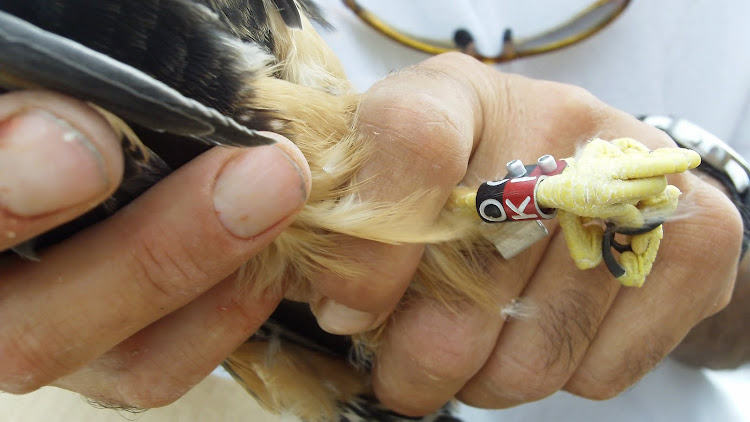
Hummingbird banding

...in November! (original link here)

Today, Wednesday, we hosted bander Kelly Bryan (of West Texas Hummingbirds) who was assisted by Carolyn Ohl of the Christmas Mountains Oasis. At 9 AM the trap was set up and within 10 minutes, the female Anna's was in hand. Before the end of the hour, the latest documented Black-chinned Hummingbird (also female) was banded and on its way!

From Kelly's e-mail prior to the banding:

There are no records beyond Oct 29 for Black-chinned and Oct 31 for Ruby-throats; however I do have two winter records for Ruby-throat (Dec for one and Jan through April for the other). ... So far I have banded 58 Anna's this fall and the last BCHU was Oct 17 and the last RTHU was Oct 4.

For those unfamiliar with banding code:
BCHU = Black-chinned Hummingbird
RTHU = Ruby-throated Hummingbird

So it goes without saying that we're thrilled to be a part of Kelly's banding research. We're even more excited that we didn't lure him all the way out here and not have a decent record for him. November 10 and two species of hummers... not so bad, eh?


...captions and further explanations will be added after a supply run and a few loads of laundry and maybe another coat of paint. Our apologies!

Friday, November 5, 2010

RFI: Bristle-thighed Curlews

From the Ornithological Society of North America comes Neswsletter #198, which includes this request:

BRISTLE-THIGHED CURLEWS COLOR-MARKED IN ALASKA –
Thirty-two Bristle-thighed Curlews were uniquely marked with coded leg flags on the breeding grounds in western Alaska in the summer of 2010 as part of a three year mark-resight project. Additional curlews will be marked during the breeding season in 2011 and 2012. The ultimate goal of this project is to collect data that will be used to estimate the current size of the curlew population breeding in the southern Nulato Hills. Each curlew has a green flag on its upper right leg and a standard federal metal band on its upper left leg. The green flag has a unique code consisting of two white characters (either two numbers or two letters). Please report all sightings to KRISTINE SOWL, Yukon Delta National Wildlife Refuge, P.O. Box 346, Bethel, Alaska 99559, USA (EM: kristine_sowl@fws.gov). Please note the date, the leg flag code, location of the bird, and its behavior. Copies of photographs of the individual may provide information on sex. Thank you for your assistance.

Wednesday, November 3, 2010

Egrets among us

Occasionally there will be a post on Texbirds (the Texas bird sighting list) about a bird with a band or tag or dye. Recently the bird in question was a white morph of the Reddish Egret.

The fellow in charge of the project, Clay Green, was fairly quickly found and kindly gave permission to post about his project here. To visit his site, click here - waterbird colony research awaits!

Because the bird is so young, there's not much data on it:
I dont know much more about the bird but it has been foraging along Texas coast since it fledged the nest in July. We have been tracking it regularly, we get latitude-longtidue fixes every 48 hours... Attached is a jpeg map of the bird's movement, we just banded it in June so it hasn't moved that much, but you can see at least where it has been going...

So this young one hatched in June of 2010, was banded in July, and this map shows through the middle of September:


With those dots representing 48 hr intervals, the huge gaps are distances covered in only two days. Dot clusters then show places that the bird loitered for extended amounts of time. I wonder if it will return to the rookery where it hatched to breed?

Friday, October 15, 2010

Knots in the news

The Western Hemisphere Shorebird Reserve Network has a fantastic reference page, mentioned in the previous post, Birding for Banded Shorebirds - it's worth printing out and keeping a copy on hand if you bird coastal areas much.

So when I came across another note on banded shorebirds, I had to share that link again before adding an article about Red Knots (Calidris canutus) from the Corpus Christi area.

Bag 'em, flag 'em and tag 'em
Coastal Bend bird biologist tracking red knots

Keep your eyes open! Red Knots are seriously declining and research like this is helping track the populations as they migrate globally.