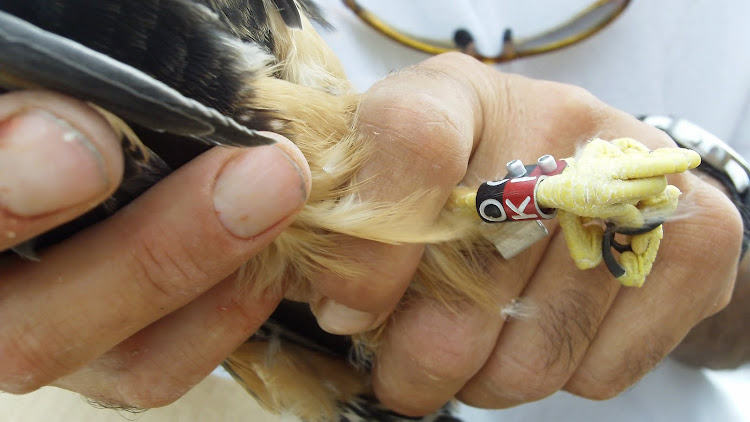
Here's a great 3 page pdf on a Whimbrel (named Chinquapin) that has skirted Hurricane Irene on a four-day non-stop flight:
click for the pdf
Update: now there's a non-pdf link!
Friday, August 26, 2011


Friday, August 5, 2011
Banded Osprey sightings
From the Texas wildlife rehab list:
Banded Osprey sightings
PLEASE REPORT SIGHTINGS - We banded reintroduced ospreys with blue, green and orange color bands with alpha-numeric codes during a project in southeastern South Dakota from 2004-2010. Please report sightings of birds with these color bands and codes, if possible, to EILEEN DOWD STUKEL, SD Game, Fish and Parks (EM:eileen.dowdstukel/at/state.sd. us; PH 605-773-4229) .
Banded Osprey sightings
PLEASE REPORT SIGHTINGS - We banded reintroduced ospreys with blue, green and orange color bands with alpha-numeric codes during a project in southeastern South Dakota from 2004-2010. Please report sightings of birds with these color bands and codes, if possible, to EILEEN DOWD STUKEL, SD Game, Fish and Parks (EM:eileen.dowdstukel/at/state.sd. us; PH 605-773-4229) .
Friday, July 8, 2011
Flier for reporting banded birds!
***a note about a note about a flier!
Subject: Banded Birds
From: Brent Ortego
Date: Fri, 8 Jul 2011 14:17:27 -0500
We get several requests per year about where to report banded shorebirds. Researchers need your help logging the distribution of their research birds. The link below will send you to a website which has much more information.
Good Birding
Brent Ortego
Victoria, TX
Greetings All,
Attached is a pdf of outreach flyers developed for bandedbirds.org by Defenders of Wildlife. Many thanks to the Defenders staff for this production. In addition to producing the flyers, Caroline Kennedy will also be putting out an alert about the availability of these flyers to Defenders contacts.
One flyer is intended as an Attention Grabber directing observers to bandedbirds.org for more information. The other flyer has more details and is also appropriate for posting, but can be used for distribution at an event.
These flyers are available for download on bandedbirds.org on the newly added Flyers page the data reporting part of the website.
http://report.bandedbirds.org/DrawOnePage.aspx?PageID=12
Please post anywhere appropriate within your organization and ask your partners to download and post. Use them freely to help increase observations for your projects.
Thanks!
Jeannine
Jeannine Parvin
Database Administrator
www.bandedbirds.org
Subject: Banded Birds
From: Brent Ortego
Date: Fri, 8 Jul 2011 14:17:27 -0500
We get several requests per year about where to report banded shorebirds. Researchers need your help logging the distribution of their research birds. The link below will send you to a website which has much more information.
Good Birding
Brent Ortego
Victoria, TX
Greetings All,
Attached is a pdf of outreach flyers developed for bandedbirds.org by Defenders of Wildlife. Many thanks to the Defenders staff for this production. In addition to producing the flyers, Caroline Kennedy will also be putting out an alert about the availability of these flyers to Defenders contacts.
One flyer is intended as an Attention Grabber directing observers to bandedbirds.org for more information. The other flyer has more details and is also appropriate for posting, but can be used for distribution at an event.
These flyers are available for download on bandedbirds.org on the newly added Flyers page the data reporting part of the website.
http://report.bandedbirds.org/DrawOnePage.aspx?PageID=12
Please post anywhere appropriate within your organization and ask your partners to download and post. Use them freely to help increase observations for your projects.
Thanks!
Jeannine
Jeannine Parvin
Database Administrator
www.bandedbirds.org
Saturday, June 25, 2011
Black-necked Stilts at Anahuac NWR
This was a post on the Texbirds listserv recently; a spot close to my heart and a species that makes black & white look exotic!
***
Subject: Color-banded black-necked stilts and noteworthy sightings at Anahuac
From: Thomas Riecke (riecket13/Y)
Date: Fri, 24 Jun 2011 15:49:00
Dear Texbirders,
We have started color-banding black-necked stilts on the refuge. Band combos will be orange over aluminum over blue/red/or green (male/female/hatch year)on the right leg, and a unique combination of three color-bands on the left leg. We expect to band several hundred birds this summer and early fall. I would greatly appreciate any observers who resight marked individuals to report them by phone AT (214) 384-8085 or by email at riecket AT titan.sfasu.edu. Phone is preferred as internet access is spotty in the field. GPS coordinates would be amazing, but even a general description of the location will be more than acceptable.
In other news, Kelli Haskett and I had black rail along Frozen Point Rd. (at
the 90 degree left hand before the long straightaway that leads to the kayak
launch on the bay) while conducting frog surveys early Thursday morning, and
Steve McDowell and I had a pair of least grebes are nest-building on one of the
moist soil units on the East Unit (closed to the public).
Thomas
***
Subject: Color-banded black-necked stilts and noteworthy sightings at Anahuac
From: Thomas Riecke (riecket13/Y)
Date: Fri, 24 Jun 2011 15:49:00
Dear Texbirders,
We have started color-banding black-necked stilts on the refuge. Band combos will be orange over aluminum over blue/red/or green (male/female/hatch year)on the right leg, and a unique combination of three color-bands on the left leg. We expect to band several hundred birds this summer and early fall. I would greatly appreciate any observers who resight marked individuals to report them by phone AT (214) 384-8085 or by email at riecket AT titan.sfasu.edu. Phone is preferred as internet access is spotty in the field. GPS coordinates would be amazing, but even a general description of the location will be more than acceptable.
In other news, Kelli Haskett and I had black rail along Frozen Point Rd. (at
the 90 degree left hand before the long straightaway that leads to the kayak
launch on the bay) while conducting frog surveys early Thursday morning, and
Steve McDowell and I had a pair of least grebes are nest-building on one of the
moist soil units on the East Unit (closed to the public).
Thomas
Friday, June 17, 2011
Laysan Albatross - two moms for some chicks
Here's the link to Science Daily's article: Laysan Albatross Employs 'Dual Mommies' I realize it's not even particularly banding related, but it's still fantastic bird research!
On the island of Oahu, in Hawaii, 31% of nests are female-female pairs. Female pairs raise fewer chicks than male-female pairs, but given the shortage of males, fewer chicks are better than none. Since albatross can only raise one chick each year, females stay together for multiple years for each to reproduce.
Monday, May 30, 2011
Piping Plovers!
This quick exchange was sent to me (by request); I've shuffled the order so it's in chronological order and a bit easier to read. What a fast response, even if official location is still pending!
> Sent: Tuesday, April 26, 2011 8:15 PM
> Subject: Banded Piping Plovers
>
> http://www.pbase.com/lgprice/texas_central_coast
>
> I observed several Piping Plovers today on Mustang Island, TX, USA just south of Mustang Island State Park at Corpus Christi Pass.
>
> There were at least two banded Piping Plovers.
>
> I put photos of the birds in the above album. There are several photos of each bird.
>
> They were foraging on the wet sand spits.
>
> Linda Gail Price
> Longview, Texas
> Pineywoods
> Date: April 26, 2011 10:40:01 PM CDT
> Subject: RE: Banded Piping Plovers
>
> Linda- Much appreciated!
>
> It looks as if they have dark green flags (colour bands that stick out for the leg) as well as normal colour bands, so they will have been banded by Virginia Tech in Texas or along the Missouri River, SD. I've forwarded your message to them - they should be able to get back to you with more information about the birds.
>
> Thanks for sending them in!
>
> Cheri
>
> Dr. C. L. Gratto-Trevor
> Research Scientist Shorebirds
> Prairie and Northern Wildlife Research Centre
> Wildlife and Landscape Science Directorate
> Science and Technology Branch
> Environment Canada
> 115 Perimeter Road
> Saskatoon, SK S7N 0X4 Canada
> cheri.gratto-trevor@ec.gc.ca
> Telephone 306-975-6128
> Facsimile 306-975-4089
> Government of Canada
> Sent: Tuesday, April 26, 2011 8:15 PM
> Subject: Banded Piping Plovers
>
> http://www.pbase.com/lgprice/texas_central_coast
>
> I observed several Piping Plovers today on Mustang Island, TX, USA just south of Mustang Island State Park at Corpus Christi Pass.
>
> There were at least two banded Piping Plovers.
>
> I put photos of the birds in the above album. There are several photos of each bird.
>
> They were foraging on the wet sand spits.
>
> Linda Gail Price
> Longview, Texas
> Pineywoods
> Date: April 26, 2011 10:40:01 PM CDT
> Subject: RE: Banded Piping Plovers
>
> Linda- Much appreciated!
>
> It looks as if they have dark green flags (colour bands that stick out for the leg) as well as normal colour bands, so they will have been banded by Virginia Tech in Texas or along the Missouri River, SD. I've forwarded your message to them - they should be able to get back to you with more information about the birds.
>
> Thanks for sending them in!
>
> Cheri
>
> Dr. C. L. Gratto-Trevor
> Research Scientist Shorebirds
> Prairie and Northern Wildlife Research Centre
> Wildlife and Landscape Science Directorate
> Science and Technology Branch
> Environment Canada
> 115 Perimeter Road
> Saskatoon, SK S7N 0X4 Canada
> cheri.gratto-trevor@ec.gc.ca
> Telephone 306-975-6128
> Facsimile 306-975-4089
> Government of Canada
Wednesday, May 18, 2011
A Whimbrel named Hope
From: THE BIRDING COMMUNITY E-BULLETIN May 2011
WHIMBREL TRAVELS: “HOPE”
Also on the subject of shorebirds and their migrations, it may be particularly instructive to follow the travels of just a single Whimbrel, a bird nicknamed “Hope.”
Hope is a female Whimbrel that was captured in Virginia on the southern Delmarva Peninsula on 19 May 2009. There, she was banded and fitted with a satellite transmitter. Since then, Hope has logged more than 21,000 miles (33,000 kilometers), flying between a remote Canadian breeding territory on the MacKenzie River (an IBA site, by the way) near Alaska and a comfortable winter territory on St. Croix in the U.S. Virgin Islands!
Last month, on 8 April, Hope returned to Virginia following a 75-hour, 1,850-mile (2,900 kilometer) flight over the Atlantic Ocean. For more details and to see a fascinating route map showing Hope’s journeys, see here:
http:www.fws.gov/northeast/news/2011/041411.html
WHIMBREL TRAVELS: “HOPE”
Also on the subject of shorebirds and their migrations, it may be particularly instructive to follow the travels of just a single Whimbrel, a bird nicknamed “Hope.”
Hope is a female Whimbrel that was captured in Virginia on the southern Delmarva Peninsula on 19 May 2009. There, she was banded and fitted with a satellite transmitter. Since then, Hope has logged more than 21,000 miles (33,000 kilometers), flying between a remote Canadian breeding territory on the MacKenzie River (an IBA site, by the way) near Alaska and a comfortable winter territory on St. Croix in the U.S. Virgin Islands!
Last month, on 8 April, Hope returned to Virginia following a 75-hour, 1,850-mile (2,900 kilometer) flight over the Atlantic Ocean. For more details and to see a fascinating route map showing Hope’s journeys, see here:
http:www.fws.gov/northeast/news/2011/041411.html
Friday, April 15, 2011
Ross's Goose seen in OH then MI
From Julie A. Craves of the Rouge River Bird Observatory - a Ross's Goose in Michigan that was also seen in Ohio!
The two links: first with general ID and photos, second with map
New for Dearborn: Ross's Goose
Update on Ross's Goose
This is a fantastic combination of sightings on one bird, kudos to Joe Hildreth for making the connection re: bands!
According to the posts, the bird was banded as a wee nestling in 2006 in Canada, seen in Ohio this March, and made the Michigan appearance in April... not a bad record of a bird on the move!
The two links: first with general ID and photos, second with map
New for Dearborn: Ross's Goose
Update on Ross's Goose
This is a fantastic combination of sightings on one bird, kudos to Joe Hildreth for making the connection re: bands!
According to the posts, the bird was banded as a wee nestling in 2006 in Canada, seen in Ohio this March, and made the Michigan appearance in April... not a bad record of a bird on the move!
Subscribe to:
Posts (Atom)

