Via Birding is Fun: banded Prairie Warblers at Montague Sandplains IBA.
No word on their background, or the project - but with multiple banded birds around, it's likely a target species for a study.
Thursday, July 12, 2012


Tuesday, July 10, 2012
Banded White-winged Dove in TX
White-winged Dove in a residential area in Victoria, TX (kind of the central coast - ish), likely part of a population study; via Texas Nature Notes!
Wednesday, June 27, 2012
Texas Black-necked Stilts
Anahuac NWR, on the Upper Texas Coast, is my old stomping ground... and now there are almost 200 banded Black-necked Stilts roaming around! Wish I were down there.
****
Texbirders,
Anahuac has been slow but steady through June. Shorebirds have returned, with up to 17 species seen (18 Jun).
Highlights include:
bronzed cowbird (male) continues by entrance
tropical kingbird, 20 June
red knot on Alice, Jackson, White (closed unit west of Shoveler
Pond), 23 June, undergoing extreme wing molt, will post photo to TOS
list when have access to my computer.
wood storks (up to 350 on Alice, Jackson, White), viewable at a distance from west side of Shoveler Pond
American avocets (up to 500)
stilt sandpiper, 20 June (early or late?)
In addition, ~175 black-necked stilts have been color-banded on Anahuac over the last two years, and capture efforts continue,
250-300 will have been banded by the end of July, please check stilt
legs for bands as we have experienced minimal resightings (Thanks Joe
Kennedy!). Much of this is due to a large stilt population
(>25,000) along the upper coast and inaccessible habitat, but I feel
that some of this is just due to people being unaware of our banding
operation, please tell others! Many of our radio-marked birds have
disappeared to parts unknown/off-refuge. Would greatly appreciate
assistance relocating these individuals.
Thanks,
Thomas Riecke
Chambers County, Texas
Thursday, June 14, 2012
13 year old Piping Plover
Via Vince Cavalieri, one of the brains behind this project!
The Great Lakes piping plover population has its own survivor story like B95 (aka moonbird) the red knot.

This is YOGs, currently our oldest known Great Lakes piping plover. In her 13 years, YOGs has flown something like 39,000 miles in migrations, well more than enough to fly completely around the world! Amongst countless predators, storms, human disturbance and many other hazards, this piping plover has survived and been a big part of the the increase in Great Lakes piping plover numbers.
B95 - Red Knot that keeps going
'Moonbird' is a Red Knot that has gotten some great coverage lately, not to mention a whole book!
Latest news is here: B95, the great survivor
Knots face some pretty amazing travel challenges as well as food shortages due to overharvesting of horseshoe crabs - the article above really does a nice job of covering some of those obstacles and outlining why the name 'moonbird' is appropriate. Namely, the distance this bird has traveled between Delaware and Argentina since being banded (as an adult!) in 1995 ...is astronomical.
Monday, May 14, 2012
Sometimes they get away...
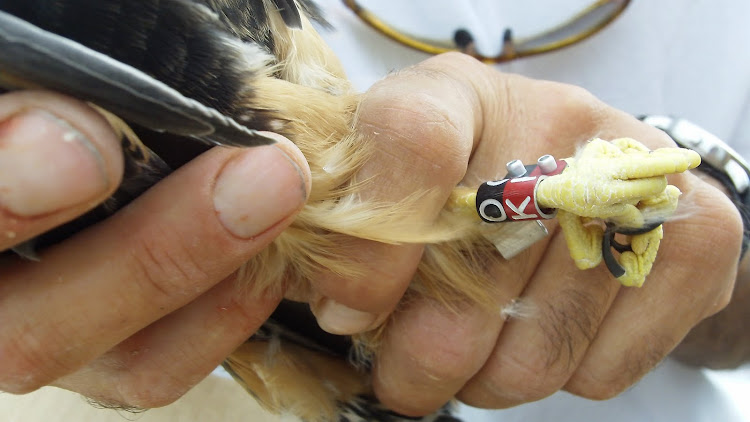
Over the weekend, a banded Western Scrub Jay was seen - without camera or binoculars - with a silver leg band (observer does not recall which leg) at the L.E. Woods picnic area in the Davis Mts. Sightings like this are a bit frustrating because it takes a lot of asking - and asking who to ask - to find out about the bird. And you'll never know the individual's story, beyond a banding. So, to keep asking...
Curious!
Curious!
Sunday, April 15, 2012
Become an Osprey Watcher
Become an Osprey Watcher: Connect with a global community of observers
The Center for Conservation Biology has launched Osprey-Watch, a project created to engage a global community to collect data on breeding osprey. Linked by an interest in osprey and a concern for the health of the aquatic environments on which they rely, this community will for the first time provide a global perspective on this charismatic species. The mission of Osprey-Watch is to bring citizen scientists together in order to collect information on a large enough spatial scale to be useful in addressing three of the most pressing issues facing aquatic ecosystems including global climate change, depletion of fish stocks, and environmental contaminants.
Osprey are one of very few truly global sentinels for aquatic health. They feed almost exclusively on live fish throughout their entire life cycle. They are a top consumer within aquatic ecosystems and are very sensitive to both overfishing and environmental contaminants. Nearly all populations breed in the northern latitudes and winter in the southern latitudes, effectively linking the aquatic health of the hemispheres. Their breeding season in the north is highly seasonal making them an effective barometer of climate change.
Osprey-Watch is a user-friendly, internet platform that allows observers across the globe to map their nests, log observations, upload photos, and interact within an observer forum. Information entered into the platform will be immediately accessible to users and will be summarized following the breeding season.
To join a growing community of global citizens, please visit http://www.osprey-watch.org and become an Osprey-Watcher.
Michael Wilson
Center for Conservation Biology
College of William and Mary & Virginia Commonwealth University
P.O. Box 8795
Williamsburg, VA 23187-8795
phone: 757-221-1649
fax: 757-221-1650
email: mdwils AT wm.edu
http://www.osprey-watch.org
Tuesday, April 3, 2012
Scissor-tailed Flycatchers around Oklahoma
For folks who are wondering about where young Scissor-tailed Flycatchers go, here's a study trying to determine just that! So keep an eye out for banded STFL!
***
From: dvl04 AT hotmail.com
Sent: Saturday, March 31, 2012 10:42 PM
To: OKBIRDS AT LISTS.OU.EDU
Subject: [OKBIRDS] Scissor-tailed Flycatchers to watch for
Hi, OKbirders!
My name is Diane Landoll and I am a PhD student at the University of Oklahoma. I have been studying Scissor-tailed Flycatchers for four years now, and this has included banding birds with aluminum USGS bands. Many birds were also banded with a combination of three other colored bands, one on the leg with the aluminum band and two on the other leg. I would like to ask for everyone's help in trying to freight these birds. I am hoping to see where young birds are going because they do not return to the area of their birth. I am also trying to figure out a rough idea of when they arrive back in the area and the route they take to get there. Since there have already been a few sightings (I saw two beautiful male today on Lawton!), now is the time to see if any banded birds from previous years are making it back to us!
What I am asking is that if you see any Scissor-tailed Flycatchers and are interested in figuring out if they are banded, try to get a look at their legs to see if they have an aluminum band only or an aluminum band and color bands. The colors can be difficult to make out sometimes, specially since the birds tend to sit on their legs a bit, so it might be a fun challenge. It always is for me, but that is really part of what makes it so fun. If you do see any banded birds, please let me know as soon as possible. If you can figure out what the color combination is, that would be amazing, but simply knowing where our banded birds are is a great help. If you do try to figure out color combinations, knowing the position of each color and which leg they are on is very important in figuring out exactly which bird it is. For example, a bird might have an aluminum band on top of a red band (so that the red band is the one nearer the foot) on its right leg and a purple band over a blue band on its left leg. If you are able to get a picture of the birds and its bands, that is even better.
Of you do see any banded birds, please let me know at this email address (dvl04 AT hotmail.com). Thank you all in advance for any help. Any sightings are very valuable and will help us get a better understanding of our magnificent state bird.
Thanks again, and good birding!
Diane Landoll
PhD Student
University of Oklahoma
Subscribe to:
Posts (Atom)

