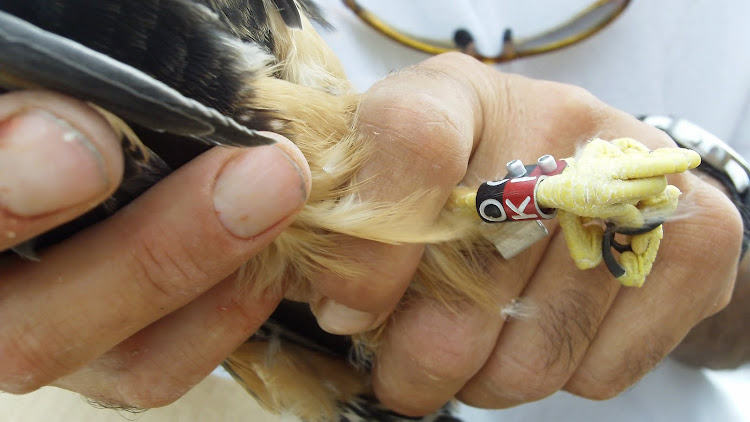
Birds captured in mist nets for banding are often in less than dignified poses, and it's quite curious to see an entire slideshow of birds in mist nets - especially on a stark white background. Not really science here, but... art as a spinoff of research?
Click here for the article and slideshow about the work of Todd Forsgren
Friday, August 3, 2012


Monday, July 30, 2012
Banded Mourning Dove
Via Les Stewart on the Texbirds facebook group:
"Had this banded Mourning Dove show up in my yard in Nacogdoches twice this week (or it could be two different banded doves). Anyway just wondering who is tagging Mourning Doves and if I should report it anywhere. I assume that would be useless, unless I shoot it and get the tag number and I wasn't planning on that..."

"Had this banded Mourning Dove show up in my yard in Nacogdoches twice this week (or it could be two different banded doves). Anyway just wondering who is tagging Mourning Doves and if I should report it anywhere. I assume that would be useless, unless I shoot it and get the tag number and I wasn't planning on that..."

Wednesday, July 25, 2012
N 1 - Texas City Oystercatcher
The more we know... well, the more we know!
"American Oystercatcher 'N 1,' Haematopus palliatus, at the Texas City dike, 26 July 2012. This bird was tagged at the Nature Conservancy's Texas City Prairie Preserve, up the coast a bit. Its mate has a broken wing and is in rehab, so 'N 1' may have left to search for a new mate."
Click here for the photo.
"American Oystercatcher 'N 1,' Haematopus palliatus, at the Texas City dike, 26 July 2012. This bird was tagged at the Nature Conservancy's Texas City Prairie Preserve, up the coast a bit. Its mate has a broken wing and is in rehab, so 'N 1' may have left to search for a new mate."
Click here for the photo.
Thursday, July 12, 2012
banded Prarie Warblers at Montague Sandplains IBA
Via Birding is Fun: banded Prairie Warblers at Montague Sandplains IBA.
No word on their background, or the project - but with multiple banded birds around, it's likely a target species for a study.
No word on their background, or the project - but with multiple banded birds around, it's likely a target species for a study.
Tuesday, July 10, 2012
Banded White-winged Dove in TX
White-winged Dove in a residential area in Victoria, TX (kind of the central coast - ish), likely part of a population study; via Texas Nature Notes!
Wednesday, June 27, 2012
Texas Black-necked Stilts
Anahuac NWR, on the Upper Texas Coast, is my old stomping ground... and now there are almost 200 banded Black-necked Stilts roaming around! Wish I were down there.
****
Texbirders,
Anahuac has been slow but steady through June. Shorebirds have returned, with up to 17 species seen (18 Jun).
Highlights include:
bronzed cowbird (male) continues by entrance
tropical kingbird, 20 June
red knot on Alice, Jackson, White (closed unit west of Shoveler
Pond), 23 June, undergoing extreme wing molt, will post photo to TOS
list when have access to my computer.
wood storks (up to 350 on Alice, Jackson, White), viewable at a distance from west side of Shoveler Pond
American avocets (up to 500)
stilt sandpiper, 20 June (early or late?)
In addition, ~175 black-necked stilts have been color-banded on Anahuac over the last two years, and capture efforts continue,
250-300 will have been banded by the end of July, please check stilt
legs for bands as we have experienced minimal resightings (Thanks Joe
Kennedy!). Much of this is due to a large stilt population
(>25,000) along the upper coast and inaccessible habitat, but I feel
that some of this is just due to people being unaware of our banding
operation, please tell others! Many of our radio-marked birds have
disappeared to parts unknown/off-refuge. Would greatly appreciate
assistance relocating these individuals.
Thanks,
Thomas Riecke
Chambers County, Texas
Thursday, June 14, 2012
13 year old Piping Plover
Via Vince Cavalieri, one of the brains behind this project!
The Great Lakes piping plover population has its own survivor story like B95 (aka moonbird) the red knot.

This is YOGs, currently our oldest known Great Lakes piping plover. In her 13 years, YOGs has flown something like 39,000 miles in migrations, well more than enough to fly completely around the world! Amongst countless predators, storms, human disturbance and many other hazards, this piping plover has survived and been a big part of the the increase in Great Lakes piping plover numbers.
The Great Lakes piping plover population has its own survivor story like B95 (aka moonbird) the red knot.

This is YOGs, currently our oldest known Great Lakes piping plover. In her 13 years, YOGs has flown something like 39,000 miles in migrations, well more than enough to fly completely around the world! Amongst countless predators, storms, human disturbance and many other hazards, this piping plover has survived and been a big part of the the increase in Great Lakes piping plover numbers.
B95 - Red Knot that keeps going
'Moonbird' is a Red Knot that has gotten some great coverage lately, not to mention a whole book!
Latest news is here: B95, the great survivor
Knots face some pretty amazing travel challenges as well as food shortages due to overharvesting of horseshoe crabs - the article above really does a nice job of covering some of those obstacles and outlining why the name 'moonbird' is appropriate. Namely, the distance this bird has traveled between Delaware and Argentina since being banded (as an adult!) in 1995 ...is astronomical.
Latest news is here: B95, the great survivor
Knots face some pretty amazing travel challenges as well as food shortages due to overharvesting of horseshoe crabs - the article above really does a nice job of covering some of those obstacles and outlining why the name 'moonbird' is appropriate. Namely, the distance this bird has traveled between Delaware and Argentina since being banded (as an adult!) in 1995 ...is astronomical.
Subscribe to:
Posts (Atom)

