Thursday, December 22, 2011

Hummingbird in the hand...

Original post from Big Bend Birds & Nature.

This bird was not found banded but the process is too interesting to resist posting here!

***

Allen's Hummingbird (Selasphorus sasin) vs. Rufous Hummingbird (Selasphorus rufus)

Most Rufous Hummingbirds have at least some green flecks on their backs at some point of growing up. Some lose them by the time of adulthood. Some keep or gain more into a "green-backed" Rufous Hummingbird status.

It's this green-backed Rufous Hummingbird that is near identical to the adult Allen's Hummingbird, a bird that always has a green back.

Where ranges overlap, it can be difficult or impossible to separate the two other than having the bird in-the-hand. As time marches on, there are those who are learned enough in their bird observing, field-work and/or region they live in that can tell the difference between the two without it in-hand. Others atleast have experienced leanings toward one species ID or another. The advent of high-shutter speed digital photography has helped, too.

There was an effort today to capture two green-backed Selasphorus species hummingbird.

We caught one. One person in the party is long-timed permitted to do this.

Allen's Hummingbird , Marathon, Brewster Co., TX. A location where migration routes do overlap.

Some diagnostics:

One way out of the hand to get a strong hunch is this:


Hatch-year (HY), birds hatched this calender year (have a mixed audience reading), Allen's Hummingbird male develop their full gorget earlier than do Rufous.

This HY male Allen's is well on his way.

By the way, HY hummingbirds have corrugations or wrinkles/grooves running alongside their bills. After-HY birds typically lack them completely or they are almost gone.


That's what Kelly is looking at in the above pic.

This HY bird (and us for that matter) is all the way into the month of December. It's lost some its older feathers, though has some left.

Check out the primary feathers of one of his wings:

It has new secondary feathers. It also has new primary feathers except for the outer-most 3 (P7-9). More brown in color and certainly more worn on the edges. He's growing up.

Also, his tail still has some old pin feathers amidst newer adult tailfeathers.


Moving from age-characteristics of humming birds back to species specific characteristics making this an Allen's Hummingbird, and not a green-backed Rufous Hummingbird...

These two species have 10 tail-feathers or retrices. There are five on the left and five on the right. The innermost are both labeled tailfeather number 1 (or R1). So from the innermost two tail-feathers, our R-1's, we count outward; R-2, R-3, R-4, R-5.

In the above photo, those two thickest feathers by his index finger are the R-1 tail-feathers.

R-2 feathers on a Rufous Hummingbird has a notch in it.

R-2 feathers on an Allen's does not.
No notch here.

All the tail-feathers in each sex and age-class are narrower in Allen's compared to Rufous.

This become more acutely apparent in R-5. The outermost tail feathers. They are narrower in Allen's Hummingbirds.


Again, no notch in R-2, and check out the narrower outermost tail-feathers. Somewhere we can dig up a photo of the tail of both species side-by-side. I'll edit that in, in the future, perhaps.


Anyways, as is standard procedure in avian fieldword various physical measures were taken.

This is wing chord length:

Chord length is a measurement taken when a bird's wing is bent at around a 90 degree angle (sort of as if it were at rest). The length from the "wrist" to the longest primary wing tip is taken.
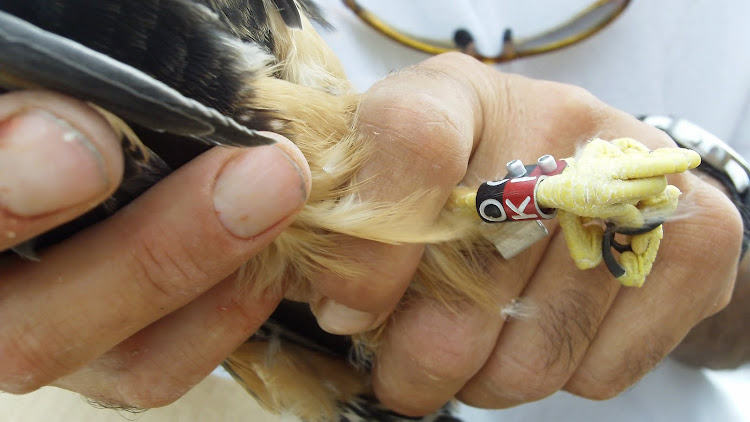
Check out his new band on his right leg. Tiny.
I've worked with band sizes from albatross, sulids, shearwaters, noddies, terns, warblers, vireos, shrikes, and others. The band size for a hummingbird is amazing!

Measuring tail length:


Width of the outer tail feather:


After various other morphological data taken, this HY male Allen's Hummingbird with a healthy weight was released ... with a bad auto-focus..


Another far-West Texas Allen's Hummingbird. This is the latest calender date that Kelly has banded an Allen's. Kelly's been doing this for a long time. (Edit: click here for his site and research on West Texas Hummingbirds!)

**He later banded an Allen's Hummingbird this afternoon at a friend's place in Alpine.

Thursday, October 20, 2011

Whimbrels in the news

From:
THE BIRDING COMMUNITY E-BULLETIN October 2011

WHIMBREL LOSS RAISES ISSUES ACROSS THE CARIBBEAN

As part of an international effort to map shorebird migration, Whimbrels on the Eastern Shore in Virginia have recently been fitted with satellite tracking devices. Some of these birds have been tracked for years. This is a project previously brought to the attention of E-bulletin readers, most recently in July when we described the remarkable international journey of one of these birds, a Whimbrel named “Hope”:
www.refugenet.org/birding/julsbc11.html#TOC05

Two other Whimbrels, a female named “Machi” and a male named “Goshen,” have also been tracked for several years. Last month, both Machi and Goshen landed on the Caribbean island of Guadeloupe, after first having successfully navigated their way through or around Tropical Storm Maria and Hurricane Irene, respectively. Although they were not migrating together, both stopped at Guadeloupe after encountering the two different storm systems. Then, on the morning of 12 September, both satellite-tracked birds were shot by hunters at two different wetlands in Guadeloupe. Not surprisingly, the loss of these two individuals on the same day and on the same island quickly raised international concerns from birders and conservationists over the vulnerability of migratory shorebirds throughout the Caribbean and the need for increased protection.

According to the United States Shorebird Conservation Plan, 28 of North America’s 57 shorebird species are now considered highly imperiled or of high conservation concern in the U.S. Among these species, population information suggests that Whimbrels may have declined by as much as 50 percent over the last several decades. Hunting and habitat loss are among the leading causes for this decline. These factors are exacerbated during migration following severe storms, when large numbers of shorebirds are sometimes forced to land at often restricted Caribbean stopover sites. Guadeloupe, Martinique, and Barbados are specifically islands where limited natural or artificial wetlands (created to attract migrant shorebirds for sport shooting) during fall migration account for tens of thousands of shorebirds getting shot annually.

Fortunately, there has been some recent progress to change this activity on Barbados, a story the E-bulletin highlighted in July 2009
www.refugenet.org/birding/julSBC09.html#TOC05

While hunters and bird conservationists on many of the islands from the Bahamas to Barbados have formed partnerships to support wiser use of hunted species and their habitats, adequate conservation regulations still seem to be lacking.

Over many decades, the International Migratory Bird Treaty (IMBT) has protected many bird species that migrate across international borders. Unfortunately neither Guadeloupe nor Martinique which are operated as French overseas departments is party to this Treaty. More importantly, birds which are protected in the French overseas departments do not benefit from the same level of protection that exists in metropolitan France. The European Directives of Birds and Habitats, pillars of conservation of nature in Europe, do not apply to these territories. Barbados, once a British colony and now an independent state, is also not party to the IMBT.

These factors complicate matters considerably.

While birds are falling between the cracks of regulation and enforcement, bird-conservation organizations across the Americas, including the Society for the Conservation and Study of Caribbean Birds (SCSCB), are calling for action to increase shorebird protection in the French West Indies. NGOs in France, Guadeloupe, French Guiana, and Martinique have called for examining a number of options, including the need for the following:
– updating the standing of hunted species, notably shorebirds, according to their population status;
– adapting the hunting season to forbid hunting during periods of reproduction, dependence, and prenuptial migration;
– limiting the number of days of hunting and bag limits;
– limiting the use of lead in wetland zones.

Lisa Sorenson, President of SCSCB commented, “This event has quickly raised awareness of the issue of shorebird hunting and the need for updated hunting regulations in the French West Indies in a way that was not possible previously. We are optimistic that better hunting laws and other shorebird conservation measures will come out of this experience.” (Those interested in writing to decision-makers in the Caribbean, with an emphasis on the French West Indies, can contact Lisa Sorenson for some guidance at: lsoren@bu.edu )

To obtain further information, visit:

http://ccb-wm.org/news/pressreleases_pdfs/20110912_Machi.pdf

and
www.birds.cornell.edu/roundrobin/2011/09/13/whimbrel-survives-tropical-storm-shot-in-caribbean/

Monday, October 3, 2011

More Whimbrel love!

This time from NPR: The Toughest Little Bird You've Never Heard Of

I'd lump it in with the previous few posts on Atlantic migrating Whimbrels, but these are the Pacific ones with a very different story than their Atlantic brethren. Basically instead of having a cushy (or deadly) stopover spot in the Bahamas, the west coast critters go straight from Alaska to New Zealand, though some go to Australia. NPR's page has a great tracking map, definitely worth a peek!

Wednesday, September 14, 2011

Whimbrel down

Goshen, a shorebird tracked by scientists, becomes second study bird to be lost on Guadeloupe

Unfortunately, large birds are often hunted outside of the US; tracking birds tells us not only about migration routes but also the unfortunate pressures they face. Goshen was a Whimbrel, but even American White Pelicans become food. (Follow-up to American White Pelican post is here)

Friday, August 26, 2011

Whimbrel vs. Hurricane Irene

Here's a great 3 page pdf on a Whimbrel (named Chinquapin) that has skirted Hurricane Irene on a four-day non-stop flight:
click for the pdf

Update: now there's a non-pdf link!

Friday, August 5, 2011

Banded Osprey sightings

From the Texas wildlife rehab list:

Banded Osprey sightings

PLEASE REPORT SIGHTINGS - We banded reintroduced ospreys with blue, green and orange color bands with alpha-numeric codes during a project in southeastern South Dakota from 2004-2010. Please report sightings of birds with these color bands and codes, if possible, to EILEEN DOWD STUKEL, SD Game, Fish and Parks (EM:eileen.dowdstukel/at/state.sd. us; PH 605-773-4229) .

Friday, July 8, 2011

Flier for reporting banded birds!

***a note about a note about a flier!

Subject: Banded Birds
From: Brent Ortego
Date: Fri, 8 Jul 2011 14:17:27 -0500

We get several requests per year about where to report banded shorebirds. Researchers need your help logging the distribution of their research birds. The link below will send you to a website which has much more information.

Good Birding
Brent Ortego
Victoria, TX


Greetings All,

Attached is a pdf of outreach flyers developed for bandedbirds.org by Defenders of Wildlife. Many thanks to the Defenders staff for this production. In addition to producing the flyers, Caroline Kennedy will also be putting out an alert about the availability of these flyers to Defenders contacts.

One flyer is intended as an Attention Grabber directing observers to bandedbirds.org for more information. The other flyer has more details and is also appropriate for posting, but can be used for distribution at an event.

These flyers are available for download on bandedbirds.org on the newly added Flyers page the data reporting part of the website.
http://report.bandedbirds.org/DrawOnePage.aspx?PageID=12

Please post anywhere appropriate within your organization and ask your partners to download and post. Use them freely to help increase observations for your projects.

Thanks!

Jeannine

Jeannine Parvin
Database Administrator
www.bandedbirds.org

Saturday, June 25, 2011

Black-necked Stilts at Anahuac NWR

This was a post on the Texbirds listserv recently; a spot close to my heart and a species that makes black & white look exotic!

***

Subject: Color-banded black-necked stilts and noteworthy sightings at Anahuac

From: Thomas Riecke (riecket13/Y)
Date: Fri, 24 Jun 2011 15:49:00

Dear Texbirders,

We have started color-banding black-necked stilts on the refuge. Band combos will be orange over aluminum over blue/red/or green (male/female/hatch year)on the right leg, and a unique combination of three color-bands on the left leg. We expect to band several hundred birds this summer and early fall. I would greatly appreciate any observers who resight marked individuals to report them by phone AT (214) 384-8085 or by email at riecket AT titan.sfasu.edu. Phone is preferred as internet access is spotty in the field. GPS coordinates would be amazing, but even a general description of the location will be more than acceptable.

In other news, Kelli Haskett and I had black rail along Frozen Point Rd. (at
the 90 degree left hand before the long straightaway that leads to the kayak
launch on the bay) while conducting frog surveys early Thursday morning, and
Steve McDowell and I had a pair of least grebes are nest-building on one of the
moist soil units on the East Unit (closed to the public).

Thomas