Become an Osprey Watcher: Connect with a global community of observers
The Center for Conservation Biology has launched Osprey-Watch, a project created to engage a global community to collect data on breeding osprey. Linked by an interest in osprey and a concern for the health of the aquatic environments on which they rely, this community will for the first time provide a global perspective on this charismatic species. The mission of Osprey-Watch is to bring citizen scientists together in order to collect information on a large enough spatial scale to be useful in addressing three of the most pressing issues facing aquatic ecosystems including global climate change, depletion of fish stocks, and environmental contaminants.
Osprey are one of very few truly global sentinels for aquatic health. They feed almost exclusively on live fish throughout their entire life cycle. They are a top consumer within aquatic ecosystems and are very sensitive to both overfishing and environmental contaminants. Nearly all populations breed in the northern latitudes and winter in the southern latitudes, effectively linking the aquatic health of the hemispheres. Their breeding season in the north is highly seasonal making them an effective barometer of climate change.
Osprey-Watch is a user-friendly, internet platform that allows observers across the globe to map their nests, log observations, upload photos, and interact within an observer forum. Information entered into the platform will be immediately accessible to users and will be summarized following the breeding season.
To join a growing community of global citizens, please visit http://www.osprey-watch.org and become an Osprey-Watcher.
Michael Wilson
Center for Conservation Biology
College of William and Mary & Virginia Commonwealth University
P.O. Box 8795
Williamsburg, VA 23187-8795
phone: 757-221-1649
fax: 757-221-1650
email: mdwils AT wm.edu
http://www.osprey-watch.org
Sunday, April 15, 2012


Tuesday, April 3, 2012
Scissor-tailed Flycatchers around Oklahoma
For folks who are wondering about where young Scissor-tailed Flycatchers go, here's a study trying to determine just that! So keep an eye out for banded STFL!
***
From: dvl04 AT hotmail.com
Sent: Saturday, March 31, 2012 10:42 PM
To: OKBIRDS AT LISTS.OU.EDU
Subject: [OKBIRDS] Scissor-tailed Flycatchers to watch for
Hi, OKbirders!
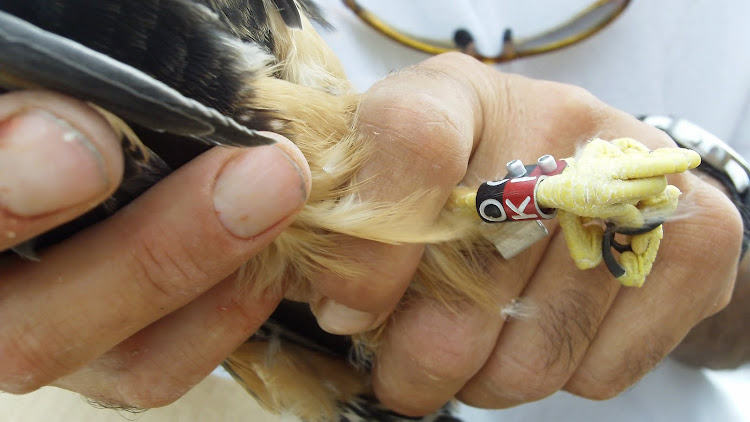
My name is Diane Landoll and I am a PhD student at the University of Oklahoma. I have been studying Scissor-tailed Flycatchers for four years now, and this has included banding birds with aluminum USGS bands. Many birds were also banded with a combination of three other colored bands, one on the leg with the aluminum band and two on the other leg. I would like to ask for everyone's help in trying to freight these birds. I am hoping to see where young birds are going because they do not return to the area of their birth. I am also trying to figure out a rough idea of when they arrive back in the area and the route they take to get there. Since there have already been a few sightings (I saw two beautiful male today on Lawton!), now is the time to see if any banded birds from previous years are making it back to us!
What I am asking is that if you see any Scissor-tailed Flycatchers and are interested in figuring out if they are banded, try to get a look at their legs to see if they have an aluminum band only or an aluminum band and color bands. The colors can be difficult to make out sometimes, specially since the birds tend to sit on their legs a bit, so it might be a fun challenge. It always is for me, but that is really part of what makes it so fun. If you do see any banded birds, please let me know as soon as possible. If you can figure out what the color combination is, that would be amazing, but simply knowing where our banded birds are is a great help. If you do try to figure out color combinations, knowing the position of each color and which leg they are on is very important in figuring out exactly which bird it is. For example, a bird might have an aluminum band on top of a red band (so that the red band is the one nearer the foot) on its right leg and a purple band over a blue band on its left leg. If you are able to get a picture of the birds and its bands, that is even better.
Of you do see any banded birds, please let me know at this email address (dvl04 AT hotmail.com). Thank you all in advance for any help. Any sightings are very valuable and will help us get a better understanding of our magnificent state bird.
Thanks again, and good birding!
Diane Landoll
PhD Student
University of Oklahoma
***
From: dvl04 AT hotmail.com
Sent: Saturday, March 31, 2012 10:42 PM
To: OKBIRDS AT LISTS.OU.EDU
Subject: [OKBIRDS] Scissor-tailed Flycatchers to watch for
Hi, OKbirders!
My name is Diane Landoll and I am a PhD student at the University of Oklahoma. I have been studying Scissor-tailed Flycatchers for four years now, and this has included banding birds with aluminum USGS bands. Many birds were also banded with a combination of three other colored bands, one on the leg with the aluminum band and two on the other leg. I would like to ask for everyone's help in trying to freight these birds. I am hoping to see where young birds are going because they do not return to the area of their birth. I am also trying to figure out a rough idea of when they arrive back in the area and the route they take to get there. Since there have already been a few sightings (I saw two beautiful male today on Lawton!), now is the time to see if any banded birds from previous years are making it back to us!
What I am asking is that if you see any Scissor-tailed Flycatchers and are interested in figuring out if they are banded, try to get a look at their legs to see if they have an aluminum band only or an aluminum band and color bands. The colors can be difficult to make out sometimes, specially since the birds tend to sit on their legs a bit, so it might be a fun challenge. It always is for me, but that is really part of what makes it so fun. If you do see any banded birds, please let me know as soon as possible. If you can figure out what the color combination is, that would be amazing, but simply knowing where our banded birds are is a great help. If you do try to figure out color combinations, knowing the position of each color and which leg they are on is very important in figuring out exactly which bird it is. For example, a bird might have an aluminum band on top of a red band (so that the red band is the one nearer the foot) on its right leg and a purple band over a blue band on its left leg. If you are able to get a picture of the birds and its bands, that is even better.
Of you do see any banded birds, please let me know at this email address (dvl04 AT hotmail.com). Thank you all in advance for any help. Any sightings are very valuable and will help us get a better understanding of our magnificent state bird.
Thanks again, and good birding!
Diane Landoll
PhD Student
University of Oklahoma
Tuesday, March 20, 2012
Black Swift - 165 years of winter mystery
165-Year-Old Mystery of Disappearing Black Swift Solved
Via the American Bird Conservancy
Snippets:
Via the American Bird Conservancy
Snippets:
Where the high flying bird vanishes to after breeding and spending summers in many parts of western North America has puzzled ornithologists since the species was discovered in 1857. Now, thanks to a new study, we learn that at least some of them travel about 4,300 miles to a remote part of western Brazil in lowland rainforest.
The study, which was published in the March 2012 issue of Wilson Journal of Ornithology, involved attaching geolocators (tiny devices that record and store tracking information) to four adult Black Swifts from two nesting sites in Colorado, then recapturing the same birds at the same sites the next year to download the stored data. Three of the four tracking devices were recovered, and showed the birds departing for their fall southerly migration between September 10 and September 19, arriving in Brazil between September 28 and October 12, departing Brazil between May 9 and 20, and arriving back at their Colorado breeding sites between May 23 and June 18.
Further, satellite GPS devices, which transmit real time tracking of individuals, are not sufficiently small to place on a species the size of the seven-inch-long Black Swift. As a result, geolocators (which record data but do not transmit it) were used which meant that the study birds would need to be recaptured for the location data to be analyzed. That necessity was made easier on one hand by the fact that the birds typically are very committed to returning to their previous breeding colony, but made more challenging because they tend to nest in areas that are incredibly difficult to access – behind waterfalls in deeply shaded niches in steep and narrow canyons.
Curiously, the birds averaged about 211 miles per day during fall migration and about 244 miles per day during spring migration, about a 15 percent increase in average daily distance covered. They spent about 220 days in Brazil before migrating north again.
Tuesday, March 13, 2012
Look for banded Golden-cheeked Warblers!
From a Texbirds post, re: a banded Golden-cheeked Warbler photographed by Sean Paul Kelly (click here for the photos) "This bird is part of the Balcones Canyonlands Preserve Golden-cheeked Warbler study that is now going on. This bird was banded last year on April 20th at Emma Long Park."
Subject: banded Golden-cheeked Warblers
From: Bill Reiner (spizella/AT/SBCGLOBAL/./NET)
Date: Mon, 12 Mar 2012 20:45:18 -0700
TexBirders,
I had a feeling I needed to send out this message pronto, and it seems I am one day late. But thanks to Mr. Kelley, for asking the question, and for posting those photos of the banded Golden-cheeked Warbler in Emma Long Park this morning! (And also thanks to the quick-responding TexBirders who alerted me to his post.)
The bird Mr. Kelley photographed is one of more than 350 Golden-cheeked Warblers that have been banded by biologists on study plots scattered across the Balcones Canyonlands Preserve, on the west side of Austin, over the past three years. The vast majority of the banded birds have been males, but a few females have also been banded. Biologists at Fort Hood have banded even more individuals of this species, over an even longer time. The goals of the studies in these two locations have included learning more about the survival rates, age ratios, and dispersal of these endangered birds.
Some of the plots where Golden-cheeks have been banded around Austin are in areas open to the public, such as Emma Long Park (Turkey Creek Trail), Barton Creek Greenbelt (Sculpture Falls area), Saint Edwards Park, and, for the first time last year, Wild Basin. However, the birds returning from their winter ranges could turn up anywhere (even South Padre Island!), so please look closely at the legs of any Golden-cheeked Warbler you spot. A banded warbler will have one numbered aluminum band (don’t even try to read it with binoculars) and two or three colored resin or plastic bands to allow for recognition of individuals in the field. If you do see a banded Golden-cheeked Warbler, I will be very happy to hear about it, and can direct the information to the biologists -- either at Fort Hood or here in Austin -- who banded it. The best place to contact me is: william.reiner AT austintexas.gov
Information to provide:
1) What color bands in what order. Banders read bands as: upper left leg/lower left leg : upper right leg/lower right leg. So, for example, Mr. Kelley's bird is red/orange : white/silver. Colors are not always what they appear at first glance, so a photograph is always welcome, if it's possible. Colors can often be misread. Legs can be mixed up -- it's the bird's left and right legs, not which is right or left as you are looking at it. Even upper and lower can be confused depending upon your vantage point. Because of the potential for confusion, it is also very important to give us...
2) The location of the bird. A GPS position would be very helpful to pinpoint its location, but if this is not possible, landmarks along a trail or road or other feature can greatly help us to relocate the individual and verify its identity.
If you want to help even more with this project, please come volunteer with us!
The BCP biologists cannot possibly watch all the suitable habitat on the Preserve, so we are seeking experienced birders willing to devote at least 3 field days this spring to searching for banded warblers. Volunteers will have the opportunity to explore a part of the Balcones Canyonlands Preserve that is not normally open to the public. Several birders are already trained and ready to go this spring, but, because we banded birds on new plots last year, we still need people to look for returning birds on the outskirts of those plots. If you have the time and the interest, please contact me at the e-mail address above.
Thank you,
Bill Reiner, field biologist
Balcones Canyonlands Preserve
City of Austin
(512) 972-1676
Subject: banded Golden-cheeked Warblers
From: Bill Reiner (spizella/AT/SBCGLOBAL/./NET)
Date: Mon, 12 Mar 2012 20:45:18 -0700
TexBirders,
I had a feeling I needed to send out this message pronto, and it seems I am one day late. But thanks to Mr. Kelley, for asking the question, and for posting those photos of the banded Golden-cheeked Warbler in Emma Long Park this morning! (And also thanks to the quick-responding TexBirders who alerted me to his post.)
The bird Mr. Kelley photographed is one of more than 350 Golden-cheeked Warblers that have been banded by biologists on study plots scattered across the Balcones Canyonlands Preserve, on the west side of Austin, over the past three years. The vast majority of the banded birds have been males, but a few females have also been banded. Biologists at Fort Hood have banded even more individuals of this species, over an even longer time. The goals of the studies in these two locations have included learning more about the survival rates, age ratios, and dispersal of these endangered birds.
Some of the plots where Golden-cheeks have been banded around Austin are in areas open to the public, such as Emma Long Park (Turkey Creek Trail), Barton Creek Greenbelt (Sculpture Falls area), Saint Edwards Park, and, for the first time last year, Wild Basin. However, the birds returning from their winter ranges could turn up anywhere (even South Padre Island!), so please look closely at the legs of any Golden-cheeked Warbler you spot. A banded warbler will have one numbered aluminum band (don’t even try to read it with binoculars) and two or three colored resin or plastic bands to allow for recognition of individuals in the field. If you do see a banded Golden-cheeked Warbler, I will be very happy to hear about it, and can direct the information to the biologists -- either at Fort Hood or here in Austin -- who banded it. The best place to contact me is: william.reiner AT austintexas.gov
Information to provide:
1) What color bands in what order. Banders read bands as: upper left leg/lower left leg : upper right leg/lower right leg. So, for example, Mr. Kelley's bird is red/orange : white/silver. Colors are not always what they appear at first glance, so a photograph is always welcome, if it's possible. Colors can often be misread. Legs can be mixed up -- it's the bird's left and right legs, not which is right or left as you are looking at it. Even upper and lower can be confused depending upon your vantage point. Because of the potential for confusion, it is also very important to give us...
2) The location of the bird. A GPS position would be very helpful to pinpoint its location, but if this is not possible, landmarks along a trail or road or other feature can greatly help us to relocate the individual and verify its identity.
If you want to help even more with this project, please come volunteer with us!
The BCP biologists cannot possibly watch all the suitable habitat on the Preserve, so we are seeking experienced birders willing to devote at least 3 field days this spring to searching for banded warblers. Volunteers will have the opportunity to explore a part of the Balcones Canyonlands Preserve that is not normally open to the public. Several birders are already trained and ready to go this spring, but, because we banded birds on new plots last year, we still need people to look for returning birds on the outskirts of those plots. If you have the time and the interest, please contact me at the e-mail address above.
Thank you,
Bill Reiner, field biologist
Balcones Canyonlands Preserve
City of Austin
(512) 972-1676
Friday, February 24, 2012
Mexican Jay, Big Bend National Park

(Photo via Mark Flippo of Birding Big Bend)
"A Mexican Jay near the Pinnacles campsites in the Chisos: note the silver band on the bird's left leg. In 1996-97 a graduate student came to BBNP to conduct research on Mexican jays and banded a number of birds, including some hatch year birds. Either he never completed his work or he didn't publish so there is no record of study results but an indirect benefit was the bands provided a datapoint... those few jays still flying aorund in the Chisos with bands on their legs are at least 15 years old. This jay is definitely a viejo..."
Photo and caption originally posted at Birding Big Bend's facebook page, thanks to Kym Flippo!
(Crossposted at Big Bend Birds & Nature)
Sunday, January 15, 2012
If you see a banded Piping Plover...
Via Texbirds, pre-dated and modified for format and lack of photos:
Here is a repost from last year, if you see Piping Plovers with colored bands:
Here is some info on what to do if you see a banded or unbanded Piping Plover. It was sent to me in 2008 from Cheri Gratto-Trevor, a Canadian researcher. Research and researchers come and go, so I'm not sure if all of the info is still current, but it's worth trying an email or 2:
"If you see a marked Piping Plover, please write down the location, date, behaviour of bird (foraging; with mate or nest), a detailed description of the bands (see below).
* To describe a band combination: describe each band:
* Type: metal, colour band, flag (band with a tab sticking out from the leg
* Colours: as exact as possible - common colours are red, yellow, orange, light blue (very pale), dark blue, white, light green (very pale), dark green, black, grey. Some are bi-coloured (2 colours on one band). Sometimes two bands of the same colour are placed over each other on a leg (may look like a very tall band). Common flag colours are black, white, dark green, yellow, orange and light blue.
* Location on bird's leg:
bird's upper left (above the "knee"), lower left (below the "knee"), upper right, lower right; above or below other bands on the same part of the leg.
* * * Note if you are unsure of any of the bands or if you did not see all parts of the leg clearly.
* * * Example:
"Black flag upper left, dark blue band lower left, metal upper right, light green over dark blue band lower right."
* Plovers banded as adults in Saskatchewan have 5 bands: a white flag upper right OR black flag upper left or right; metal upper on opposite leg to flag (rarely on lower leg with colour bands), 2 colour bands on 1 lower leg, and one plain colour on the other lower leg. Colours used were red, orange, yellow, light green, dark green, grey, black, dark blue; there may be two of the same colour on the same part of the leg).
Plovers banded as chicks are variable - some are similar to the adult schemes noted above, while others just have either a white or black flag upper and metal upper, no other colour bands. In other projects; some chicks (Lake Diefenbaker, SK) have a white band upper left (not a flag), metal on a lower leg, and 1-3 other bands; some (Chaplin Lake, SK) have a light green/dark green bi-coloured band on one leg, metal other upper leg, and 1-2 bands on the lower legs; some (Alberta) have a bicoloured black and white band, metal and 1-2 colour bands. Some plovers from the U.S. Great Lakes have been banded with an orange flag on an upper leg (metal other upper, 2 colour bands on one lower leg and one on the other), and in the Missouri River, USA with a dark green flag upper (2 colour bands on each lower leg, no metal; or just the flag and 2 colour bands in total), or yellow flag on an upper leg (metal other upper, 2 colour bands on one lower leg and one on the other) . And of course, bands can discolour, or occasionally, fall off.
However this information can provide very useful data on Piping Plover movements and survival, so please look for marked birds and send in your sightings!
Band sightings can be sent to Greg Pavelka (Gregory.A.Pavelka AT usace.army.mil), especially if no flag or a light blue flag is seen; or directly to the bander if a flag is observed:
white or black flag: Cheri Gratto-Trevor (cheri.gratto-trevor AT ec.gc.ca)
dark green flag: Dan Catlin (dcatlin AT vt.edu)
yellow or red flag: Jennifer Stucker (jstucker AT usgs.gov)
orange flag: Great Lakes (plover AT umn.edu)
Thanks for looking for our birds!
Here is a repost from last year, if you see Piping Plovers with colored bands:
Here is some info on what to do if you see a banded or unbanded Piping Plover. It was sent to me in 2008 from Cheri Gratto-Trevor, a Canadian researcher. Research and researchers come and go, so I'm not sure if all of the info is still current, but it's worth trying an email or 2:
"If you see a marked Piping Plover, please write down the location, date, behaviour of bird (foraging; with mate or nest), a detailed description of the bands (see below).
* To describe a band combination: describe each band:
* Type: metal, colour band, flag (band with a tab sticking out from the leg
* Colours: as exact as possible - common colours are red, yellow, orange, light blue (very pale), dark blue, white, light green (very pale), dark green, black, grey. Some are bi-coloured (2 colours on one band). Sometimes two bands of the same colour are placed over each other on a leg (may look like a very tall band). Common flag colours are black, white, dark green, yellow, orange and light blue.
* Location on bird's leg:
bird's upper left (above the "knee"), lower left (below the "knee"), upper right, lower right; above or below other bands on the same part of the leg.
* * * Note if you are unsure of any of the bands or if you did not see all parts of the leg clearly.
* * * Example:
"Black flag upper left, dark blue band lower left, metal upper right, light green over dark blue band lower right."
* Plovers banded as adults in Saskatchewan have 5 bands: a white flag upper right OR black flag upper left or right; metal upper on opposite leg to flag (rarely on lower leg with colour bands), 2 colour bands on 1 lower leg, and one plain colour on the other lower leg. Colours used were red, orange, yellow, light green, dark green, grey, black, dark blue; there may be two of the same colour on the same part of the leg).
Plovers banded as chicks are variable - some are similar to the adult schemes noted above, while others just have either a white or black flag upper and metal upper, no other colour bands. In other projects; some chicks (Lake Diefenbaker, SK) have a white band upper left (not a flag), metal on a lower leg, and 1-3 other bands; some (Chaplin Lake, SK) have a light green/dark green bi-coloured band on one leg, metal other upper leg, and 1-2 bands on the lower legs; some (Alberta) have a bicoloured black and white band, metal and 1-2 colour bands. Some plovers from the U.S. Great Lakes have been banded with an orange flag on an upper leg (metal other upper, 2 colour bands on one lower leg and one on the other), and in the Missouri River, USA with a dark green flag upper (2 colour bands on each lower leg, no metal; or just the flag and 2 colour bands in total), or yellow flag on an upper leg (metal other upper, 2 colour bands on one lower leg and one on the other) . And of course, bands can discolour, or occasionally, fall off.
However this information can provide very useful data on Piping Plover movements and survival, so please look for marked birds and send in your sightings!
Band sightings can be sent to Greg Pavelka (Gregory.A.Pavelka AT usace.army.mil), especially if no flag or a light blue flag is seen; or directly to the bander if a flag is observed:
white or black flag: Cheri Gratto-Trevor (cheri.gratto-trevor AT ec.gc.ca)
dark green flag: Dan Catlin (dcatlin AT vt.edu)
yellow or red flag: Jennifer Stucker (jstucker AT usgs.gov)
orange flag: Great Lakes (plover AT umn.edu)
Thanks for looking for our birds!
Thursday, December 22, 2011
Hummingbird in the hand...
Original post from Big Bend Birds & Nature.
This bird was not found banded but the process is too interesting to resist posting here!
***
Allen's Hummingbird (Selasphorus sasin) vs. Rufous Hummingbird (Selasphorus rufus)
Most Rufous Hummingbirds have at least some green flecks on their backs at some point of growing up. Some lose them by the time of adulthood. Some keep or gain more into a "green-backed" Rufous Hummingbird status.
It's this green-backed Rufous Hummingbird that is near identical to the adult Allen's Hummingbird, a bird that always has a green back.
Where ranges overlap, it can be difficult or impossible to separate the two other than having the bird in-the-hand. As time marches on, there are those who are learned enough in their bird observing, field-work and/or region they live in that can tell the difference between the two without it in-hand. Others atleast have experienced leanings toward one species ID or another. The advent of high-shutter speed digital photography has helped, too.
There was an effort today to capture two green-backed Selasphorus species hummingbird.
We caught one. One person in the party is long-timed permitted to do this.
Allen's Hummingbird , Marathon, Brewster Co., TX. A location where migration routes do overlap.
Some diagnostics:
One way out of the hand to get a strong hunch is this:

Hatch-year (HY), birds hatched this calender year (have a mixed audience reading), Allen's Hummingbird male develop their full gorget earlier than do Rufous.
This HY male Allen's is well on his way.
By the way, HY hummingbirds have corrugations or wrinkles/grooves running alongside their bills. After-HY birds typically lack them completely or they are almost gone.

That's what Kelly is looking at in the above pic.
This HY bird (and us for that matter) is all the way into the month of December. It's lost some its older feathers, though has some left.
Check out the primary feathers of one of his wings:

It has new secondary feathers. It also has new primary feathers except for the outer-most 3 (P7-9). More brown in color and certainly more worn on the edges. He's growing up.
Also, his tail still has some old pin feathers amidst newer adult tailfeathers.

Moving from age-characteristics of humming birds back to species specific characteristics making this an Allen's Hummingbird, and not a green-backed Rufous Hummingbird...
These two species have 10 tail-feathers or retrices. There are five on the left and five on the right. The innermost are both labeled tailfeather number 1 (or R1). So from the innermost two tail-feathers, our R-1's, we count outward; R-2, R-3, R-4, R-5.
In the above photo, those two thickest feathers by his index finger are the R-1 tail-feathers.
R-2 feathers on a Rufous Hummingbird has a notch in it.

R-2 feathers on an Allen's does not.
No notch here.
All the tail-feathers in each sex and age-class are narrower in Allen's compared to Rufous.
This become more acutely apparent in R-5. The outermost tail feathers. They are narrower in Allen's Hummingbirds.

Again, no notch in R-2, and check out the narrower outermost tail-feathers. Somewhere we can dig up a photo of the tail of both species side-by-side. I'll edit that in, in the future, perhaps.
Anyways, as is standard procedure in avian fieldword various physical measures were taken.
This is wing chord length:

Chord length is a measurement taken when a bird's wing is bent at around a 90 degree angle (sort of as if it were at rest). The length from the "wrist" to the longest primary wing tip is taken.
Check out his new band on his right leg. Tiny.
I've worked with band sizes from albatross, sulids, shearwaters, noddies, terns, warblers, vireos, shrikes, and others. The band size for a hummingbird is amazing!
Measuring tail length:

Width of the outer tail feather:

After various other morphological data taken, this HY male Allen's Hummingbird with a healthy weight was released ... with a bad auto-focus..

Another far-West Texas Allen's Hummingbird. This is the latest calender date that Kelly has banded an Allen's. Kelly's been doing this for a long time. (Edit: click here for his site and research on West Texas Hummingbirds!)
**He later banded an Allen's Hummingbird this afternoon at a friend's place in Alpine.
This bird was not found banded but the process is too interesting to resist posting here!
***
Allen's Hummingbird (Selasphorus sasin) vs. Rufous Hummingbird (Selasphorus rufus)
Most Rufous Hummingbirds have at least some green flecks on their backs at some point of growing up. Some lose them by the time of adulthood. Some keep or gain more into a "green-backed" Rufous Hummingbird status.
It's this green-backed Rufous Hummingbird that is near identical to the adult Allen's Hummingbird, a bird that always has a green back.
Where ranges overlap, it can be difficult or impossible to separate the two other than having the bird in-the-hand. As time marches on, there are those who are learned enough in their bird observing, field-work and/or region they live in that can tell the difference between the two without it in-hand. Others atleast have experienced leanings toward one species ID or another. The advent of high-shutter speed digital photography has helped, too.
There was an effort today to capture two green-backed Selasphorus species hummingbird.
We caught one. One person in the party is long-timed permitted to do this.
Allen's Hummingbird , Marathon, Brewster Co., TX. A location where migration routes do overlap.
Some diagnostics:
One way out of the hand to get a strong hunch is this:
Hatch-year (HY), birds hatched this calender year (have a mixed audience reading), Allen's Hummingbird male develop their full gorget earlier than do Rufous.
This HY male Allen's is well on his way.
By the way, HY hummingbirds have corrugations or wrinkles/grooves running alongside their bills. After-HY birds typically lack them completely or they are almost gone.
That's what Kelly is looking at in the above pic.
This HY bird (and us for that matter) is all the way into the month of December. It's lost some its older feathers, though has some left.
Check out the primary feathers of one of his wings:
It has new secondary feathers. It also has new primary feathers except for the outer-most 3 (P7-9). More brown in color and certainly more worn on the edges. He's growing up.
Also, his tail still has some old pin feathers amidst newer adult tailfeathers.
Moving from age-characteristics of humming birds back to species specific characteristics making this an Allen's Hummingbird, and not a green-backed Rufous Hummingbird...
These two species have 10 tail-feathers or retrices. There are five on the left and five on the right. The innermost are both labeled tailfeather number 1 (or R1). So from the innermost two tail-feathers, our R-1's, we count outward; R-2, R-3, R-4, R-5.
In the above photo, those two thickest feathers by his index finger are the R-1 tail-feathers.
R-2 feathers on a Rufous Hummingbird has a notch in it.
R-2 feathers on an Allen's does not.
No notch here.
All the tail-feathers in each sex and age-class are narrower in Allen's compared to Rufous.
This become more acutely apparent in R-5. The outermost tail feathers. They are narrower in Allen's Hummingbirds.
Again, no notch in R-2, and check out the narrower outermost tail-feathers. Somewhere we can dig up a photo of the tail of both species side-by-side. I'll edit that in, in the future, perhaps.
Anyways, as is standard procedure in avian fieldword various physical measures were taken.
This is wing chord length:
Chord length is a measurement taken when a bird's wing is bent at around a 90 degree angle (sort of as if it were at rest). The length from the "wrist" to the longest primary wing tip is taken.
Check out his new band on his right leg. Tiny.
I've worked with band sizes from albatross, sulids, shearwaters, noddies, terns, warblers, vireos, shrikes, and others. The band size for a hummingbird is amazing!
Measuring tail length:
Width of the outer tail feather:
After various other morphological data taken, this HY male Allen's Hummingbird with a healthy weight was released ... with a bad auto-focus..
Another far-West Texas Allen's Hummingbird. This is the latest calender date that Kelly has banded an Allen's. Kelly's been doing this for a long time. (Edit: click here for his site and research on West Texas Hummingbirds!)
**He later banded an Allen's Hummingbird this afternoon at a friend's place in Alpine.
Thursday, October 20, 2011
Whimbrels in the news
From:
THE BIRDING COMMUNITY E-BULLETIN October 2011
THE BIRDING COMMUNITY E-BULLETIN October 2011
WHIMBREL LOSS RAISES ISSUES ACROSS THE CARIBBEAN
As part of an international effort to map shorebird migration, Whimbrels on the Eastern Shore in Virginia have recently been fitted with satellite tracking devices. Some of these birds have been tracked for years. This is a project previously brought to the attention of E-bulletin readers, most recently in July when we described the remarkable international journey of one of these birds, a Whimbrel named “Hope”:
www.refugenet.org/birding/julsbc11.html#TOC05
Two other Whimbrels, a female named “Machi” and a male named “Goshen,” have also been tracked for several years. Last month, both Machi and Goshen landed on the Caribbean island of Guadeloupe, after first having successfully navigated their way through or around Tropical Storm Maria and Hurricane Irene, respectively. Although they were not migrating together, both stopped at Guadeloupe after encountering the two different storm systems. Then, on the morning of 12 September, both satellite-tracked birds were shot by hunters at two different wetlands in Guadeloupe. Not surprisingly, the loss of these two individuals on the same day and on the same island quickly raised international concerns from birders and conservationists over the vulnerability of migratory shorebirds throughout the Caribbean and the need for increased protection.
According to the United States Shorebird Conservation Plan, 28 of North America’s 57 shorebird species are now considered highly imperiled or of high conservation concern in the U.S. Among these species, population information suggests that Whimbrels may have declined by as much as 50 percent over the last several decades. Hunting and habitat loss are among the leading causes for this decline. These factors are exacerbated during migration following severe storms, when large numbers of shorebirds are sometimes forced to land at often restricted Caribbean stopover sites. Guadeloupe, Martinique, and Barbados are specifically islands where limited natural or artificial wetlands (created to attract migrant shorebirds for sport shooting) during fall migration account for tens of thousands of shorebirds getting shot annually.
Fortunately, there has been some recent progress to change this activity on Barbados, a story the E-bulletin highlighted in July 2009
www.refugenet.org/birding/julSBC09.html#TOC05
While hunters and bird conservationists on many of the islands from the Bahamas to Barbados have formed partnerships to support wiser use of hunted species and their habitats, adequate conservation regulations still seem to be lacking.
Over many decades, the International Migratory Bird Treaty (IMBT) has protected many bird species that migrate across international borders. Unfortunately neither Guadeloupe nor Martinique which are operated as French overseas departments is party to this Treaty. More importantly, birds which are protected in the French overseas departments do not benefit from the same level of protection that exists in metropolitan France. The European Directives of Birds and Habitats, pillars of conservation of nature in Europe, do not apply to these territories. Barbados, once a British colony and now an independent state, is also not party to the IMBT.
These factors complicate matters considerably.
While birds are falling between the cracks of regulation and enforcement, bird-conservation organizations across the Americas, including the Society for the Conservation and Study of Caribbean Birds (SCSCB), are calling for action to increase shorebird protection in the French West Indies. NGOs in France, Guadeloupe, French Guiana, and Martinique have called for examining a number of options, including the need for the following:
– updating the standing of hunted species, notably shorebirds, according to their population status;
– adapting the hunting season to forbid hunting during periods of reproduction, dependence, and prenuptial migration;
– limiting the number of days of hunting and bag limits;
– limiting the use of lead in wetland zones.
Lisa Sorenson, President of SCSCB commented, “This event has quickly raised awareness of the issue of shorebird hunting and the need for updated hunting regulations in the French West Indies in a way that was not possible previously. We are optimistic that better hunting laws and other shorebird conservation measures will come out of this experience.” (Those interested in writing to decision-makers in the Caribbean, with an emphasis on the French West Indies, can contact Lisa Sorenson for some guidance at: lsoren@bu.edu )
To obtain further information, visit:
http://ccb-wm.org/news/pressreleases_pdfs/20110912_Machi.pdf
and
www.birds.cornell.edu/roundrobin/2011/09/13/whimbrel-survives-tropical-storm-shot-in-caribbean/
Subscribe to:
Posts (Atom)

